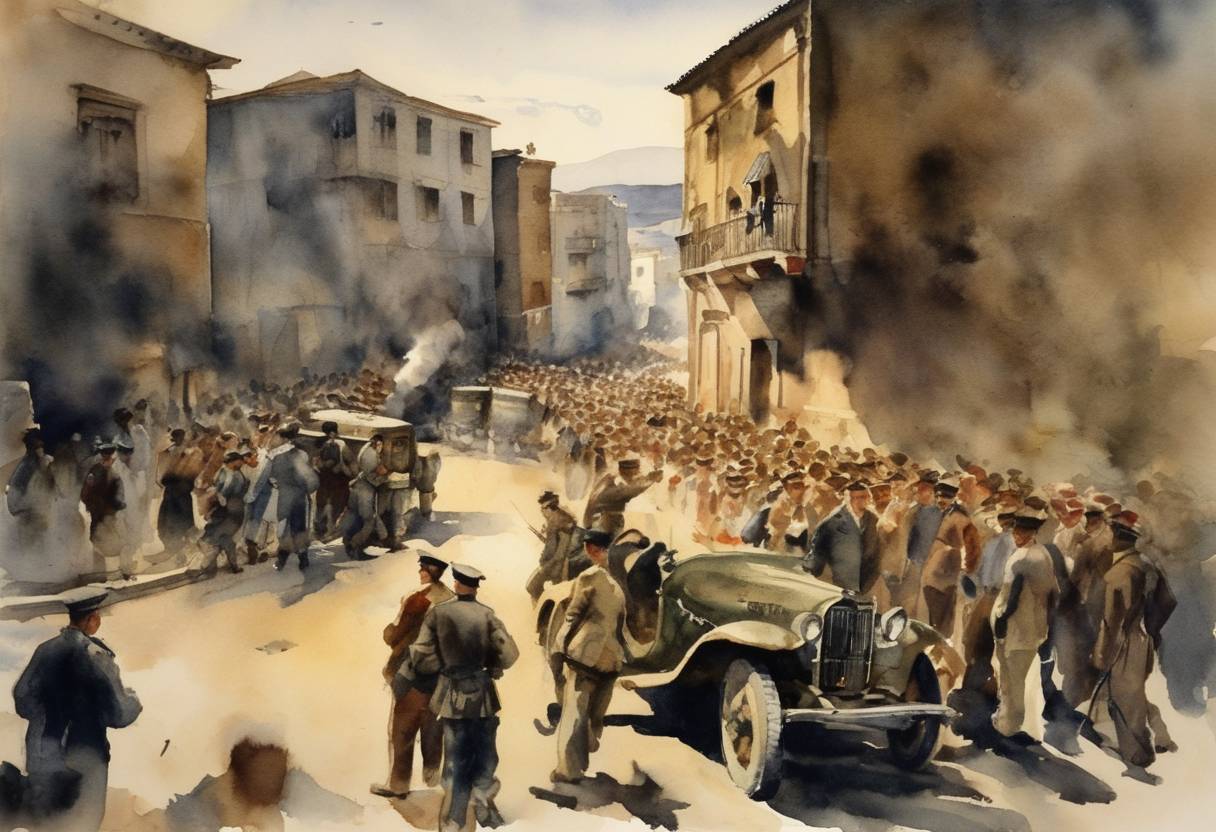
The Outbreak of the Spanish Civil War: July 18, 1936
On July 18, 1936, the Spanish Civil War officially began as a group of high-ranking officers in the Spanish military launched a coup against the republican government. This insurrection marked the start of a brutal and complex conflict that would have lasting impacts on both Spain and the broader international community.
Context and Causes
Spain in the early 20th century was a nation fraught with political instability, economic hardship, and deep social divisions. The Second Spanish Republic, established in 1931, had attempted to implement progressive reforms, including land redistribution, separation of church and state, and expansion of workers’ rights. These efforts, however, faced fierce opposition from conservative, monarchist, and fascist segments of the population.
By 1936, tensions in Spain had reached a boiling point. The Popular Front, a coalition of left-wing parties, had been elected to power, exacerbating fears among conservative factions who viewed their policies as radical and a threat to traditional Spanish values.
The Coup d’État
The rebellion on July 18 was spearheaded by a coalition of conservative forces, fascist elements, and military officers who opposed the leftist government’s reforms. Key figures included General Francisco Franco, who would later emerge as the leader of the Nationalist forces.
The revolt began in Spanish Morocco, where the Spanish Army of Africa, consisting of elite troops, declared against the government. The insurgence swiftly spread to mainland Spain, with numerous cities falling under Nationalist control. However, the rebellion did not succeed in defeating the republic outright, leading to a protracted and bitter civil war.
International Implications
The Spanish Civil War quickly became a microcosm of the ideological battles of the 20th century. The conflict saw an influx of foreign assistance, with Nazi Germany and Fascist Italy providing significant military support to Franco and the Nationalists, while the Soviet Union supplied aid to the Republicans. Additionally, international brigades composed of volunteers from around the world came to support the Republican cause.
Aftermath and Consequences
The war would rage on until 1939, resulting in immense loss of life and widespread devastation across Spain. The Nationalist victory led to the establishment of a dictatorial regime under Franco, lasting until his death in 1975. This conflict also served as a prelude to World War II, as it tested the policies and military strategies that would later be employed on a global scale.
The Spanish Civil War remains a poignant chapter in history, reflecting the complex interplay of ideology, power, and human resilience. Its legacy is still felt in Spain and beyond, offering vital lessons on the perils of political polarization and the fragility of democracy.