Charles Darwin Publishes *On the Origin of Species*
1859 · London, United Kingdom
Charles Darwin publishes 'On the Origin of Species', introducing the theory of evolution by natural selection.
June 30, 1860
The 1860 Oxford evolution debate took place at the Oxford University Museum, focusing on Darwin's theory of evolution.
Oxford, United Kingdom | Oxford University
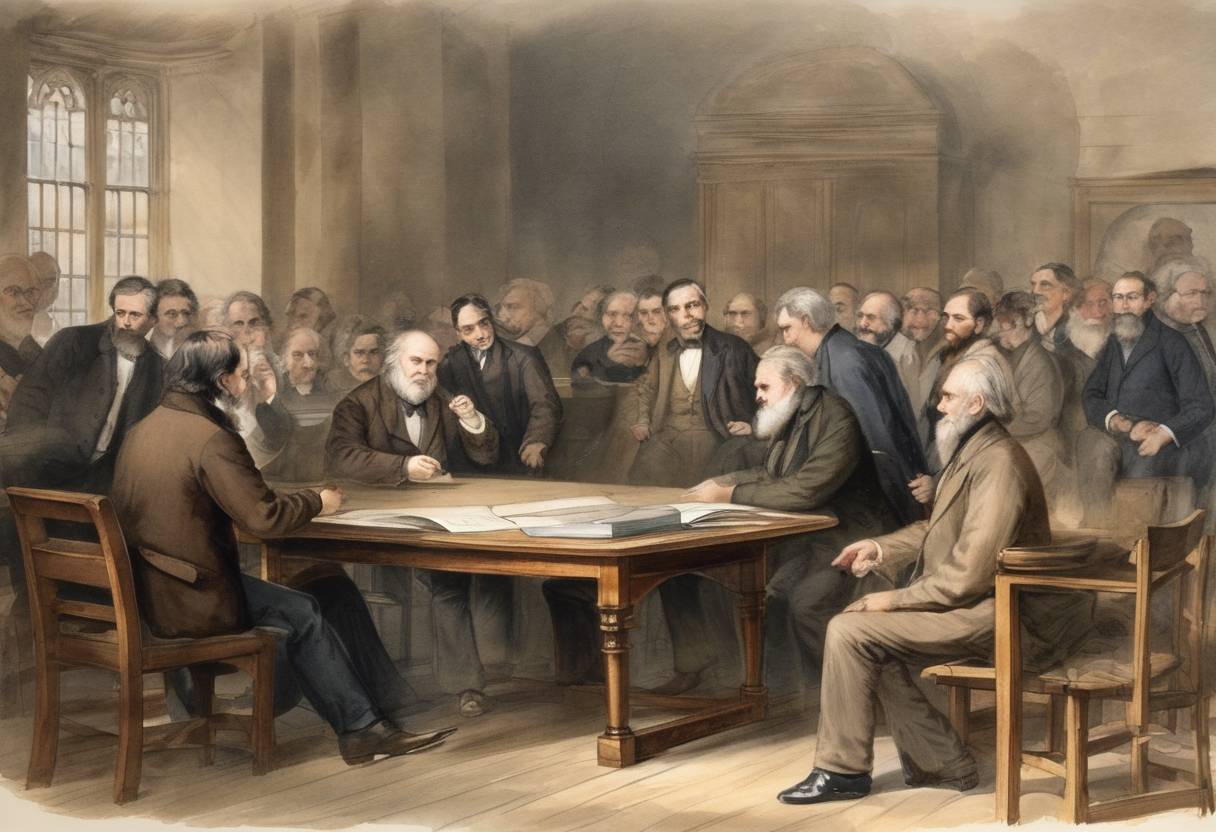
The 1860 Oxford Evolution Debate, a pivotal moment in the history of science, took place on June 30, 1860, at the Oxford University Museum of Natural History. This debate is renowned for its dramatic clash over Charles Darwin’s theory of evolution, which had been published in “On the Origin of Species” in November 1859. The event was part of the annual meeting of the British Association for the Advancement of Science.
Thomas Huxley (1825–1895): Known as “Darwin’s Bulldog,” Huxley was a passionate advocate for evolution and a staunch defender of Darwin’s ideas. His expertise as a biologist and his rhetorical skill made him a formidable opponent in any public debate on scientific matters.
Bishop Samuel Wilberforce (1805–1873): The Bishop of Oxford, Wilberforce was a prominent figure in the Church of England. Known for his oratorical skills, he was a critic of Darwin’s theory. While knowledgeable on various topics, his scientific understanding was not as robust as some of his peers.
The publication of Darwin’s “On the Origin of Species” introduced the controversial theory of natural selection, provoking widespread discussion and debate. By 1860, the potential implications of Darwin’s work for traditional religious and scientific beliefs were being hotly contested across Britain and beyond.
The annual meeting of the British Association for the Advancement of Science, held in Oxford, was a central forum for scientific discourse of the time. Darwin, who was not present at the debate due to health reasons, had his theory vigorously defended by allies like Thomas Huxley.
The debate is most famously characterized by the exchange between Bishop Wilberforce and Huxley. Wilberforce reportedly questioned Huxley on whether he claimed descent from an ape on his grandfather’s or grandmother’s side, aiming to highlight the purported absurdity of human evolution from primates.
Huxley’s retort highlighted his preference for an ape ancestor over an eminent man who misuses his brilliant gifts to cloud scientific truths with rhetoric. This sharp exchange was emblematic of the broader clash between traditional religious perspectives and emerging scientific explanations for the natural world.
The 1860 debate is often seen as a defining moment in the public acceptance and understanding of evolutionary theory. Although no clear “winner” emerged, the discourse significantly raised the profile of Darwin’s ideas. The debate also symbolized the growing tensions between science and religion, marking a shift towards a more secular, scientifically-oriented society.
This event contributed to the eventual acceptance of evolution as the foundational principle of modern biology, influencing scientific thought profoundly in the subsequent decades. The vigorous advocacy by scientists like Huxley helped cement the legitimacy of Darwinian theory, promoting a broader public dialogue about the nature of scientific inquiry and evidence-based reasoning.
Source: en.wikipedia.org