The Ousting of Tunisian President Zine El Abidine Ben Ali
2011 · Tunis, Tunisia
Tunisian President Zine El Abidine Ben Ali flees to Saudi Arabia after a month of protests, marking the first successful ousting of an Arab leader in the Arab Spring.
August 15, 1270
King Louis IX of France, also known as Saint Louis, leads the Eighth Crusade which begins its journey and arrives in Tunis.
Tunis, Tunisia | Eighth Crusade
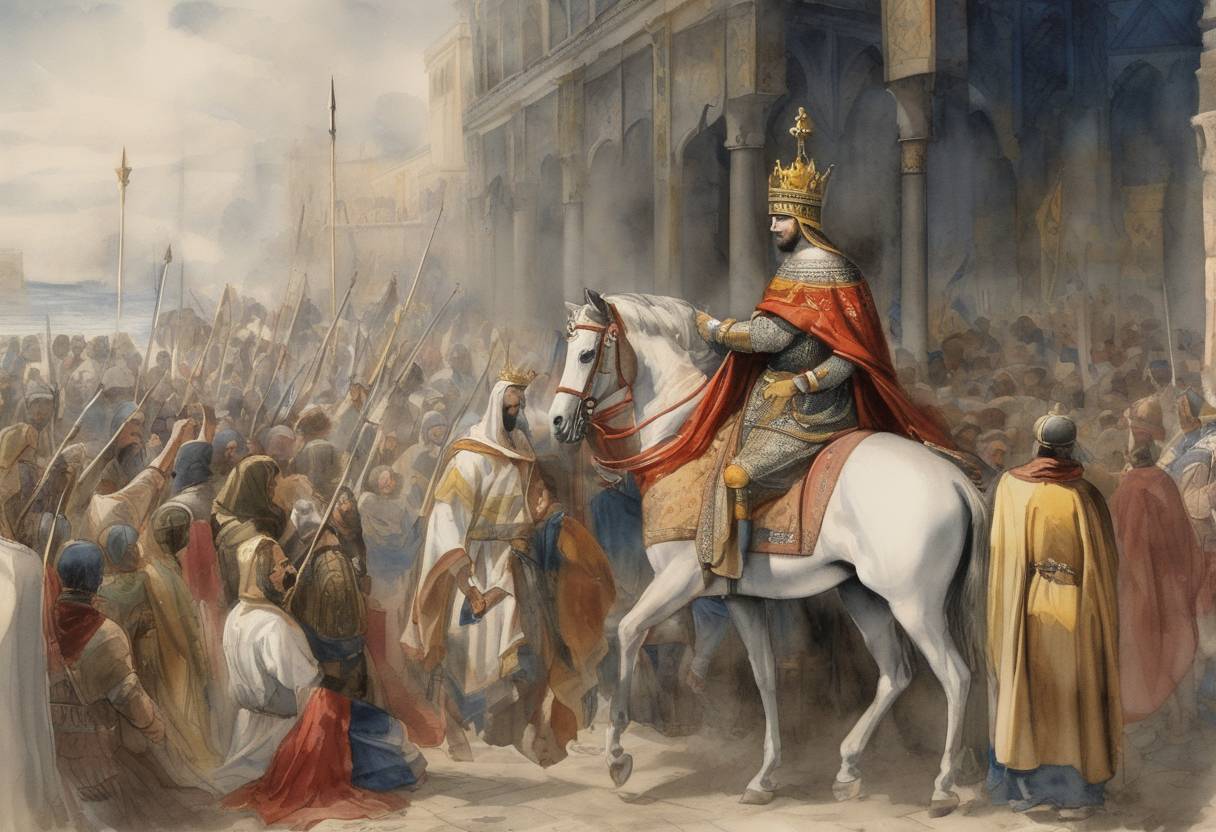
On August 15, 1270, King Louis IX of France, later canonized as Saint Louis, led the Eighth Crusade, with the crusaders arriving in Tunis. This crusade marked his second major expedition to the Muslim-controlled territories of the Eastern Mediterranean. The Eighth Crusade holds significant importance as both a part of the broader crusading movement and a pivotal event in Louis’s life.
The Eighth Crusade was initiated against a backdrop of continued friction between Christian Europe and the Islamic powers of the Near East and North Africa. Following the relative failure of the Seventh Crusade, which Louis led to Egypt from 1248 to 1254, Louis remained committed to the idea of reclaiming and securing the Holy Land for Christendom.
Despite the waning enthusiasm for crusading efforts across Europe due to previous failures, Louis’s deep personal piety and sense of duty compelled him to launch another expedition. His intention was to strike at Egypt’s Mamluk sultanate indirectly by capturing Tunis, which was strategically located on North Africa’s northern coast. By this, he hoped to establish a stronger base for further operations in the Holy Land.
The expedition assembled mainly French forces but included a small contingent of troops from the Kingdom of Sicily, whose king, Charles of Anjou, was Louis’s brother. The crusading forces set sail from the South of France and headed towards the North African coast.
Upon reaching Tunis on August 15, 1270, Louis hoped to convert or forge an alliance with the Hafsid emir of the region. However, this mission faced immediate challenges. The expected negotiations with the emir faltered as the military focus shifted towards the complications arising due to local conditions.
Shortly after arriving, the crusading army was stricken with disease, particularly dysentery, exacerbated by the sweltering heat and inadequate provisions. Tragically, King Louis IX himself succumbed to illness and passed away on August 25, 1270, just ten days after reaching Tunis.
Louis’s death marked the end of the Eighth Crusade as a serious military endeavor. Although his brother Charles of Anjou arrived with additional troops, the campaign quickly transitioned into a negotiated peace. The forces withdrew shortly after, thus drawing the Eighth Crusade to an inconclusive and hastily concluded end.
Despite its failure, the expedition illustrated the enduring zeal of European crusaders and the continued complex interplay between Christian Europe and the Islamic world. The Eighth Crusade, and in particular Louis’s tragic death, cemented his legacy as a dedicated ruler in the annals of history, further elevating his status, leading to his eventual canonization as Saint Louis in 1297.
Source: www.britannica.com