James Watt's Birth and Contributions
1736 · Greenock, Scotland
James Watt, the Scottish inventor known for improvements to the steam engine, was born.
December 8, 1765
Eli Whitney, inventor of the cotton gin and a pioneer in developing the concept of mass production of interchangeable parts, was born.
Westborough, American Colonies
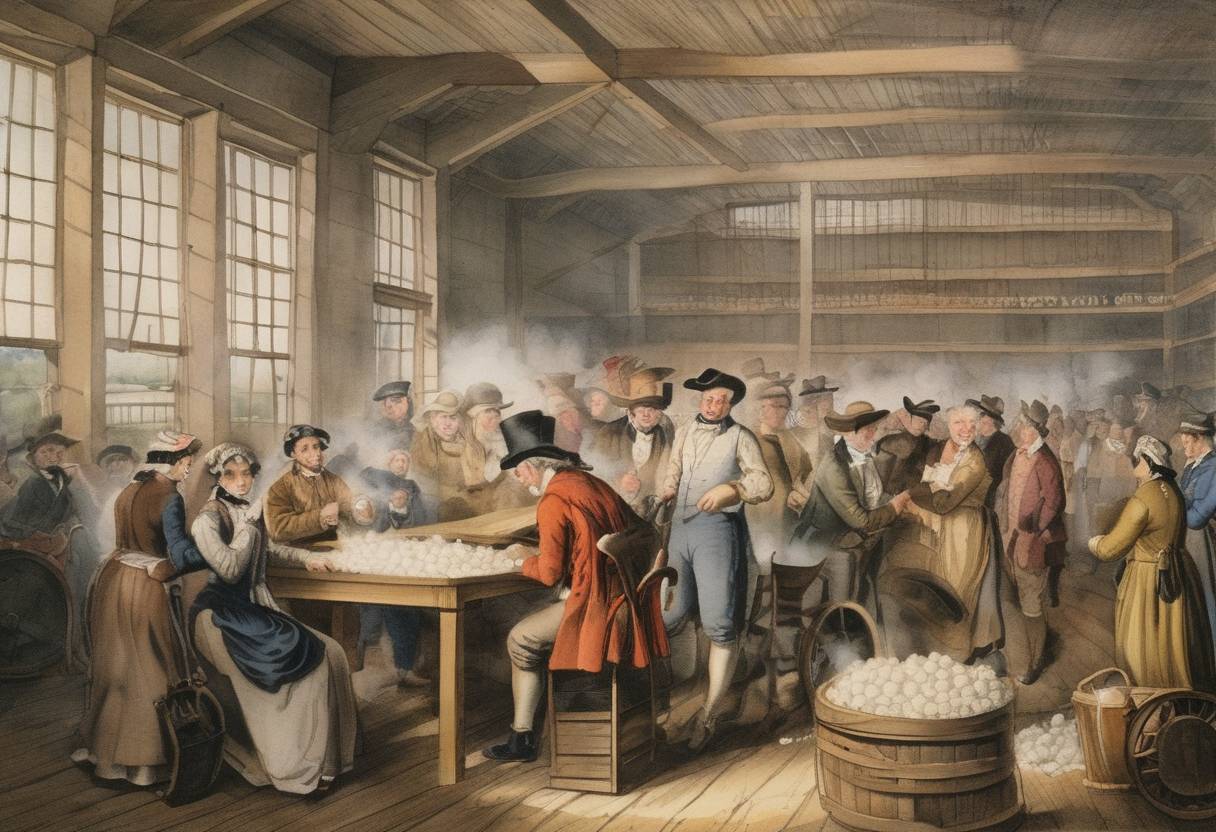
Eli Whitney was born on December 8, 1765, in Westborough, Massachusetts. He grew up on a farm, where he displayed an early talent for mechanics and engineering. This skill would later lead him to become a significant figure in the American Industrial Revolution.
Whitney is best known for inventing the cotton gin in 1793. This device revolutionized the cotton industry by efficiently separating cotton fibers from their seeds, a process that was previously labor-intensive and time-consuming. The cotton gin greatly increased the profitability of cotton farming, particularly in the southern United States, and played a crucial role in the expansion of the cotton economy.
While the cotton gin bolstered the agricultural prosperity of the South, it also had profound social consequences. It inadvertently contributed to the entrenchment of slavery in the United States by increasing the demand for slave labor to cultivate and harvest the expanded cotton crops.
Beyond the cotton gin, Whitney also laid the groundwork for modern manufacturing. He was a pioneer in developing the concept of interchangeable parts, which he implemented in the production of muskets for the U.S. government. Whitney’s approach to standardized parts facilitated the assembly and repair of products, setting the stage for the future of manufacturing and mass production.
Eli Whitney’s contributions had a lasting impact on both American industry and society. Though his inventions provided technological and economic advancements, they also brought about complex social dynamics. Whitney passed away on January 8, 1825, in New Haven, Connecticut, but his legacy as an innovator endures, illustrating the dual-edge of technological progress in society.