1759 · Youngstown, United States
British forces captured Fort Niagara from the French during the French and Indian War, marking a significant British victory that helped establish control over the region.
September 8, 1755
The Battle of Lake George was fought in the British American colony of New York as part of the French and Indian War, resulting in a strategic victory for the British and their Iroquois allies.
Lake George, United States | British Army
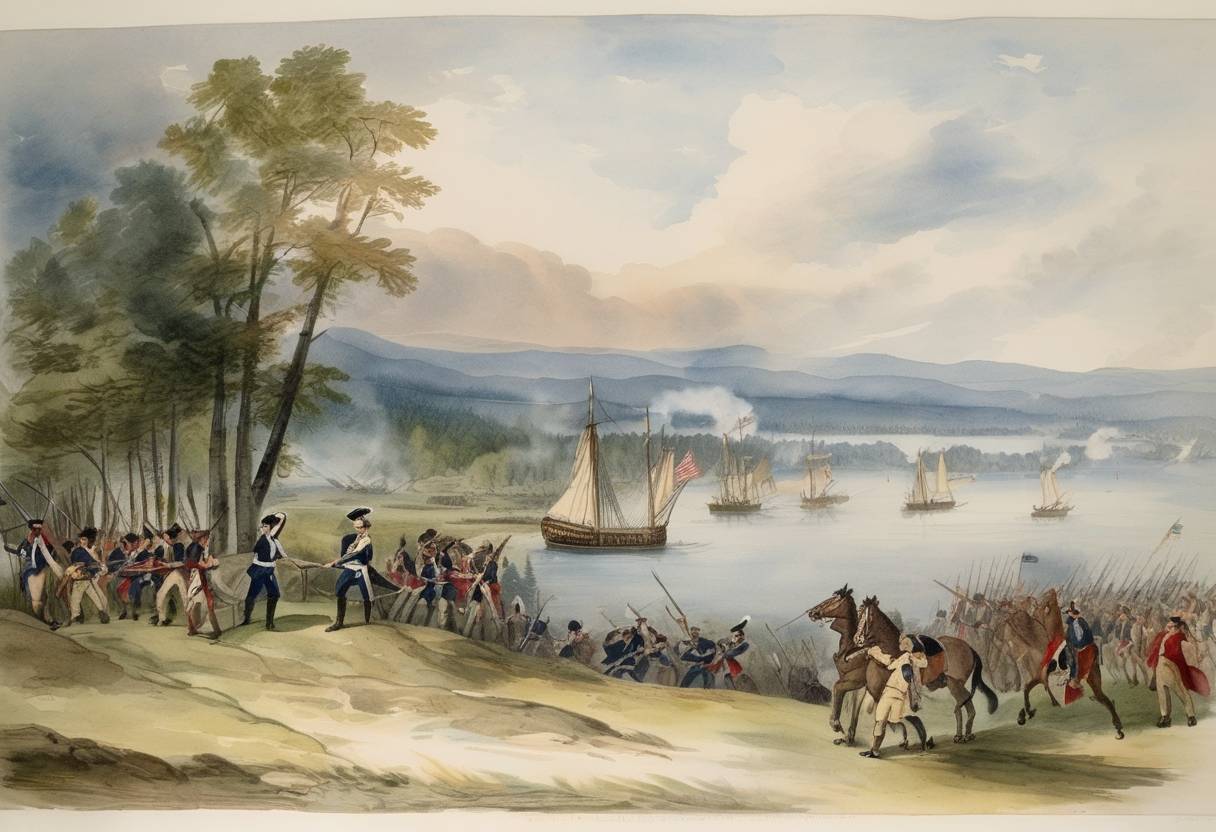
The Battle of Lake George occurred on September 8, 1755, in the British American colony of New York. This engagement was a pivotal conflict in the French and Indian War (1754-1763), a North American theater of the global Seven Years’ War. The battle saw British colonial forces, commanded by Sir William Johnson, clash with French troops led by Baron de Dieskau in a strategic bid for control over the key region.
The French and Indian War was characterized by the struggle between British and French imperial powers for dominance in North America. The strategic location of Lake George, connecting the Hudson River to Lake Champlain, made it a critical point for controlling colonial supply routes and military movements. The British organized an expedition aimed at capturing French forts in Canada, including Fort Saint-Frédéric at Crown Point, to interrupt French communications and expansion.
The British expedition comprised approximately 1,500 colonial militia troops and was supported by Native American forces from the Iroquois Confederacy, which sought to counter French influence in the region. The French, recognizing the strategic threat, deployed a force of around 1,500, including experienced Canadian militiamen and allied Native American warriors.
On the morning of September 8, Baron de Dieskau, leading a detachment of French troops, moved to engage the British forces camped at Lake George. The initial encounter was marked by French aggression but was quickly countered by strategic British defensive positions. The British forces, utilizing fortifications made from felled trees, managed to withstand the French assault.
The battle soon grew into a series of engagements across the area, with a critical point occurring when the British and their Iroquois allies repelled the French and pursued them. Despite Dieskau’s attempts to reform his lines, shortly thereafter he was wounded and captured, which led to the French retreat.
The Battle of Lake George ended in a British victory, demonstrating the efficacy of cooperation between colonial forces and Native American allies. The success bolstered British confidence and morale, as well as diplomatic relations with the Iroquois Confederacy. The battle also led to the construction of Fort William Henry, reinforcing British presence in the region.
Strategically, the British victory interrupted French plans to advance into the British colonies and weakened French influence over indigenous peoples in the area. The engagement also exemplified the complexities of colonial warfare, where alliances with Native American tribes played a crucial role in the outcome of military campaigns.
The Battle of Lake George is remembered as a significant victory for the British in the early stages of the French and Indian War, setting the stage for future confrontations in the conflict over North American territories.
Source: www.battlefields.org