Henry VI of England Crowned King of France
1431 · Paris, France
Henry VI of England is crowned King of France at Notre Dame in Paris.
December 1, 1420
Henry V of England entered Paris. This marked a significant point in the Lancastrian phase of the Hundred Years' War. Upon the death of Charles VI of France, Henry was set to unite the crowns of England and France under one rule.
Paris, France | House of Lancaster
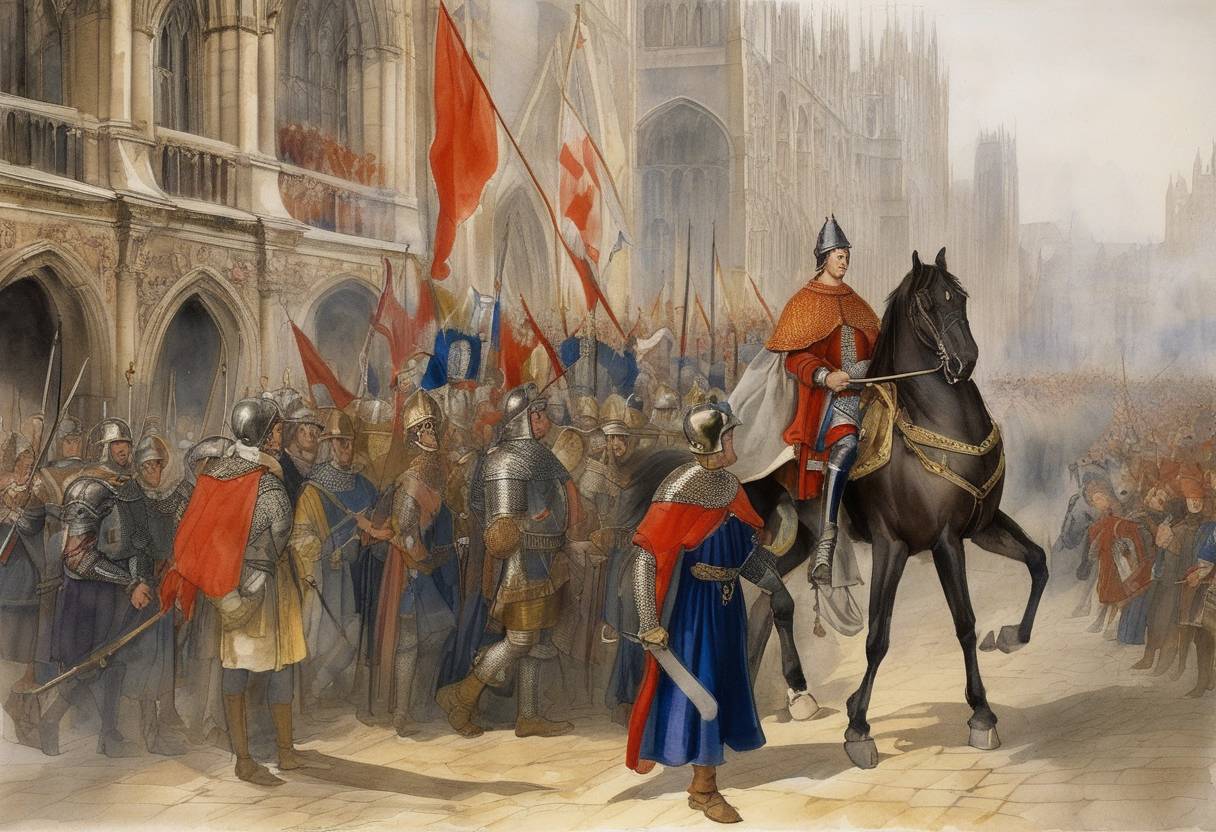
On December 1, 1420, Henry V of England made a triumphant entry into Paris, an event that underscored the far-reaching ambitions of the English crown during the latter stages of the Hundred Years’ War, specifically the Lancastrian phase. This entry was a direct consequence of the Treaty of Troyes, signed earlier that year on May 21, 1420. The treaty was a diplomatic masterpiece of Henry V, arranged with the mentally unstable Charles VI of France amidst the turmoil of the French civil war between the Armagnacs and the Burgundian factions.
The Treaty of Troyes was a pivotal agreement that recognized Henry V as the heir to the French throne, effectively disinheriting Charles VI’s own son, the future Charles VII of France. The treaty also arranged for Henry’s marriage to Catherine of Valois, Charles VI’s daughter, cementing the legitimacy of his claim to the French crown. This agreement was instrumental in furthering English influence in France and was part of Henry’s grand strategy to expand his dominion over the French territories.
The execution of this treaty and the subsequent English political machinations allowed Henry V to command significant power in France. By entering Paris, Henry not only demonstrated his enforcement of the treaty but also bolstered the symbolic legitimacy of his future rule over France. It was a time of profound instability in France, where factions within the country could not effectively counter the Anglo-Burgundian alliance, providing Henry with a strategic advantage.
The entry into Paris signified the height of English power during the Hundred Years’ War. It underscored Henry V’s success in gaining substantial territories in northern France and securing a claim to the French throne for his heirs. For the citizens of Paris and observers across Europe, it was a moment fraught with both fear and expectation, as the entry marked an English assertion that seemed to change the course of French history.
The aftermath of Henry V’s presence in Paris was complex. Although the Treaty of Troyes set the groundwork for a dual monarchy under English leadership, the untimely death of Henry V in 1422, followed by the death of Charles VI, left a power vacuum. The complexities of succession and the resurgence of French nationalism eventually led to the continued conflict and the eventual expulsion of English forces from French territories. The long-term implications were profound, as they foreshadowed the eventual rise of Charles VII and the reconsolidation of French royal power, aided by figures such as Joan of Arc.
In summary, Henry V’s entry into Paris on December 1, 1420, represented both the zenith of English territorial ambitions in France and the complicated, often tumultuous nature of medieval European dynastic politics.
Source: en.wikipedia.org