Death of James Clerk Maxwell: November 4, 1879
1879 · Cambridge, United Kingdom
James Clerk Maxwell, the Scottish physicist famous for formulating the classical theory of electromagnetic radiation, died.
August 29, 1831
Michael Faraday discovered electromagnetic induction, a fundamental principle of electromagnetism, which laid the groundwork for the development of electric generators and transformers.
London, United Kingdom | Royal Institution
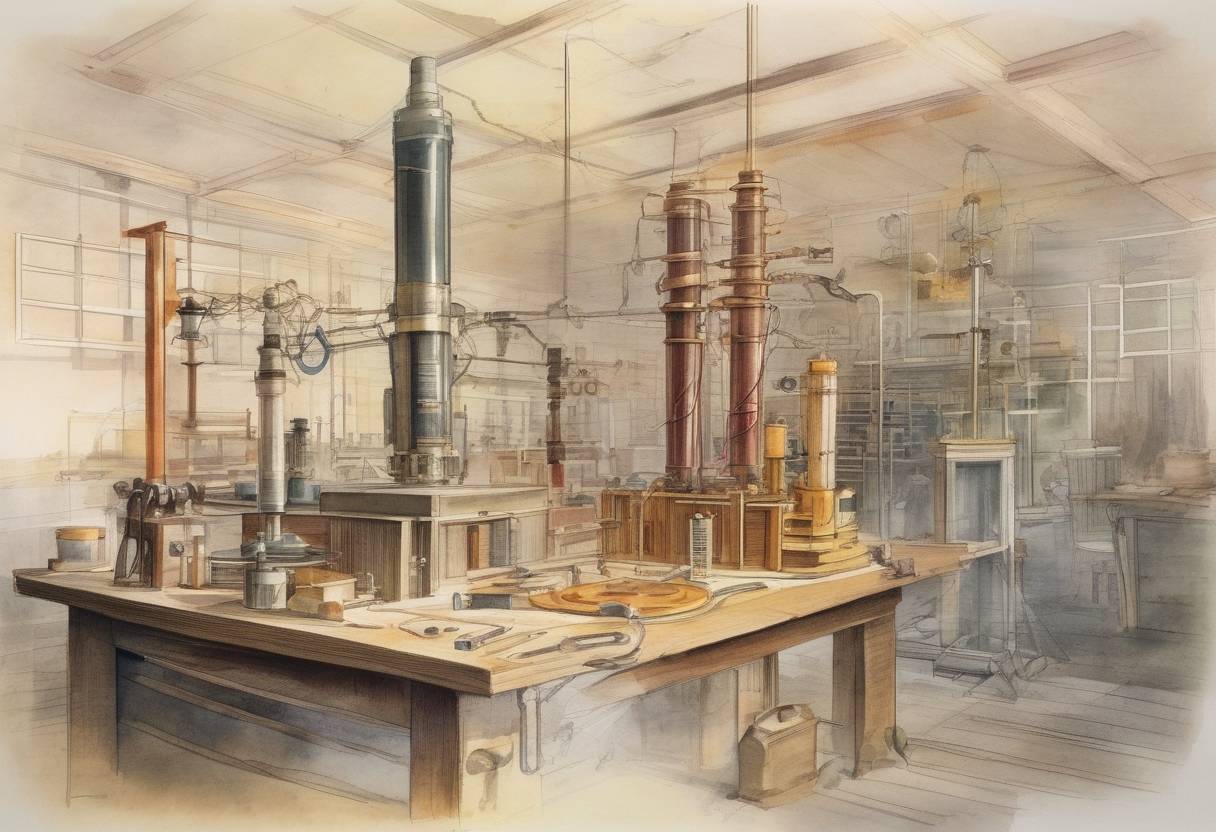
On August 29, 1831, Michael Faraday, a British scientist renowned for his contributions to the study of electromagnetism and electrochemistry, made a groundbreaking discovery that would profoundly influence the future of technology and industry: electromagnetic induction. This principle became the cornerstone for the development of electric generators and transformers, revolutionizing the way electricity was generated and utilized.
Michael Faraday was born on September 22, 1791, in Newington Butts, England. Despite having little formal education, Faraday became one of the most influential scientists of the 19th century. He began his career as an apprentice to a bookbinder, which allowed him access to a wide range of scientific literature. His curiosity and self-education led him to attend lectures by the eminent chemist Humphry Davy, who later employed Faraday as his assistant at the Royal Institution.
Faraday’s interest in electromagnetism was piqued by the work of Hans Christian Ørsted, who discovered the relationship between electricity and magnetism in 1820, and André-Marie Ampère, who further explored this connection. Faraday sought to understand how a magnetic field could produce an electric current, a question that had intrigued scientists since Ørsted’s discovery.
On August 29, 1831, Faraday conducted a series of experiments that led to the discovery of electromagnetic induction. He wrapped two coils of wire around opposite sides of an iron ring. When he passed an electric current through one coil (the primary coil), he observed that a transient current was induced in the second coil (the secondary coil) when the current in the primary coil was started or stopped. This demonstrated that a changing magnetic field could induce an electric current in a nearby conductor.
Faraday’s experiments showed that it was not the presence of a magnetic field that induced the current, but rather the change in the magnetic field. This principle, known as Faraday’s Law of Induction, states that the induced electromotive force in any closed circuit is equal to the negative of the time rate of change of the magnetic flux through the circuit.
Faraday’s discovery of electromagnetic induction was pivotal in the development of electrical technology. It laid the groundwork for the invention of electric generators, which convert mechanical energy into electrical energy, and transformers, which transfer electrical energy between circuits. These technologies are fundamental to the generation and distribution of electricity, powering everything from industrial machinery to household appliances.
Faraday’s work also influenced the theoretical framework of electromagnetism, contributing to the development of Maxwell’s equations, which describe the behavior of electric and magnetic fields. His discoveries have had a lasting impact on both science and engineering, making him one of the most celebrated figures in the history of physics.
Michael Faraday’s discovery of electromagnetic induction on August 29, 1831, was a monumental achievement that transformed the landscape of science and technology. His work not only advanced the understanding of electromagnetism but also paved the way for innovations that continue to shape modern life. Faraday’s legacy endures in the countless applications of electricity that define the contemporary world.
Source: www.britannica.com