Siege of Mafeking: April 9, 1900
1900 · Mafeking (now Mafikeng), South Africa
British forces under Major-General Robert Baden-Powell successfully relieve the Siege of Mafeking during the Second Boer War.
November 2, 1899
The Boers began their 118-day siege of British-held Ladysmith during the Second Boer War.
Ladysmith, South Africa | Boer forces
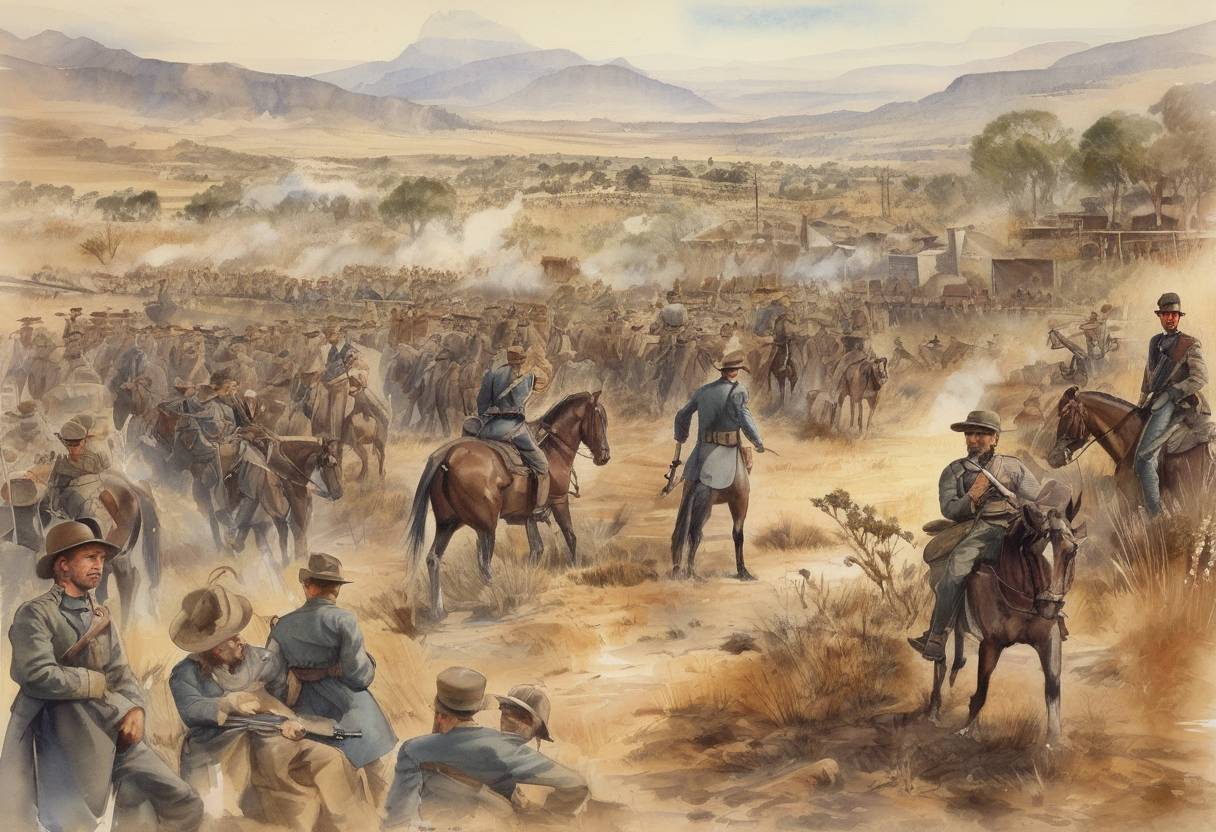
On November 2, 1899, during the Second Boer War, the Boer forces initiated a 118-day siege of the British-held town of Ladysmith in Natal, South Africa. This event marked a significant phase in the early stages of the conflict between the British Empire and the two Boer republics: the South African Republic (Transvaal) and the Orange Free State.
The Second Boer War, which lasted from 1899 to 1902, was primarily a struggle for control over the rich gold and diamond resources in the Boer territories. Tensions had been escalating due to British imperial ambitions and the Boers’ desire to maintain their independence. The war officially began on October 11, 1899, when the Boers declared war on Britain.
Ladysmith, a strategically important town, became a focal point due to its location on the railway line connecting Durban to Johannesburg. Its capture was crucial for the Boers to disrupt British supply lines and communications.
Initial Encirclement: On November 2, 1899, Boer forces under the command of General Piet Joubert surrounded Ladysmith, effectively cutting off the town from reinforcements and supplies. The British garrison, led by Lieutenant General Sir George White, was composed of approximately 13,000 troops.
Conditions Inside Ladysmith: The siege led to severe shortages of food and medical supplies within the town. The British forces and civilians endured harsh conditions, with diseases such as typhoid fever spreading rapidly due to inadequate sanitation.
Attempts to Break the Siege: Several attempts were made by British forces to relieve Ladysmith. The most notable was the Battle of Colenso on December 15, 1899, which ended in a disastrous defeat for the British, highlighting the challenges they faced against the well-entrenched Boer forces.
Relief of Ladysmith: The siege finally ended on February 28, 1900, when British forces under General Redvers Buller successfully broke through the Boer lines, lifting the siege and relieving the beleaguered garrison.
The Siege of Ladysmith was a pivotal moment in the Second Boer War, demonstrating the resilience and tactical prowess of the Boer fighters. It also exposed the vulnerabilities of the British military, leading to significant changes in their strategy and command structure.
The eventual relief of Ladysmith boosted British morale and marked a turning point in the war, as British forces began to gain the upper hand. The conflict continued until 1902, ultimately resulting in a British victory and the incorporation of the Boer republics into the British Empire.
The siege remains a significant event in South African history, symbolizing the intense struggle between colonial powers and local populations during the era of imperial expansion.
Source: en.wikipedia.org