Military Coup in Argentina - March 24, 1976
1976 · Buenos Aires, Argentina
A military coup in Argentina led by Jorge Rafael Videla ousted President Isabel Perón, beginning a period of dictatorship known as the National Reorganization Process.
October 17, 1945
A massive demonstration of workers in Buenos Aires demanded the release of Juan Perón, leading to his return to power and eventual presidency of Argentina.
Buenos Aires, Argentina | Argentine Workers
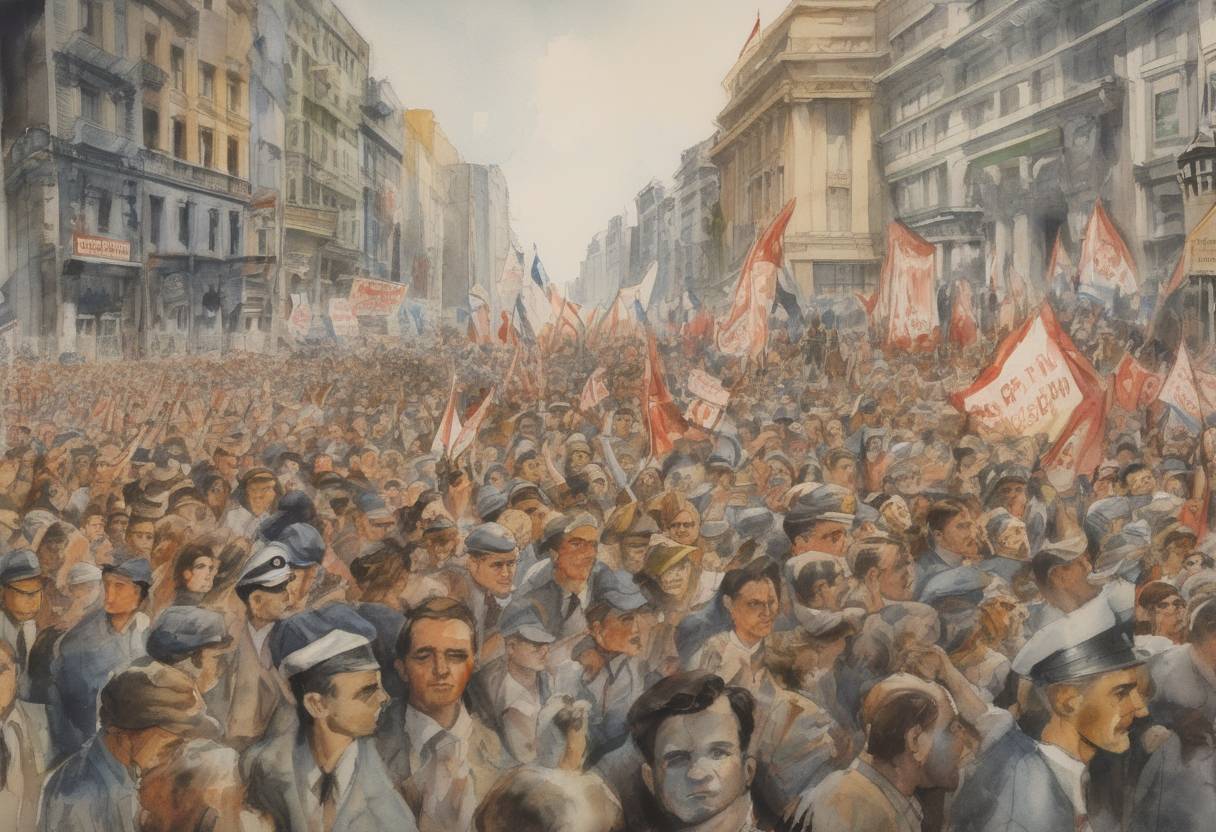
On October 17, 1945, a massive demonstration took place in Buenos Aires, Argentina, which became a pivotal moment in the country’s history. This event, known as the “Día de la Lealtad” (Loyalty Day), marked the rise of Juan Domingo Perón as a central figure in Argentine politics and laid the groundwork for his eventual presidency.
In the early 1940s, Argentina was experiencing significant political and social changes. Juan Perón, a military officer, had risen to prominence within the government, holding various positions, including Secretary of Labor and Social Welfare. During his tenure, Perón implemented policies that favored labor rights and social welfare, earning him substantial support from the working class and labor unions.
However, Perón’s growing influence and his populist policies alarmed the traditional political elite and segments of the military. In October 1945, a faction within the military forced Perón to resign and subsequently detained him on Martín García Island.
The news of Perón’s detention galvanized his supporters, particularly the working class and labor unions, who viewed him as a champion of their rights. On October 17, 1945, tens of thousands of workers from various parts of Argentina converged on the Plaza de Mayo in Buenos Aires. This spontaneous and massive demonstration demanded Perón’s release, showcasing the power and organization of the labor movement.
The demonstrators’ persistence and the sheer size of the protest compelled the government to release Perón. That evening, Perón addressed the crowd from the balcony of the Casa Rosada, the presidential palace, solidifying his connection with the Argentine masses.
The events of October 17, 1945, were a turning point in Argentine history. The demonstration not only secured Perón’s release but also propelled him to the forefront of national politics. In the subsequent months, Perón capitalized on his popularity, and in 1946, he was elected President of Argentina.
Perón’s presidency marked the beginning of a new era in Argentine politics, characterized by his focus on social justice, economic nationalism, and labor rights. The day itself became a symbol of Peronist loyalty and is commemorated annually in Argentina as “Día de la Lealtad.”
The demonstration underscored the power of organized labor and the working class in shaping political outcomes in Argentina. It also highlighted the deep social and political divisions within the country, which would continue to influence Argentine politics for decades.
In summary, the demonstration on October 17, 1945, was a critical moment that not only led to Juan Perón’s return to power but also reshaped the political landscape of Argentina, establishing the foundation for the Peronist movement that continues to play a significant role in the country’s politics today.
Source: en.wikipedia.org