The 1934 Plebiscite in Germany: Adolf Hitler Becomes Führer
1934 · Berlin, Germany
A plebiscite in Germany gives Adolf Hitler complete power as Führer.
February 20, 1933
Adolf Hitler secretly met with German industrialists to secure funding for the Nazi Party's election campaign.
Berlin, Germany | Nazi Party
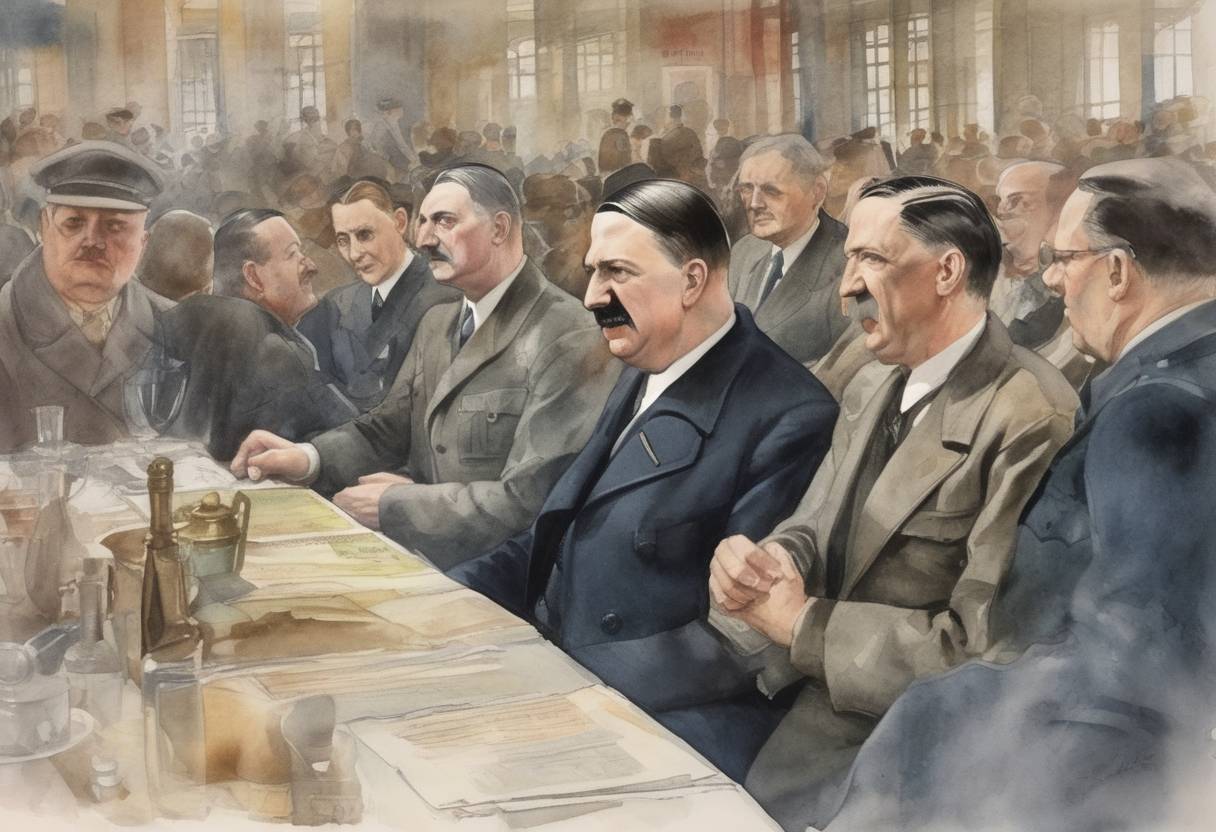
On February 20, 1933, Adolf Hitler, who had recently been appointed Chancellor of Germany, held a clandestine meeting with prominent German industrialists at the official residence of Hermann Göring, the President of the Reichstag at the time. This meeting was pivotal in securing financial backing for the Nazi Party’s upcoming election campaign, which was crucial for consolidating their power.
Nazi Rise to Power: By early 1933, the Nazi Party had become a significant political force in Germany, capitalizing on economic instability and widespread discontent following the Great Depression. Hitler was appointed Chancellor on January 30, 1933, in a coalition government.
Reichstag Fire: Just days after the meeting, on February 27, 1933, the Reichstag building was set on fire, an event that the Nazis used to justify the suspension of civil liberties and the arrest of political opponents, particularly communists.
Attendees: The meeting was attended by approximately 20 to 25 influential industrialists and businessmen, including representatives from major companies such as IG Farben, Krupp, and Siemens. These figures were crucial in Germany’s industrial and economic sectors.
Purpose: The primary aim was to secure financial contributions to support the Nazi Party’s campaign for the Reichstag elections scheduled for March 5, 1933. Hitler assured the industrialists that a Nazi-led government would be beneficial for business, promising stability and a strong stance against communism.
Outcome: The meeting was successful in raising substantial funds, reportedly around 3 million Reichsmarks. This financial support was instrumental in the Nazi Party’s ability to conduct an effective election campaign.
Election Results: The March 1933 elections resulted in the Nazi Party increasing its share of the vote, although they did not achieve an outright majority. However, with the support of coalition partners and the suppression of opposition, they were able to consolidate power.
Enabling Act: On March 23, 1933, the Reichstag passed the Enabling Act, which granted Hitler dictatorial powers. This legislation effectively marked the end of the Weimar Republic and the beginning of Nazi totalitarian rule.
Impact on Industry: The relationship between the Nazi regime and German industrialists continued throughout the Third Reich, with many companies benefiting from rearmament and wartime production, albeit often at the cost of ethical compromises and complicity in war crimes.
This meeting on February 20, 1933, was a critical step in the Nazi Party’s path to establishing a totalitarian regime, highlighting the complex interplay between politics and industry during this tumultuous period in history.
Source: en.wikipedia.org