Assassination of King Carlos I of Portugal and Prince Luís Filipe
1908 · Lisbon, Portugal
King Carlos I of Portugal and his heir, Prince Luis Filipe, are assassinated in Lisbon.
October 22, 1383
The 1383–1385 Crisis in Portugal begins with the death of King Ferdinand I, leading to a period of civil war and political instability.
Lisbon, Portugal | Portuguese monarchy
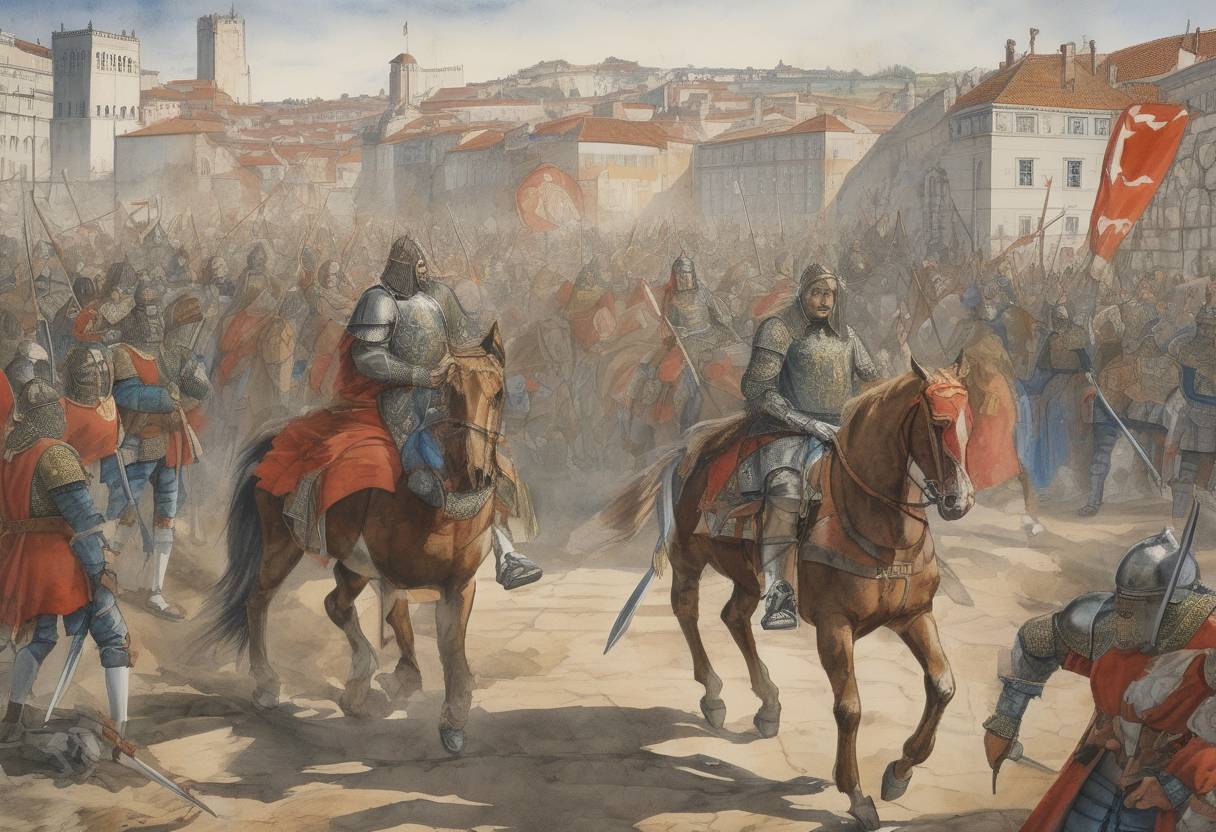
On October 22, 1383, the death of King Ferdinand I of Portugal marked the beginning of a significant period of civil war and political instability known as the 1383–1385 Crisis. This crisis was a pivotal moment in Portuguese history, as it ultimately led to the establishment of the Aviz dynasty and the strengthening of Portuguese independence from Castile.
King Ferdinand I, also known as Ferdinand the Handsome, reigned from 1367 until his death in 1383. His rule was marked by a series of conflicts with Castile, primarily over territorial disputes and claims to the Castilian throne. Ferdinand’s marriage to Leonor Telles de Meneses was unpopular, and his only legitimate child, Beatrice, was married to King John I of Castile. This marriage arrangement posed a significant threat to Portuguese sovereignty, as it could potentially lead to a dynastic union with Castile.
Upon Ferdinand’s death, his widow, Queen Leonor, assumed the regency on behalf of her daughter Beatrice. However, the prospect of Castilian influence over Portugal was met with strong opposition from the Portuguese nobility and commoners alike. Many feared that Beatrice’s marriage to the Castilian king would result in the annexation of Portugal by Castile.
Popular Uprising: The crisis quickly escalated into a popular uprising against the regency of Queen Leonor and the potential Castilian dominance. The Portuguese nobility, clergy, and urban middle class rallied against the perceived threat to their independence.
John of Aviz: A central figure in the resistance was John of Aviz, the illegitimate half-brother of Ferdinand I. He emerged as a leader of the opposition and was supported by influential figures such as Nuno Álvares Pereira, a skilled military commander.
Battle of Atoleiros (1384): One of the early significant military engagements during the crisis was the Battle of Atoleiros, where Nuno Álvares Pereira successfully repelled a Castilian force, bolstering the morale of the Portuguese resistance.
The crisis culminated in the decisive Battle of Aljubarrota on August 14, 1385, where the Portuguese forces, led by John of Aviz and Nuno Álvares Pereira, achieved a resounding victory over the Castilian army. This victory secured Portuguese independence and led to John of Aviz being acclaimed as King John I of Portugal.
The resolution of the crisis with the establishment of the Aviz dynasty marked a turning point in Portuguese history. It not only ensured the continuation of an independent Portuguese kingdom but also set the stage for the Age of Discoveries, during which Portugal emerged as a leading maritime and colonial power.
The 1383–1385 Crisis was crucial in shaping the national identity of Portugal. It reinforced the country’s independence from Castile and laid the foundation for a period of exploration and expansion that would have a lasting impact on global history. The successful resistance against Castilian domination also fostered a sense of unity and national pride among the Portuguese people.
Source: en.wikipedia.org