September 30, 1520

Suleiman the Magnificent leads the Ottoman Empire in a decisive victory over the Hungarians at the Battle of Mohács, marking the end of the medieval Kingdom of Hungary and establishing Ottoman dominance in central Europe.


Mohács, Hungary | Ottoman Empire
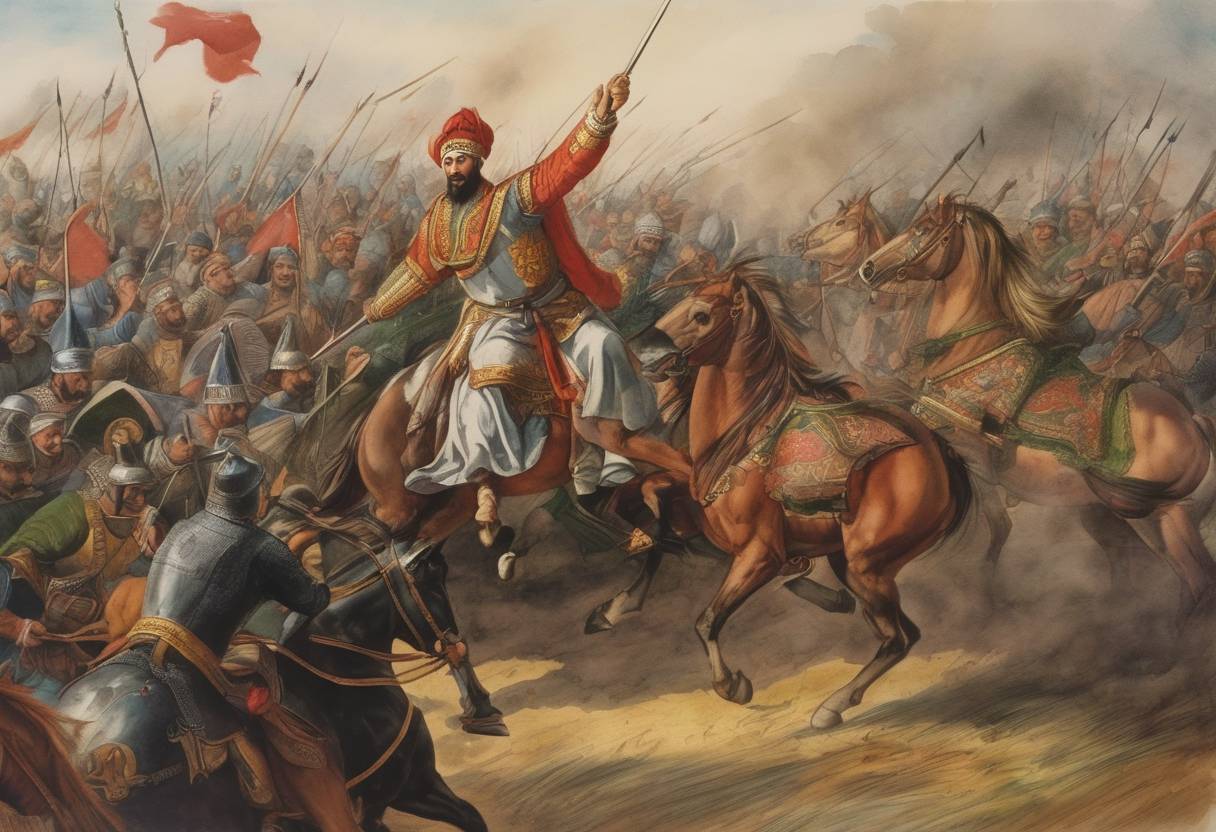
Watercolor painting based depiction of Suleiman the Magnificent leads the Ottoman Empire in a decisive victory over the Hungarians at the Battle of Mohács, marking the end of the medieval Kingdom of Hungary and establishing Ottoman dominance in central Europe. (1520)

Battle of Mohács

The assertion of a decisive Ottoman victory led by Suleiman the Magnificent over the Hungarians at the Battle of Mohács does not align with the date September 30, 1520. The actual Battle of Mohács occurred on August 29, 1526. Below is a detailed account of the Battle of Mohács that falls on the correct date.

Background

The Battle of Mohács was a critical conflict in the struggle between the Ottoman Empire and the Kingdom of Hungary. By the early 16th century, Suleiman the Magnificent, the tenth Sultan of the Ottoman Empire, was expanding his empire’s territories across Europe and Asia. The Kingdom of Hungary, significantly weakened by its political instability and lack of unity, stood directly in the Ottoman path of expansion.

The Battle

  • Date: August 29, 1526
  • Location: Near Mohács, in the Kingdom of Hungary (present-day Hungary)
  • Forces Involved: The Ottoman army, estimated at around 100,000 troops, faced the Hungarian forces, which numbered approximately 25,000.

Key Events

  1. Ottoman Advantages: The Ottomans, whose forces significantly outnumbered the Hungarians, were well-trained and equipped with superior artillery and cavalry.
  2. Hungarian Weaknesses: The Hungarian army suffered from internal disorganization and lacked effective leadership, primarily due to divisions within the nobility.
  3. Battle Tactics: The Ottomans employed a tactical feigned retreat maneuver, which tricked the Hungarian cavalry into a premature and overextended attack, compromising their defensive capabilities.
  4. Decisive Victory: The battle culminated in a catastrophic defeat for Hungary, with the Hungarian king, Louis II, and numerous nobles perishing, leaving the kingdom leaderless.

Aftermath and Significance

  • Territorial Consequences: The defeat at Mohács led to the partial disintegration of the medieval Kingdom of Hungary. The Ottomans quickly established control over much of central Hungary, while the remainder was partitioned between the Habsburg Monarchy and the Principality of Transylvania.
  • European Politics: This victory marked the expansion of the Ottoman Empire into Central Europe and established its dominance in the region for the next century.
  • End of an Era: The loss at Mohács is often symbolically considered the end of the medieval Kingdom of Hungary, with profound effects on its political and social fabric.

The Battle of Mohács remains a seminal event in Hungarian history, symbolizing a turning point that reshaped the political landscape of Central Europe in the early modern period.