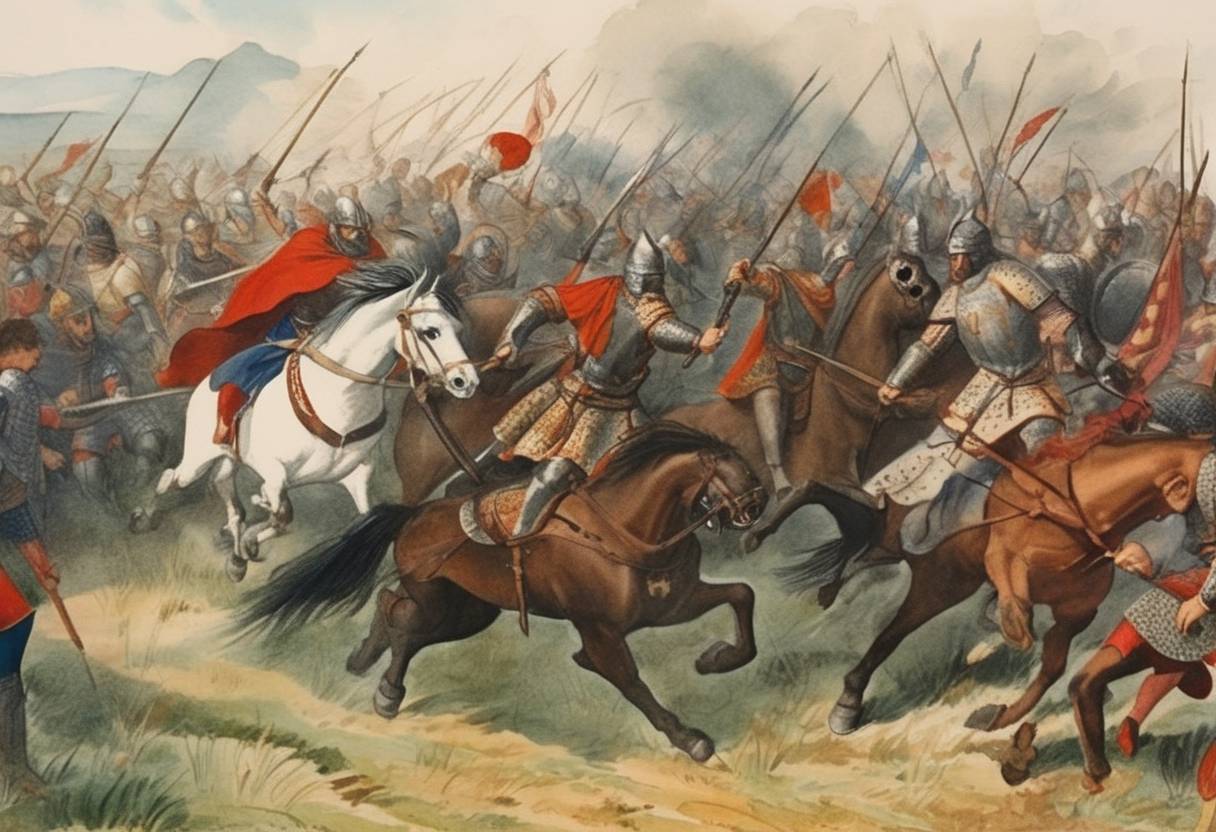
Battle of Picotin - February 27, 1316
Context and Background
The Battle of Picotin was a significant military engagement during the period of feudal conflicts in the Latin states established in Greece following the Fourth Crusade’s fragmentation of the Byzantine Empire. This conflict took place in the region of Messenia, in the Peloponnesian peninsula of present-day Greece. The battle was primarily a struggle for control over the Principality of Achaea, a feudal opportunity contested by various European nobles trying to expand their influence in the region.
Ferdinand of Majorca: A member of the Royal House of Barcelona, Ferdinand was a claimant to the Principality of Achaea through his marriage to Isabella of Sabran, a title which he sought to enforce militarily.
Matilda of Hainaut: Matilda was the widow of Guy II de la Roche, Duke of Athens, and an influential noblewoman in her own right. She was contesting the principality’s control as a significant figure of the regional feudal hierarchy.
Louis of Burgundy: As the husband of Matilda, Louis provided military support, furthering their joint claim over the Principality of Achaea.
The Battle
The confrontation occurred on February 27, 1316, in the vicinity of Koutifari, near the area of Picotin in Messenia. Despite being outnumbered, Ferdinand of Majorca managed to soundly defeat the allied forces of Matilda of Hainaut and Louis of Burgundy. Utilizing tactical expertise and the mobility of his troops, Ferdinand took advantage of the terrain and environmental factors to upset the balance of power in the region.
Consequences and Historical Importance
The victory at Picotin solidified Ferdinand’s claim to parts of the Principality of Achaea, albeit temporarily, as his hold over the area was challenged continually after the battle. The battle and its outcome contributed to the broader geopolitical dynamics of the period, which included the tension between different noble houses looking to capitalize on the power vacuum left by the dissolution of Byzantine control.
In the aftermath, the broader struggle for the Principality of Achaea continued, reflecting the volatile and often shifting loyalties characterizing the era’s feudal conflicts in Southern Greece. Ferdinand’s subsequent death later that year further complicated succession claims, showcasing the precarious nature of power during this epoch of Mediterranean history. The battle, therefore, stands as a testament to the complex interplay of diplomacy, marital alliances, and military prowess during the Middle Ages in the Latin East.