The Death of Pope Constantine on April 9, 715
715 · Rome, Italy
Pope Constantine dies, ending his papacy which began in 708. He was known for his diplomatic efforts with the Byzantine Empire.
April 2, 0999
Sylvester II became Pope, the head of the Catholic Church.
Rome, Italy | Catholic Church
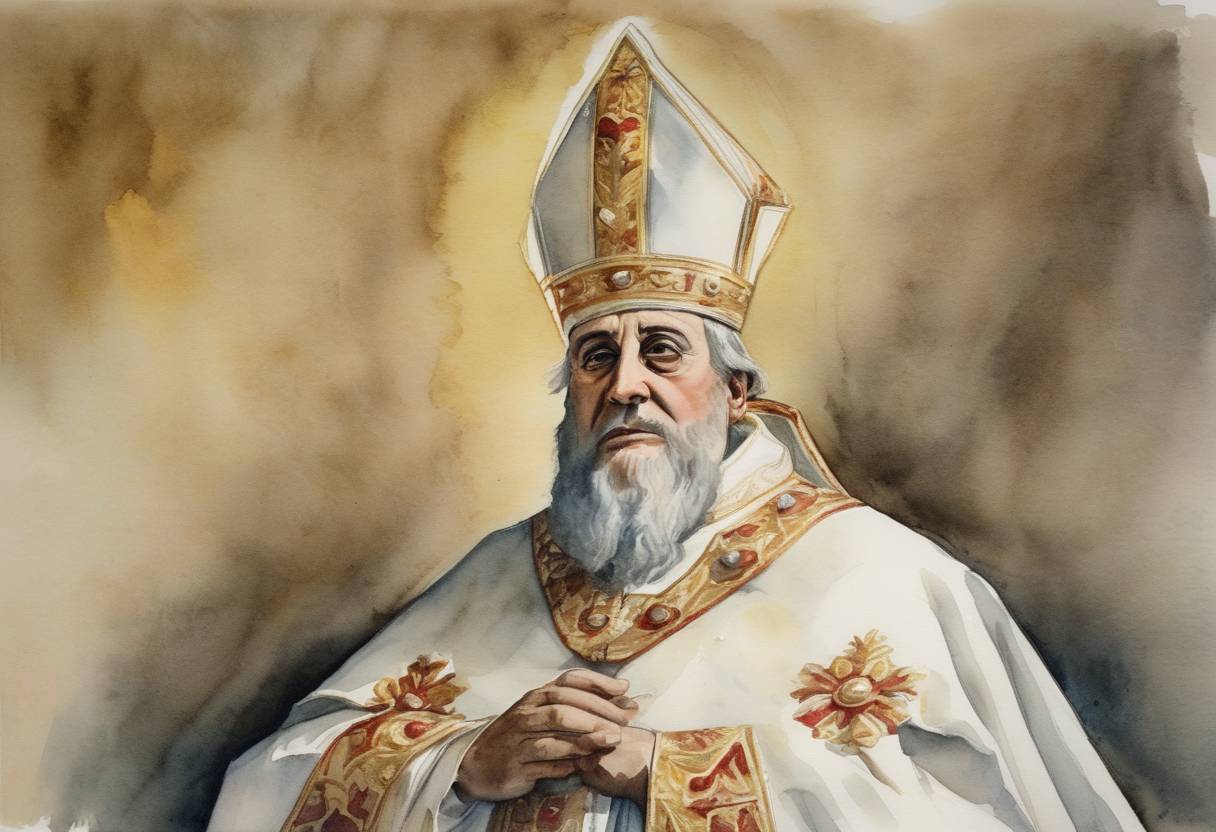
On April 2, 999, Gerbert of Aurillac was elected as Pope Sylvester II, becoming one of the most erudite and progressive pontiffs of the Middle Ages. His papacy marked a significant turn in the history of the Catholic Church, as it was infused with a spirit of intellectual revitalization and administrative reform.
Gerbert of Aurillac was born around 946 in the region of Auvergne, France. He garnered a reputation as a brilliant scholar, having been educated at the monastic school at Aurillac and further honing his knowledge in Catalonia. Gerbert’s pursuits took him to various learning centers throughout Europe, where he absorbed classical texts that had been preserved by Islamic and Byzantine scholars.
Before his papacy, Gerbert held influential ecclesiastical positions, such as the Archbishop of Reims and the Archbishop of Ravenna. His intellectual acumen and political insights caught the attention of Otto III, the Holy Roman Emperor, whose support was instrumental in Gerbert’s election as Pope.
As the first Frenchman to ascend to the papacy, Pope Sylvester II was deeply committed to education and scientific inquiry. He was a pioneer in integrating Arab and Greek knowledge with Christian learning, enhancing the educational landscape of medieval Europe.
Sylvester II is credited with introducing advances such as the use of the abacus, and the armillary sphere—a device used to model the heavens—thereby indirectly promoting the later Renaissance movement that would emerge centuries later. His papacy was further marked by administrative reforms aimed at consolidating the Church’s political power and bringing a measure of unity to the fragmented states under the Holy Roman Empire.
Sylvester II’s papacy was relatively brief, lasting until his death in 1003, but his impact on the Church and broader intellectual life in Europe was considerable. His commitment to learning and reform helped lay the groundwork for the subsequent revival of classical scholarship. Moreover, his close alliance with Otto III represented a collaboration between the Papacy and the Holy Roman Empire, aiming to renew a Christian Roman Empire that fused spiritual and temporal power.
In historical memory, Sylvester II is often celebrated not only as a learned pope but also as a symbol of the early medieval intertwining of faith and reason, which eventually contributed to the intellectual flowering of the High Middle Ages. His tenure is a testament to the vital role the Roman Catholic Church played in the preservation and advancement of knowledge during a time often characterized as the ‘Dark Ages’.
Source: en.wikipedia.org