1789 · New York City, United States
The United States Congress passed the Judiciary Act of 1789, establishing the federal judiciary and the Supreme Court.
February 1, 1790
The Supreme Court of the United States convenes for the first time.
New York City, United States | Supreme Court of the United States
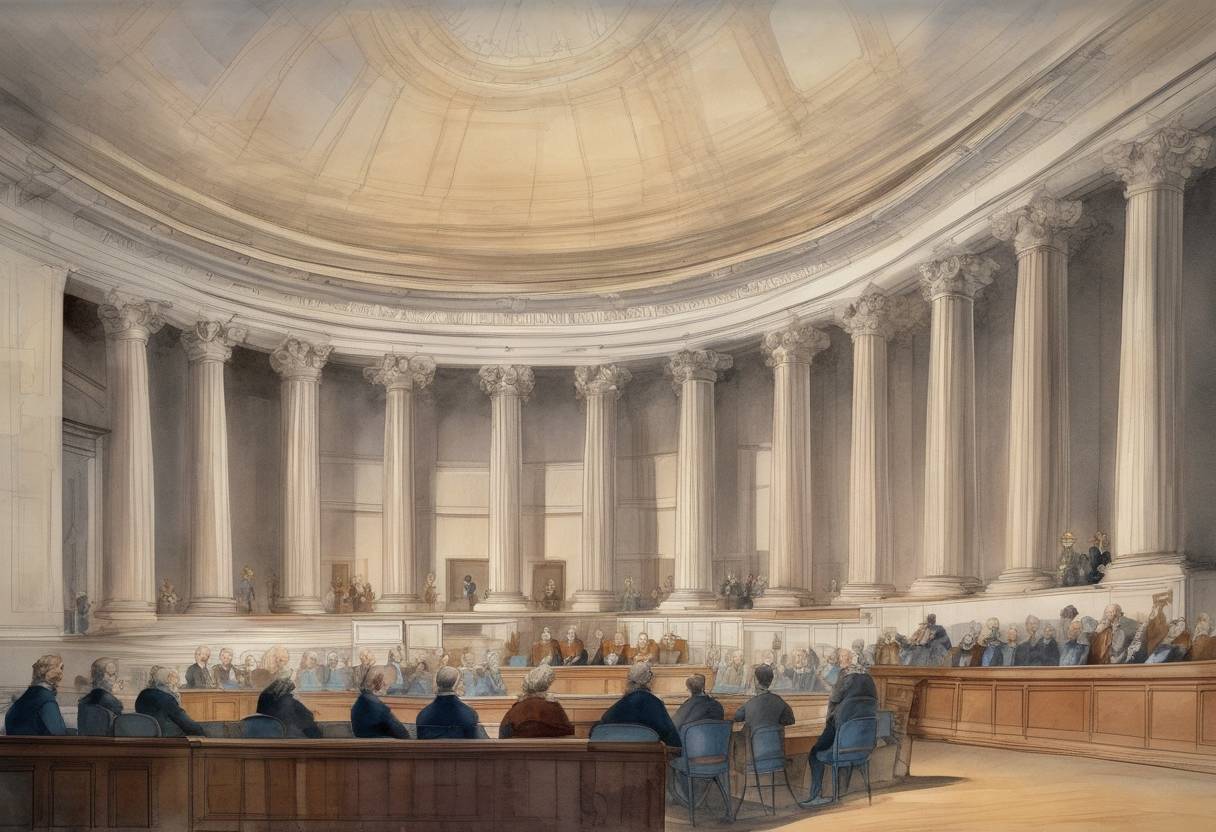
On February 1, 1790, the Supreme Court of the United States convened for the first time, marking a pivotal moment in American judicial history. This event took place in the Merchants Exchange Building in New York City, which was then the nation’s capital.
Constitutional Foundation: The establishment of the Supreme Court was mandated by Article III of the United States Constitution, which was ratified in 1788. The Constitution provided the framework for the federal judiciary but left the specifics to be determined by Congress.
Judiciary Act of 1789: This crucial piece of legislation, passed by the first Congress and signed into law by President George Washington on September 24, 1789, established the structure and jurisdiction of the federal court system. It created a Supreme Court with six justices, including one Chief Justice and five Associate Justices.
John Jay: Appointed as the first Chief Justice of the United States, John Jay was a prominent statesman and diplomat. His leadership was instrumental in shaping the early role of the Supreme Court.
Associate Justices: The initial roster of Associate Justices included John Rutledge, William Cushing, James Wilson, John Blair, and James Iredell. These men were selected for their legal acumen and contributions to the founding of the nation.
Attendance: Despite the historic nature of the event, the first session of the Supreme Court was largely ceremonial. Only three of the six justices were present: Chief Justice John Jay, and Associate Justices William Cushing and James Wilson. The absence of a quorum meant that no cases could be heard.
Significance: The convening of the Supreme Court symbolized the operational commencement of the judicial branch of the United States government. It underscored the separation of powers and the establishment of a federal judiciary as a co-equal branch of government.
Early Challenges: In its early years, the Supreme Court faced challenges in asserting its authority and establishing its role within the federal government. The justices often traveled extensively to serve on circuit courts, which limited their ability to hear cases.
Marbury v. Madison (1803): The Supreme Court’s role as the arbiter of constitutional interpretation was solidified in this landmark case, which established the principle of judicial review.
Enduring Legacy: Over time, the Supreme Court has evolved into a powerful institution, playing a crucial role in interpreting the Constitution and shaping American law and society.
The first convening of the Supreme Court on February 1, 1790, laid the groundwork for the development of the United States’ judicial system, which continues to influence the nation’s legal landscape to this day.
Source: en.wikipedia.org