Historic Summit on April 28, 2018: North and South Korea
2018 · Panmunjom, Korea
North and South Korea agreed to work towards denuclearization and formally ending the Korean War during a historic summit between leaders Kim Jong-un and Moon Jae-in.
July 27, 1953
The Korean War armistice was signed, effectively ending hostilities between North and South Korea, although a formal peace treaty was never signed.
Panmunjom, Korea | United Nations Command
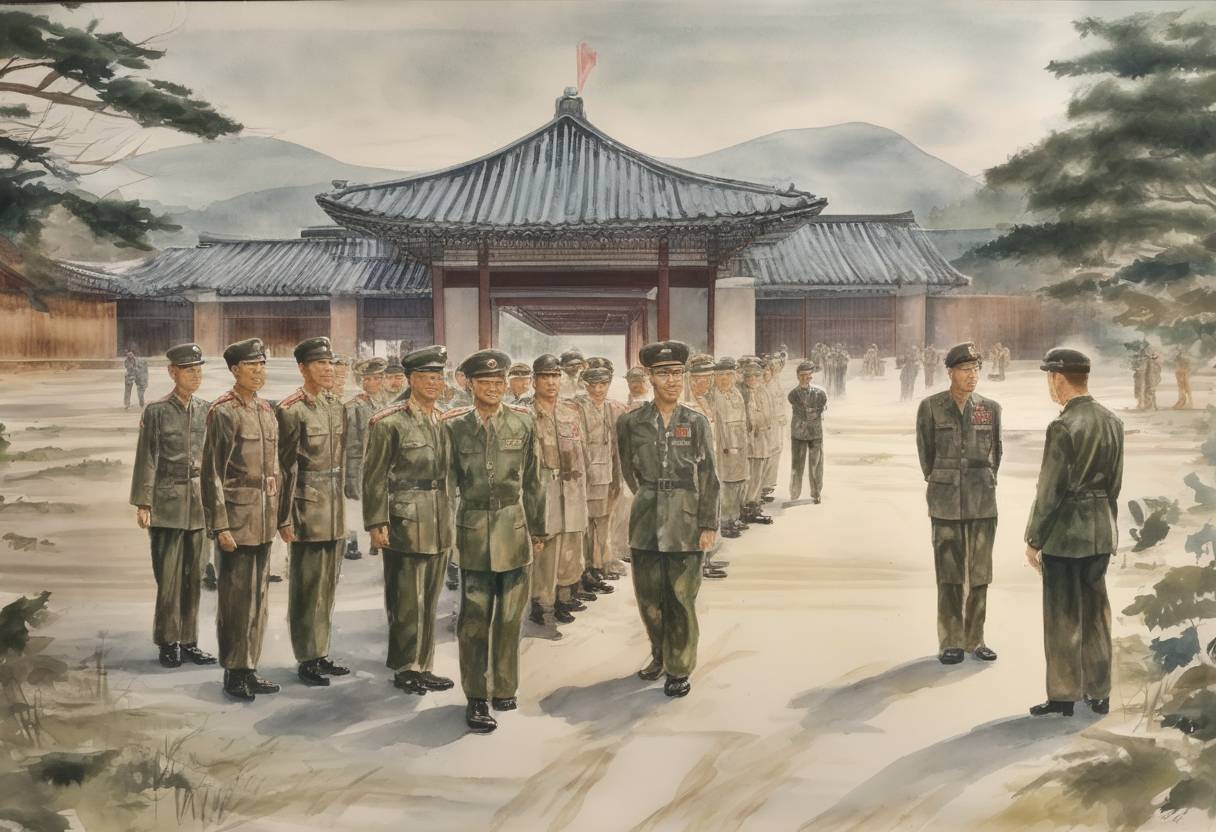
On July 27, 1953, an armistice agreement was signed, effectively ceasing hostilities in the Korean War, a conflict that had raged since June 25, 1950. This armistice marked a significant moment in 20th-century history, as it brought an end to active combat between North Korea, supported by China and the Soviet Union, and South Korea, backed by United Nations forces primarily composed of United States troops.
The Korean War began when North Korean forces, under the leadership of Kim Il-sung, crossed the 38th parallel and invaded South Korea. This aggressive move prompted a swift response from the United Nations, with the United States playing a leading role in the military intervention to support South Korea.
The war saw several phases, including the initial North Korean advance, the UN counteroffensive that pushed into North Korea, and the subsequent Chinese intervention that stabilized the front near the original dividing line. By 1951, the conflict had settled into a bloody stalemate, with both sides entrenched along the 38th parallel.
Negotiations for an armistice began as early as July 1951 but were protracted and fraught with difficulties, including disagreements over prisoner exchanges and the demarcation line. Finally, after two years of negotiations, the armistice was signed at Panmunjom, a village located in the demilitarized zone (DMZ) that still separates North and South Korea.
While the armistice ended active combat, it did not result in a formal peace treaty, meaning that technically, North and South Korea remain in a state of war. The Korean Peninsula has since been marked by periodic tensions and conflicts, although large-scale hostilities have not resumed.
The Korean War had significant implications for Cold War geopolitics, reinforcing the division between communist and capitalist blocs. It also set the stage for the militarization of the Korean Peninsula and the enduring U.S. military presence in South Korea.
The armistice remains a critical moment in Korean history, symbolizing both the cessation of open warfare and the enduring division of Korea. It serves as a reminder of the complex legacy of the Cold War and the ongoing quest for peace and reconciliation on the Korean Peninsula.
Source: en.wikipedia.org