Judges' Investigations for the Trial of Joan of Arc
1431 · Rouen, France
Judges' investigations for the trial of Joan of Arc began in Rouen, France.
February 21, 1431
Joan of Arc's trial for heresy began in Rouen, France. She was accused of cross-dressing and claiming divine guidance, which led to her execution later that year.
Rouen, France | Catholic Church
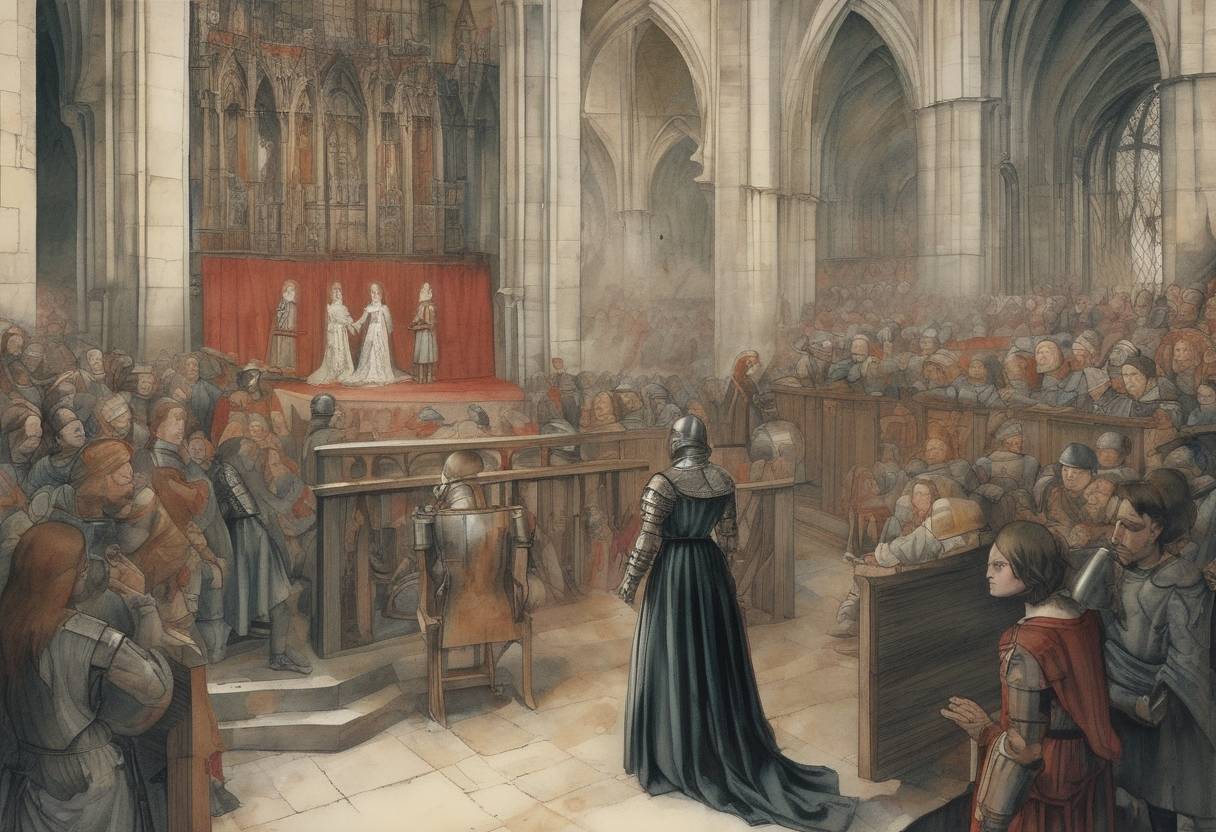
On February 21, 1431, the trial of Joan of Arc, a pivotal figure in the Hundred Years’ War, commenced in Rouen, France. This trial was a significant event in medieval history, marking the culmination of Joan’s extraordinary journey from a peasant girl to a national heroine and military leader.
Joan of Arc, born around 1412 in Domrémy, France, claimed to have received visions from saints instructing her to support Charles VII and recover France from English domination. Her conviction and leadership played a crucial role in lifting the Siege of Orléans in 1429, which was a turning point in the war. However, her capture by the Burgundians in 1430 and subsequent sale to the English led to her trial.
Joan was brought before an ecclesiastical court in Rouen, which was under English control. The trial was orchestrated by Bishop Pierre Cauchon, who was sympathetic to the English cause. The charges against her included:
The trial was heavily biased, with a focus on discrediting Joan’s claims of divine inspiration. The court was composed of pro-English clergy, and Joan was denied legal counsel. Despite the adversarial environment, Joan defended herself with remarkable poise and intelligence.
On May 30, 1431, after months of trial, Joan was declared guilty of heresy and was sentenced to death. She was burned at the stake in the marketplace of Rouen. Her execution was intended to undermine the legitimacy of Charles VII, whom she had helped to crown.
Joan’s trial and execution had lasting impacts:
Joan of Arc’s trial remains a poignant example of the intersection of politics, religion, and gender in medieval Europe. Her legacy endures as a testament to her courage and faith.
Source: en.wikipedia.org