The Russo-Turkish War of 1828–1829: Russia Declares War
1828 · Saint Petersburg, Russia
Russia declares war on the Ottoman Empire, marking the start of the Russo-Turkish War of 1828–1829.
December 14, 1825
Russia's Tsar Alexander I was buried in the Saints Peter and Paul Cathedral in Saint Petersburg.
Saint Petersburg, Russia | Russian Empire
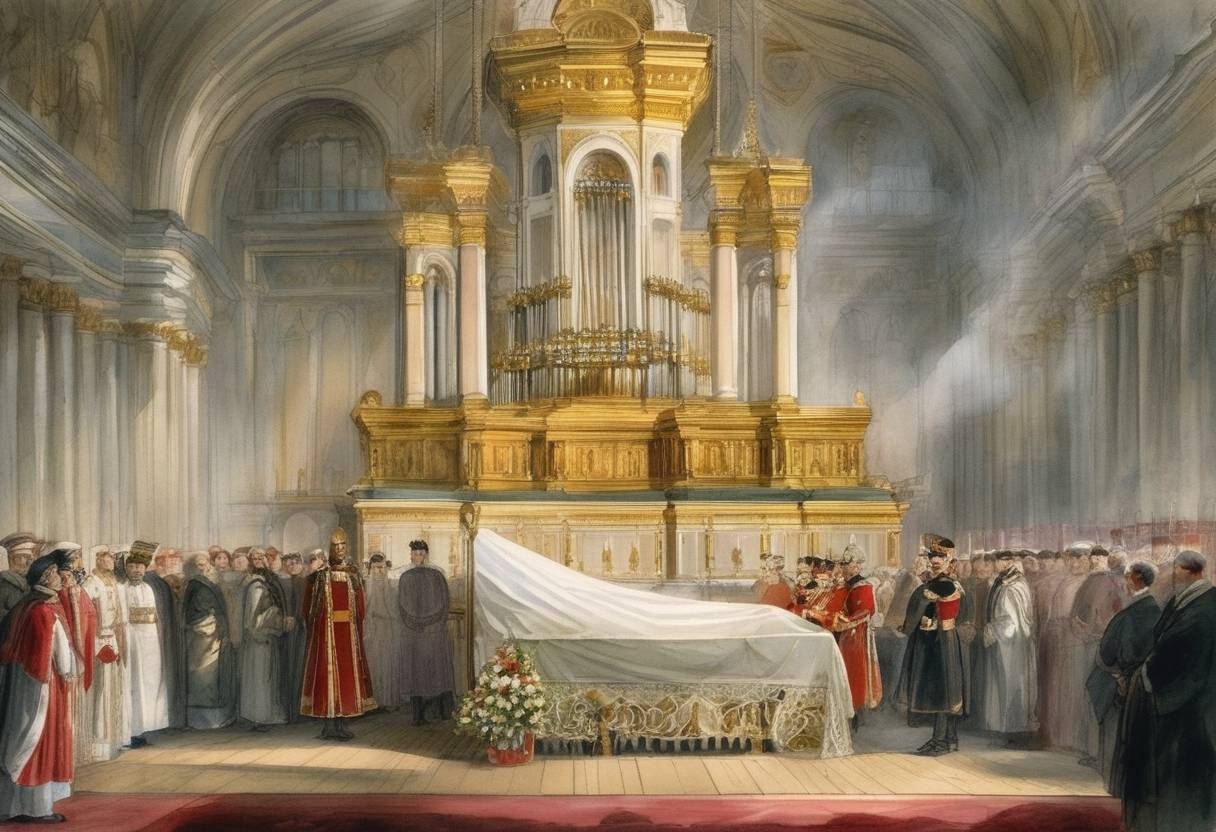
On December 14, 1825, Tsar Alexander I of Russia, known for his complex legacy as a ruler who navigated the Napoleonic Wars and initiated a mix of liberal reforms and autocratic policies, was laid to rest in the Saints Peter and Paul Cathedral in Saint Petersburg.
Alexander I became Emperor of Russia in 1801 following the assassination of his father, Tsar Paul I. His reign was marked by the oscillation between progressive reforms and conservative policies. Early in his reign, he advocated for some enlightened reforms, influenced by the ideas of the Enlightenment, which included attempts at a constitutional government and the modernization of the Russian state. However, the pressures of the Napoleonic Wars and the maintenance of autocratic rule curtailed many of these reforms.
During the Napoleonic Wars, Alexander I emerged as a key figure in the coalition that ultimately defeated Napoleon. His diplomatic acumen was demonstrated at the Congress of Vienna where he helped redraw the map of Europe. The latter part of his reign became increasingly reactionary, particularly following Napoleon’s defeat and the domestic uprisings that threatened monarchical structures across Europe.
Alexander I’s death on November 19, 1825, in Taganrog, a town in Southern Russia, was sudden and somewhat unexpected. Officially, his death was attributed to typhus, although there were rumors and intrigue surrounding his demise, including conjectures of possible foul play or even that he faked his death to live in anonymity, given his reported spiritual crisis and disenchantment with power.
Upon his death, the transfer of power initiated a crisis of succession as Alexander had no legitimate direct heirs; his brother, Nicholas I, eventually succeeded him after his other brother, Constantine, abdicated his claim.
The ceremony on December 14, 1825, was attended by various dignitaries and members of the Russian nobility, reflecting the significant role Alexander had played in Russian and European history. The Saints Peter and Paul Cathedral, the burial place for Russian tsars since Peter the Great, was a fitting final resting place, symbolizing the continuity of the Romanov dynasty.
Alexander I’s burial marks not only the end of a turbulent reign but also serves as a prelude to the Decembrist Revolt, which occurred on the same day as his burial. The Decembrist Revolt was a crucial moment in Russian history, representing the first significant challenge to autocratic rule by educated elites and military officers advocating for liberal reforms.
Alexander’s complex legacy and his shifting domestic and foreign policies would continue to be debated, influencing Russian governance and its interactions with Europe long after his passing. His burial in the powerful symbolism of the Saints Peter and Paul Cathedral underscores his place in the lineage of tsars who shaped Russian history.
Source: www.britannica.com