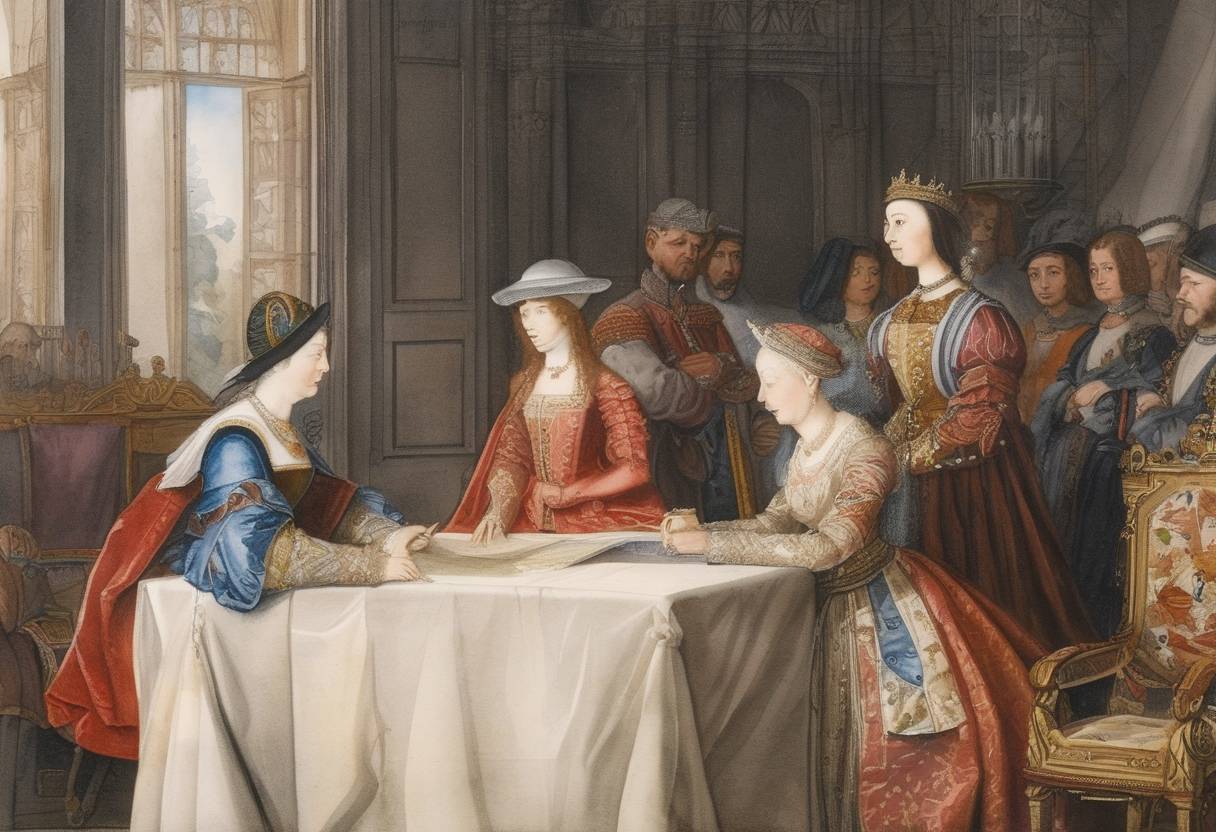
The Treaty of Cambrai: The Ladies’ Peace
The Treaty of Cambrai, often referred to as the “Ladies’ Peace,” was signed on August 3, 1529, marking a pivotal moment in the Italian Wars. These wars were part of a series of complex conflicts involving major European powers, primarily France and the Holy Roman Empire, as they vied for control over the Italian Peninsula.
The treaty was notable for the prominent roles of two influential women in its negotiation and conclusion:
- Margaret of Austria: As the regent of the Netherlands and the aunt of Emperor Charles V, she played a crucial diplomatic role in representing the interests of the Habsburgs.
- Louise of Savoy: The mother of King Francis I of France, she acted on behalf of her son. As regent for France in his absence, her involvement underscored the importance of women in diplomacy during this period.
Context and Background
- The Italian Wars began as a struggle for domination over Italy, embroiling many European powers over several decades from late 15th to mid-16th centuries.
- After a series of battles, including the Battle of Pavia in 1525 where Francis I was captured, a power struggle persisted between the Habsburg Empire under Charles V and France.
- Despite earlier attempts to resolve their differences, tensions reignited, culminating in yet another conflict over Italian territories.
Terms of the Treaty
- Territorial Adjustments: The treaty terms resulted in significant territorial concessions by the French. Francis I renounced all claims to the Duchy of Milan, which remained under Habsburg influence.
- Financial Reparations: France agreed to pay a substantial ransom for the release of Francis I’s sons, who had been held as hostages following an earlier armistice agreement.
- Restoration of Peace: The treaty aimed to restore peace across the affected regions within Europe, particularly along the contested Italian Peninsula.
Aftermath and Significance
- The Treaty of Cambrai effectively ended the current phase of the Italian Wars, offering a temporary respite in conflicts dominated by Charles V’s ambitions and Francis I’s quest for influence.
- Though it brought a lull in active hostilities, the treaty’s impact was ultimately transient. Charles and Francis would continue their rivalry in subsequent conflicts.
- The agreement further underscored the evolving role of women in diplomacy and the complexities of European political alliances during the Renaissance period.
The Treaty of Cambrai highlights the intersection of personal diplomacy and large-scale geopolitical strategies, unraveling a tapestry of ambition, power, and influence that defined early modern European history.