The Battle of Tukaroi: The End of the Bengal Sultanate
1575 · Tukaroi, India
The Mughal Emperor Akbar decisively defeats the Sultan of Bengal Daud Khan in the Battle of Tukaroi, which effectively ends the Bengal Sultanate.
March 5, 1512
After a day of conflict, the Battle of Waghad came to an end with victory for the Ahmadnagar Sultanate over the Vijayanagara Empire.
Waghad, India
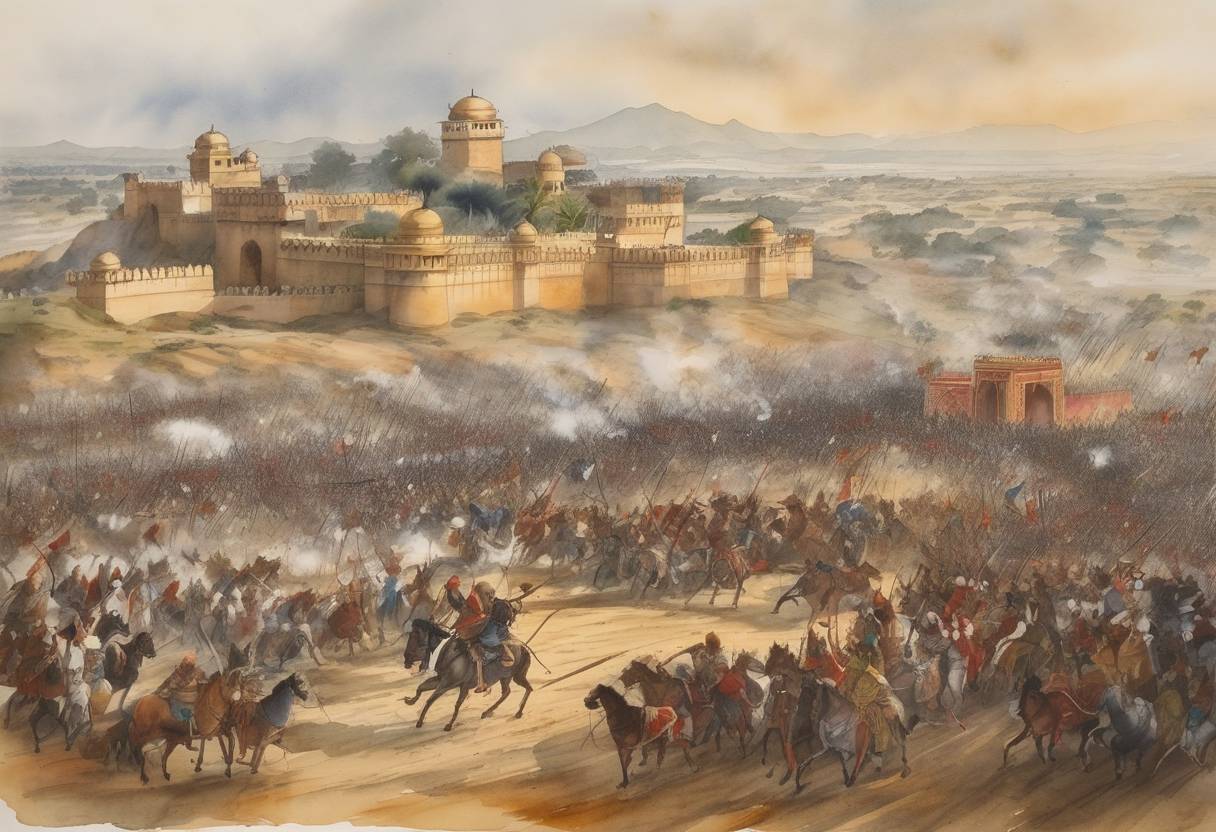
The Battle of Waghad concluded on March 5, 1512, marking a pivotal moment in the ongoing territorial conflicts between the Ahmadnagar Sultanate and the Vijayanagara Empire in the Deccan region of India.
By the early 16th century, the Deccan Sultanates and the Vijayanagara Empire were engaged in a series of territorial disputes and power struggles. The Ahmadnagar Sultanate, under the rule of Ahmad Nizam Shah, sought to consolidate power and expand its influence over the Deccan plateau. Concurrently, the Vijayanagara Empire was at the peak of its political and military strength, aiming to counter the encroachments of neighboring powers.
The Battle of Waghad was a significant military confrontation that exemplified the regional power dynamics of the time. Details about the tactics and exact location remain sparse, but the conflict demonstrated the military prowess of the Ahmadnagar Sultanate. The victory effectively allowed Ahmad Nizam Shah to assert greater control over contested territories in the northern Deccan while weakening the influence of the Vijayanagara Empire in that area.
The outcome of the battle solidified Ahmadnagar’s territorial claims and bolstered its position among the Deccan Sultanates. In the broader historical context, this victory was part of the intricate tapestry of alliances and rivalries that characterized the region. It underscored the fragmentation and competitive nature of South and Central Indian politics during the period, which continued until the eventual consolidation under larger empires, such as the Mughal Empire.
The Battle of Waghad is often referenced in historical analyses of Deccan politics, illustrating the dynamics between emerging sultanates and established empires in early modern India. It highlighted the strategic importance of alliances and the balance of power that defined the era’s geopolitics.
Source: en.wikipedia.org