Battle of Río Salado: October 31, 1340
1340 · Tarifa, Spain
Battle of Río Salado: A significant military engagement where the combined forces of Castile and Portugal defeated the Marinid Dynasty of Morocco and their allies at Tarifa.
March 28, 1188
A firefight occurred between the knights of Portugal and the Almohad dynasty near Santarém, affecting territorial control in the region.
Santarém, Portugal | Knights of Portugal
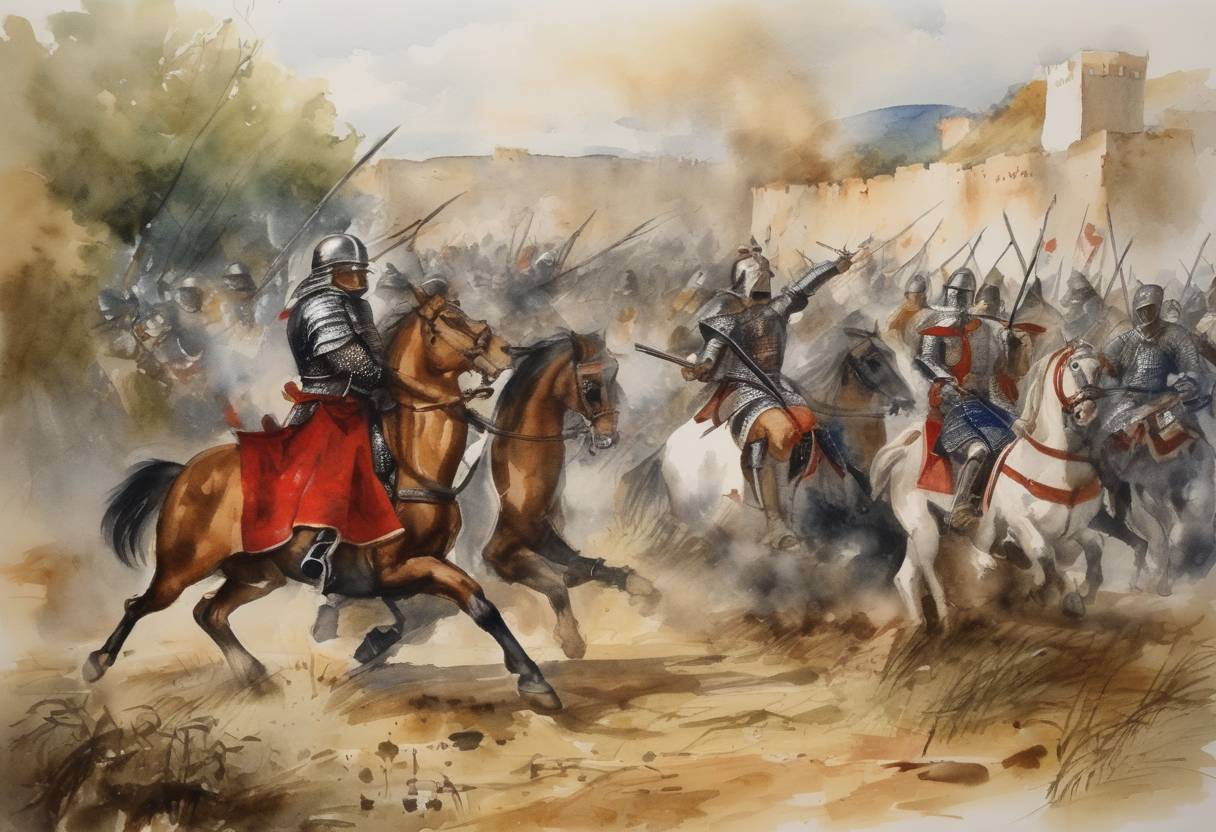
On March 28, 1188, a significant military engagement unfolded near the Portuguese town of Santarém involving the forces of the Kingdom of Portugal and the Almohad Caliphate. This confrontation was part of the broader series of conflicts known as the Reconquista, where Christian kingdoms sought to reclaim territories on the Iberian Peninsula from Muslim rule.
The Reconquista was a protracted series of campaigns spanning from the early 8th century until the late 15th century, aimed at recapturing territory taken by Muslim rulers in the Iberian Peninsula. By the late 12th century, the Christian kingdoms, including Portugal, had gained significant ground but remained engaged in ongoing skirmishes and battles with Muslim forces. The Almohad dynasty, having succeeded the Almoravid dynasty, controlled vast parts of southern Spain and North Africa and were key opponents in this struggle.
Santarém was a strategic military and trading post on the right bank of the Tagus River in Portugal. Its geographic importance made it a focal point of contention between the advancing Portuguese forces and the Almohad defenders. Control over Santarém and its surrounding areas had implications for both military operations and economic resources.
On March 28, 1188, the Portuguese army, bolstered by both knights and infantry, engaged with the Almohad forces in a decisive encounter. Under the command of an as-yet-unidentified Portuguese leader, the aim was to solidify further control over the central regions, facilitating additional conquests down the line.
Confrontations like these typically involved complex pre-battle positioning, feigned retreats, and cavalry charges, which were central to medieval warfare. The Portuguese forces, adept at utilizing these tactics, aimed to exploit any weaknesses in the Almohad positions.
As a result of the battle, the Portuguese solidified their influence over the regions surrounding Santarém. These gains were instrumental in securing supply lines and establishing a stronger defensive perimeter against future incursions by the Almohads.
This engagement was one of many that contributed to the slow north-to-south progression of Christian reclamation during the Reconquista. While not a conclusive victory that ended Muslim presence in Portugal, it was a vital step in bolstering Portuguese territorial integrity.
The ongoing campaigns and repeated defeats in battles such as the one near Santarém gradually weakened Almohad hold on the Iberian Peninsula, paving the way for eventual decline. This confrontation contributed to a series of failed defenses that would eventually destabilize their dominance.
The firefight near Santarém on March 28, 1188, epitomizes the dynamic and often chaotic nature of medieval warfare during the Reconquista. It underscores the persistent struggle for sovereignty and control between Christian and Muslim factions, providing a microcosmic glimpse into the broader religious and territorial shifts of the period. Such battles were instrumental in shaping modern Portuguese boundaries and cultural identity.
Source: historical-reference.com