The Battle of the Alamo Begins
1836 · San Antonio, Republic of Texas
The Battle of the Alamo began, as Mexican troops under General Santa Anna began a siege of the Texan defenders of the Alamo Mission.
March 27, 1836
The Goliad Massacre took place during the Texas Revolution, where over 400 Texan prisoners were executed by the Mexican Army.
Goliad, United States | Mexican Army
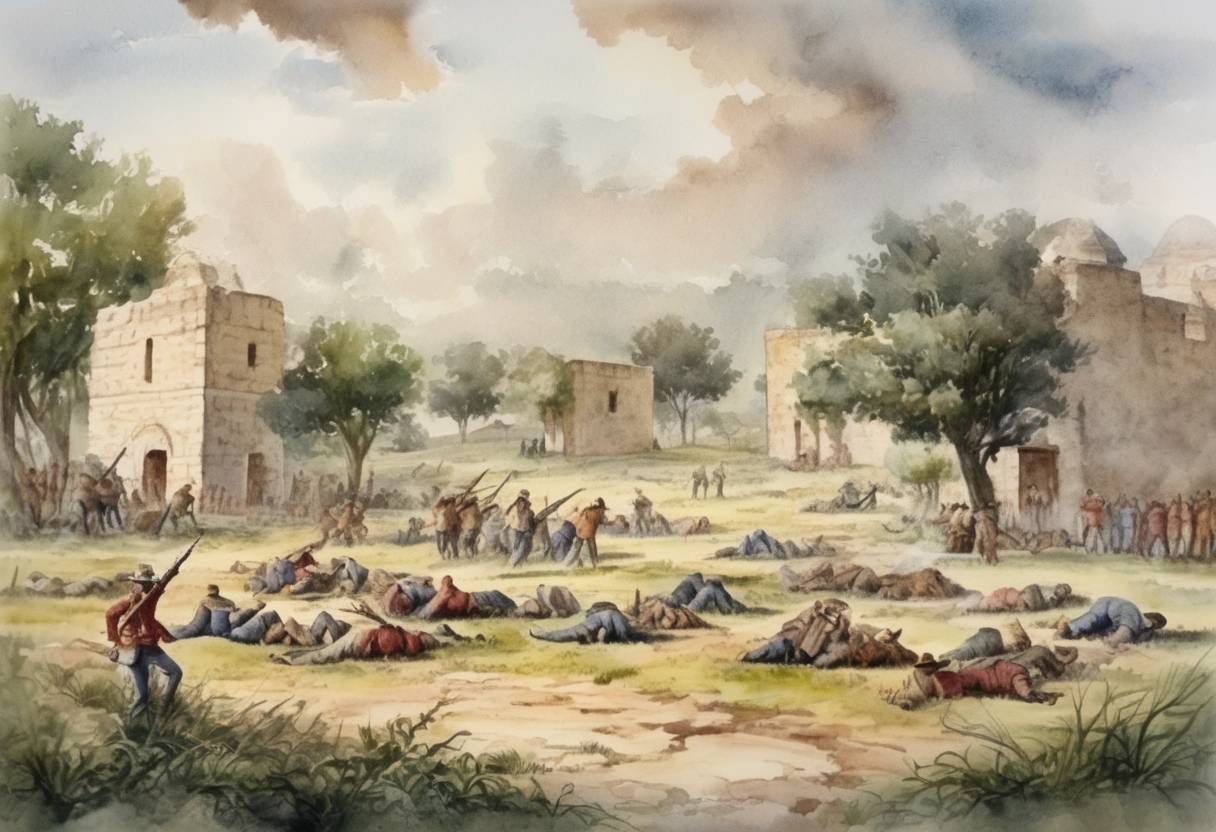
The Goliad Massacre was a pivotal and tragic event during the Texas Revolution, occurring on March 27, 1836. This event involved the execution of over 400 Texan prisoners by the Mexican Army, under the orders of General Antonio López de Santa Anna. It stands as one of the most somber moments in the struggle for Texan independence from Mexico.
Texas Revolution: The Texas Revolution was a rebellion of colonists from the United States and Tejanos (Texans of Mexican descent) against the centralist Mexican government. The conflict began in October 1835 and was driven by issues such as cultural differences, political autonomy, and land rights.
The Battle of Coleto: Prior to the massacre, Colonel James Fannin and his troops were engaged in the Battle of Coleto, which took place on March 19-20, 1836. Fannin’s forces, numbering around 300-400 men, were surrounded by a larger Mexican force led by General José de Urrea. After a day of fighting and realizing their dire situation, Fannin surrendered under the belief that they would be treated as prisoners of war.
Orders from Santa Anna: Despite General Urrea’s inclination to treat the prisoners with clemency, Santa Anna ordered their execution. Santa Anna’s directive was part of a broader strategy to quell the rebellion by instilling fear and demonstrating the consequences of defying Mexican authority.
Execution: On Palm Sunday, March 27, 1836, the prisoners were divided into groups and marched out of the Presidio La Bahía, where they were held. Under the pretense of being transferred, they were instead led to open fields and shot. Those who survived the initial volley were killed by bayonet or other means.
Casualties: Approximately 342 men were executed, including Colonel Fannin, who was shot separately after witnessing the massacre of his men. A few managed to escape or were spared by Mexican soldiers sympathetic to their plight.
Impact on the Texas Revolution: The Goliad Massacre, along with the fall of the Alamo earlier in March, galvanized Texan forces and supporters. The rallying cry “Remember the Alamo! Remember Goliad!” became a powerful motivator for the Texan army.
Battle of San Jacinto: The massacre fueled the resolve of Texan forces, leading to their decisive victory at the Battle of San Jacinto on April 21, 1836. This victory resulted in the capture of Santa Anna and ultimately secured Texan independence.
Legacy: The Goliad Massacre is remembered as a symbol of sacrifice and the harsh realities of war. It remains a significant event in Texas history, commemorated for its role in the fight for independence and its enduring impact on Texan identity.
The Goliad Massacre serves as a poignant reminder of the human cost of conflict and the complexities of the struggle for independence. Its legacy continues to be honored and studied as a crucial chapter in the history of Texas and the broader narrative of American expansion.
Source: www.tshaonline.org