The Battle of Midway Begins: June 4, 1942
1942 · Midway Atoll, United States
The Battle of Midway begins, marking a turning point in the Pacific Theater of World War II as the United States Navy decisively defeats the Imperial Japanese Navy.
June 7, 1942
The Battle of Midway, a pivotal naval battle in the Pacific Theater of World War II, ended with a decisive victory for the United States over Japan.
Midway Atoll, United States | United States Navy
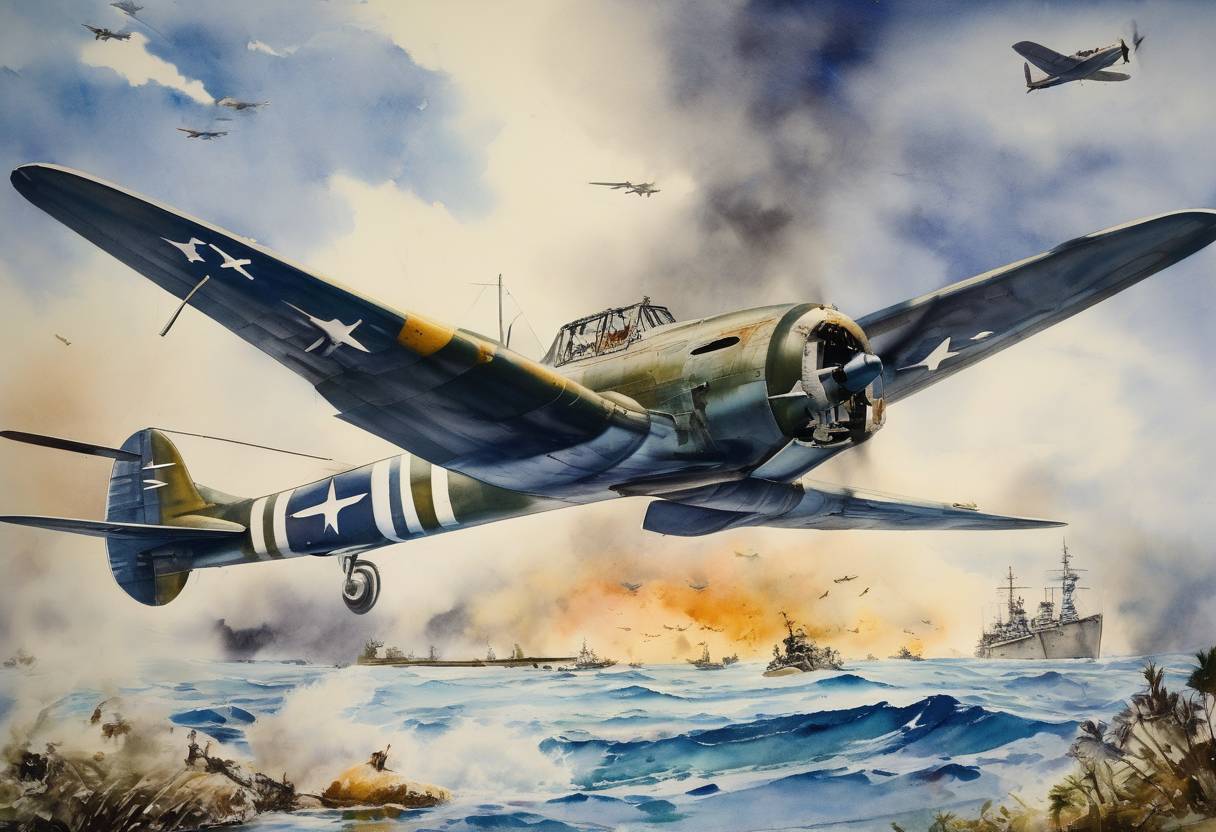
The Battle of Midway, which concluded on June 7, 1942, stands as a critical turning point in the Pacific Theater of World War II. This decisive naval battle saw the United States Navy achieve a significant victory over the Imperial Japanese Navy, altering the course of the war in the Pacific.
Strategic Importance: Midway Atoll, located in the central Pacific Ocean, was strategically significant for both the United States and Japan. Control of Midway would have allowed Japan to extend its defensive perimeter and potentially threaten Hawaii and the West Coast of the United States.
Japanese Objectives: Following their success at Pearl Harbor and in the early months of the Pacific War, Japan sought to eliminate the United States as a strategic power in the Pacific, thereby securing its dominance. The plan involved luring the U.S. Pacific Fleet into a trap and destroying it.
American Intelligence: The United States had broken Japanese naval codes, giving them foreknowledge of Japan’s plans. This intelligence allowed the U.S. to prepare and set up an ambush of their own.
Date: The battle took place from June 4 to June 7, 1942.
Forces Involved: The Japanese fleet, commanded by Admiral Isoroku Yamamoto, included four aircraft carriers—Akagi, Kaga, Soryu, and Hiryu—along with battleships, cruisers, and destroyers. The U.S. fleet, under Admirals Chester W. Nimitz, Frank J. Fletcher, and Raymond A. Spruance, included three carriers—USS Enterprise, USS Hornet, and USS Yorktown.
Initial Engagement: On June 4, U.S. carrier-based aircraft launched a surprise attack on the Japanese fleet. Despite initial setbacks, including heavy losses among American torpedo bombers, dive bombers managed to inflict devastating damage on the Japanese carriers.
Outcome: By June 7, all four Japanese carriers were sunk, along with a heavy cruiser. The U.S. lost the carrier USS Yorktown and a destroyer. The battle resulted in a significant loss of experienced Japanese pilots and aircraft.
Turning Point: The Battle of Midway marked the first major defeat for the Japanese Navy and shifted the balance of naval power in the Pacific towards the United States.
Strategic Impact: The victory halted Japanese expansion in the Pacific and set the stage for Allied offensives, including the Guadalcanal Campaign.
Long-term Consequences: The loss of four carriers and many seasoned pilots severely weakened Japan’s naval capabilities, from which it never fully recovered.
The Battle of Midway is often cited as one of the most significant naval battles in history. It demonstrated the importance of intelligence, air power, and strategic planning, and it underscored the resilience and capability of the United States Navy in the face of formidable odds.
Source: en.wikipedia.org