Adolf Hitler's Sentencing for the Beer Hall Putsch
1924 · Munich, Germany
Adolf Hitler was sentenced to five years in prison for his role in the Beer Hall Putsch, though he would serve less than a year.
July 29, 1921
Adolf Hitler became the leader of the National Socialist German Workers' Party (NSDAP).
Munich, Germany | NSDAP
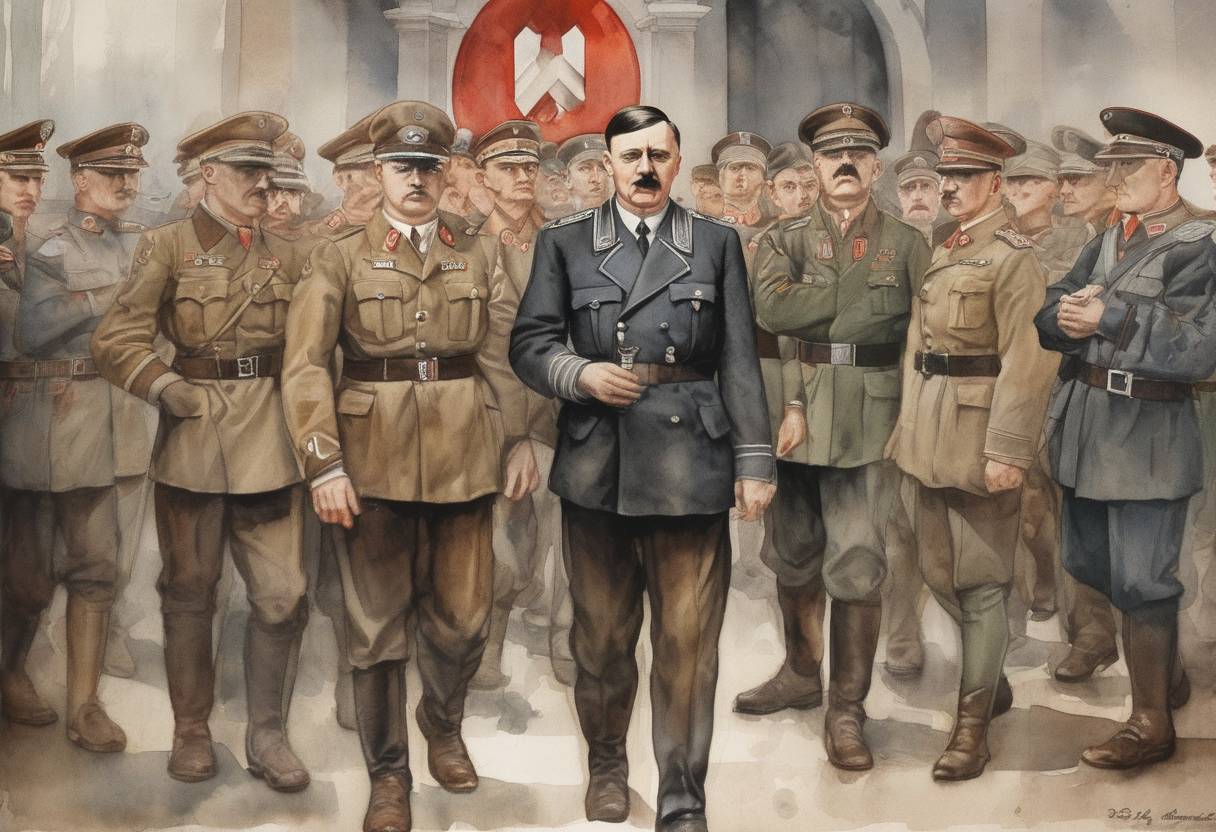
On July 29, 1921, Adolf Hitler was appointed as the leader of the National Socialist German Workers’ Party (NSDAP), marking a pivotal moment in the history of Germany and the world. This event set the stage for the rise of the Nazi Party and the subsequent impact it would have on global history.
The NSDAP, commonly known as the Nazi Party, was initially a small political group called the German Workers’ Party (DAP), founded in 1919 by Anton Drexler. The party was rooted in nationalist, anti-Semitic, and anti-Marxist ideologies. Adolf Hitler, a former soldier who had served in World War I, joined the DAP in September 1919 after being sent by the German Army to monitor political groups in Munich.
Hitler quickly distinguished himself as a charismatic orator and propagandist, attracting new members and increasing the party’s visibility. His speeches, which tapped into widespread discontent in post-World War I Germany, resonated with many who were dissatisfied with the Treaty of Versailles and the economic hardships facing the nation.
In 1920, the DAP was rebranded as the National Socialist German Workers’ Party (NSDAP), and Hitler played a crucial role in shaping its platform and ideology. His influence within the party grew, and he became a prominent figure in its leadership.
By mid-1921, internal conflicts within the NSDAP leadership emerged. A faction within the party sought to merge with a rival nationalist group, which Hitler opposed. In response, Hitler offered his resignation, leveraging his popularity to force the party’s hand. Recognizing his value, the party’s executive committee capitulated to his demands.
On July 29, 1921, Hitler was formally appointed as the party’s chairman, or “Führer,” granting him dictatorial powers over the NSDAP. This appointment marked the consolidation of his control over the party and allowed him to implement his vision without opposition.
Hitler’s leadership of the NSDAP was a critical step in the party’s transformation from a fringe group to a dominant political force in Germany. Under his direction, the party adopted the swastika as its symbol and expanded its paramilitary wing, the Sturmabteilung (SA), to intimidate opponents and protect party meetings.
The consolidation of power within the NSDAP enabled Hitler to pursue his agenda more aggressively, ultimately leading to the party’s rise to power in 1933. This event set the stage for the establishment of a totalitarian regime, the outbreak of World War II, and the Holocaust, profoundly shaping the course of 20th-century history.
In summary, Hitler’s ascension to the leadership of the NSDAP on July 29, 1921, was a turning point that facilitated the party’s growth and the eventual implementation of its radical and destructive policies.
Source: en.wikipedia.org