The Battle of Roundway Down: July 13, 1643
1643 · Roundway Down, England
The English Civil War saw the Battle of Roundway Down, where Royalist forces defeated the Parliamentarians.
August 22, 1642
King Charles I of England raised his standard at Nottingham, marking the beginning of the English Civil War.
Nottingham, England | Royalists
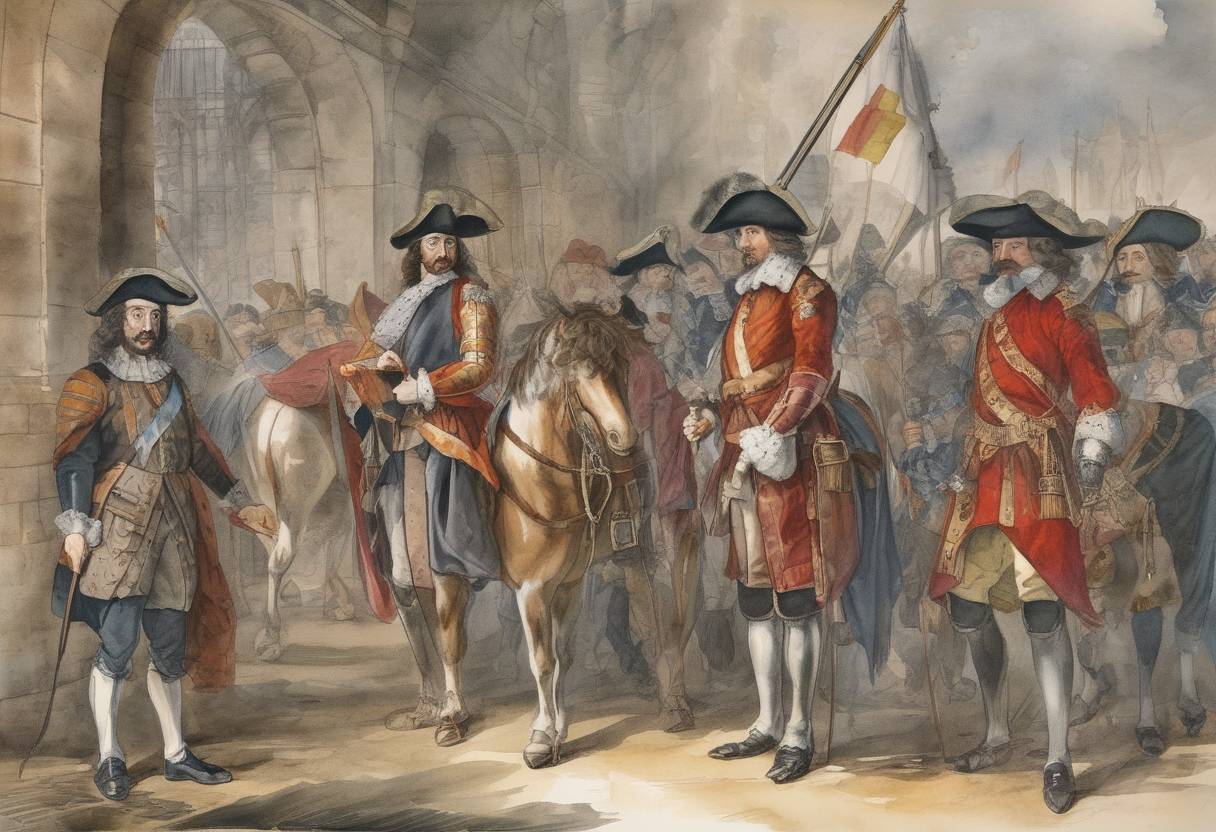
On August 22, 1642, King Charles I of England took a decisive step that marked the beginning of the English Civil War by raising his royal standard at Nottingham. This act symbolized his formal declaration of war against Parliament, setting the stage for a conflict that would engulf England for nearly a decade.
The roots of the English Civil War lay in a complex web of political, religious, and economic tensions that had been building for years:
Political Tensions: King Charles I’s belief in the divine right of kings led to frequent clashes with Parliament. His attempts to govern without Parliament, particularly during the period known as the Personal Rule (1629-1640), exacerbated tensions.
Religious Conflicts: Charles’s marriage to a Catholic, Henrietta Maria of France, and his perceived favoritism towards high Anglican practices alienated Puritans and other Protestant factions within England.
Financial Strains: Charles’s financial policies, including the imposition of unpopular taxes like Ship Money, further strained his relationship with Parliament and the English populace.
The Bishops’ Wars: Conflicts with Scotland over religious reforms led to the Bishops’ Wars (1639-1640), which drained the royal coffers and forced Charles to call the Long Parliament in 1640.
By 1642, relations between Charles and Parliament had deteriorated beyond repair. After failed negotiations and increasing hostilities, Charles left London and moved north. On August 22, 1642, he raised his standard at Nottingham Castle, a traditional symbol of rallying troops for war. This act was a clear signal that he intended to use military force to resolve the disputes with Parliament.
Symbolism: The raising of the standard was a ceremonial act, intended to summon loyal subjects to the king’s cause. However, the event was poorly attended, reflecting the divided loyalties among the English nobility and commoners.
Immediate Consequences: The raising of the standard marked the official start of the English Civil War, as both Royalist and Parliamentary forces began to mobilize for battle.
The English Civil War would last until 1651, resulting in significant political and social upheaval:
Key Battles: The war included major battles such as the Battle of Edgehill (1642), the Battle of Marston Moor (1644), and the Battle of Naseby (1645).
Outcome: The conflict ultimately led to the trial and execution of King Charles I in 1649, the abolition of the monarchy, and the establishment of the Commonwealth under Oliver Cromwell.
Long-term Impact: The war and its aftermath had profound effects on the English monarchy, Parliament, and society, laying the groundwork for the eventual establishment of a constitutional monarchy.
The raising of the royal standard at Nottingham remains a pivotal moment in British history, symbolizing the deep divisions that would shape the future of the nation.
Source: en.wikipedia.org