The Second Battle of Kosovo: October 17, 1448
1448 · Kosovo Polje, Ottoman Empire
The Second Battle of Kosovo began between the Ottoman Empire and a coalition of Hungarian and Wallachian forces, resulting in an Ottoman victory.
June 28, 1389
The Battle of Kosovo took place between the Serbian army led by Prince Lazar and the Ottoman Empire led by Sultan Murad I. This battle was significant in the history of the Balkans and marked the beginning of Ottoman dominance in the region.
Kosovo Polje, Serbia | Ottoman Empire
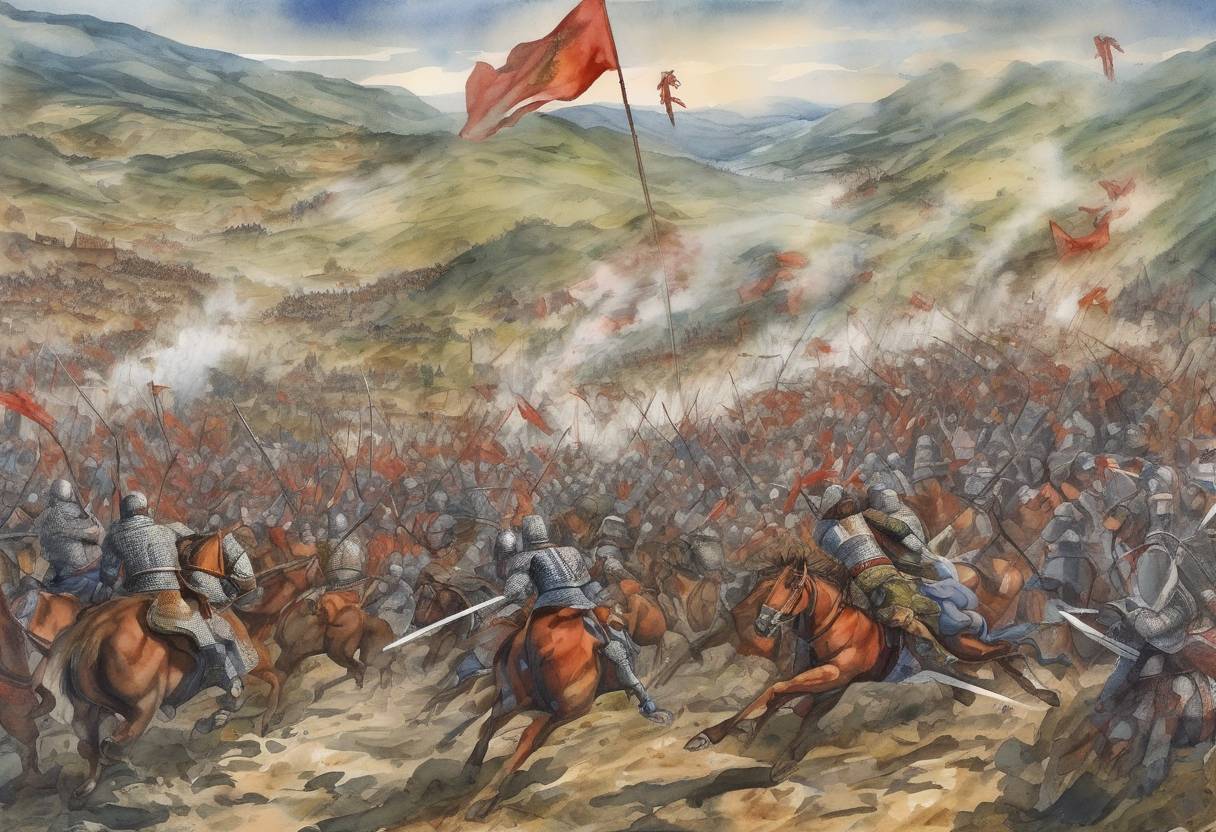
The Battle of Kosovo, fought on June 28, 1389, was a pivotal conflict between the forces of the Serbian army, led by Prince Lazar Hrebeljanović, and the Ottoman Empire, commanded by Sultan Murad I. This battle is considered one of the most significant in the history of the Balkans, marking a crucial moment in the expansion of Ottoman influence in the region.
In the late 14th century, the Balkans were a patchwork of feudal states and principalities, often in conflict with one another. The Ottoman Empire, under the leadership of Sultan Murad I, had been steadily expanding its territory into Europe, posing a significant threat to the Christian states of the Balkans. The Serbian Empire, once a dominant power in the region, had fragmented after the death of Emperor Dušan the Mighty, leading to internal strife and weakened defenses.
Prince Lazar, a regional lord, emerged as a unifying figure among the Serbian nobility, rallying support to resist the Ottoman advance. The confrontation at Kosovo Polje (Field of Blackbirds) was the culmination of these tensions, as both sides prepared for a decisive engagement.
The battle commenced on the morning of June 28, 1389, with both armies arrayed on the plains of Kosovo. The Serbian forces, though outnumbered, were composed of a coalition of Serbian, Bosnian, and Albanian troops. Prince Lazar’s strategy relied on the strength and valor of his knights and infantry.
The Ottoman army, larger and more experienced, was well-organized under the leadership of Sultan Murad I and his sons, Bayezid and Yakub. The Ottomans employed a combination of archers, cavalry, and infantry, utilizing their tactical flexibility to great effect.
The battle was fiercely contested, with heavy casualties on both sides. According to historical accounts, Sultan Murad I was killed during the battle, allegedly by a Serbian knight named Miloš Obilić, who infiltrated the Ottoman camp. Despite the loss of their leader, the Ottomans maintained their cohesion under the command of Bayezid, Murad’s son.
The outcome of the Battle of Kosovo was inconclusive in terms of immediate territorial gains, as both armies suffered devastating losses, and neither side could claim a decisive victory. However, the death of Prince Lazar and the weakening of Serbian forces marked a turning point in the region’s history.
In the years following the battle, the Ottomans continued their expansion into the Balkans, eventually subjugating most of the region. The battle became a symbol of Serbian resistance and sacrifice, deeply ingrained in the national consciousness and folklore.
The Battle of Kosovo is often viewed as the beginning of Ottoman dominance in the Balkans, setting the stage for centuries of Ottoman rule. It also highlighted the strategic importance of the region and the complex interplay of power, religion, and culture that would shape its future.
The battle’s legacy extends beyond its immediate military and political consequences. It has been commemorated in Serbian epic poetry and remains a potent symbol of national identity and resilience. The memory of Kosovo has influenced Balkan politics and cultural narratives, contributing to the region’s complex historical tapestry.
In summary, the Battle of Kosovo was a significant event that not only marked the rise of Ottoman power in the Balkans but also left a lasting impact on the cultural and historical identity of the region.
Source: en.wikipedia.org