The Invasion of Kuwait by Iraq on August 2, 1990
1990 · Kuwait City, Kuwait
Iraq invaded Kuwait, leading to the Gulf War, a major conflict that involved a coalition of forces led by the United States to liberate Kuwait.
February 24, 1991
The ground phase of the Gulf War began with a massive coalition force assault on Iraqi positions in Kuwait and southern Iraq, leading to the liberation of Kuwait.
Kuwait City, Kuwait | Coalition forces
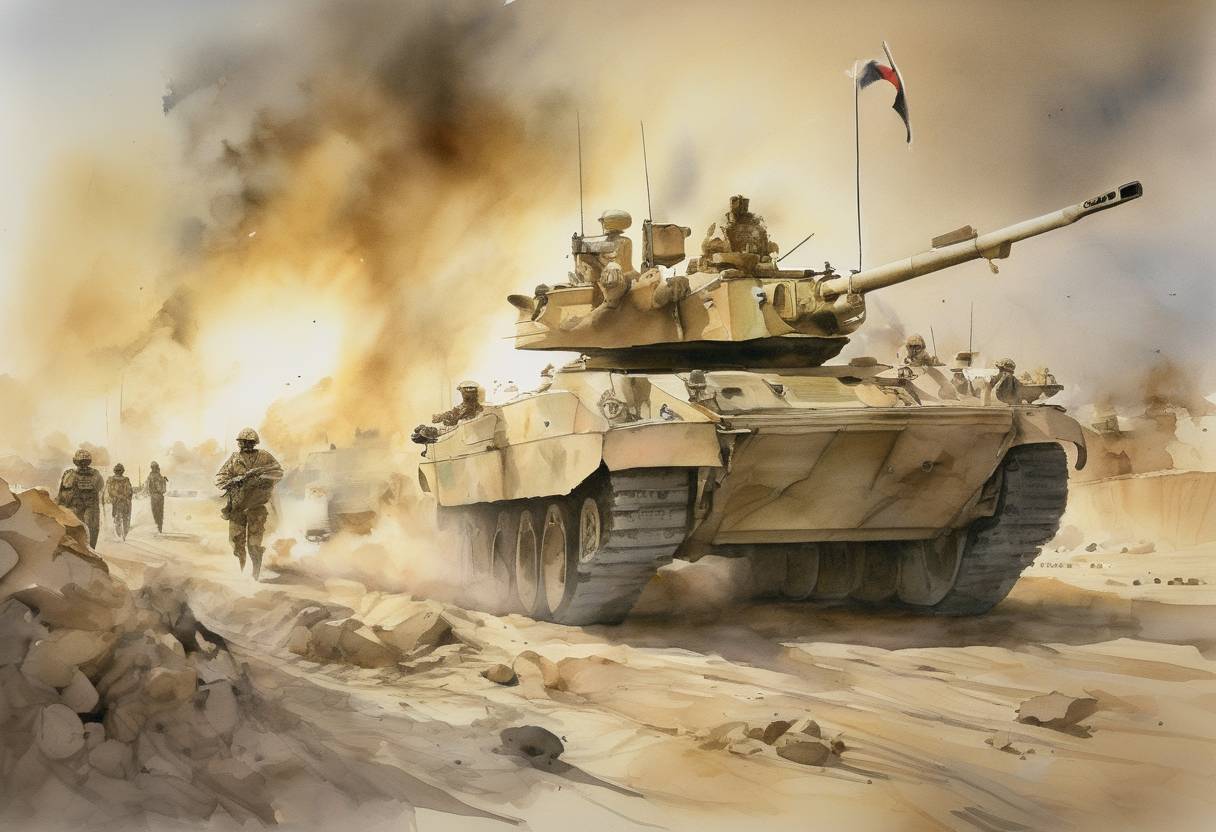
On February 24, 1991, the ground phase of the Gulf War, also known as Operation Desert Storm, commenced with a large-scale assault by coalition forces against Iraqi positions in Kuwait and southern Iraq. This marked a pivotal moment in the conflict, leading to the liberation of Kuwait from Iraqi occupation.
The Gulf War began on August 2, 1990, when Iraq, led by President Saddam Hussein, invaded and annexed Kuwait. This act was met with international condemnation and led to the formation of a coalition force under United Nations authorization, spearheaded by the United States, to expel Iraqi forces from Kuwait.
Operation Desert Shield: Following Iraq’s invasion of Kuwait, Operation Desert Shield was launched to deter further Iraqi aggression and to build up coalition forces in the region. This operation saw the deployment of hundreds of thousands of troops from various countries to Saudi Arabia.
Air Campaign: On January 17, 1991, the coalition initiated a massive air campaign targeting Iraqi military infrastructure, command and control centers, and supply lines. This phase significantly weakened Iraqi capabilities and paved the way for a ground offensive.
The ground assault began in the early hours of February 24, 1991. The operation was characterized by a swift and decisive attack strategy, leveraging the coalition’s technological and numerical superiority.
Coalition Forces: The coalition consisted of forces from 35 nations, with the United States, the United Kingdom, France, Saudi Arabia, and Egypt contributing significant military assets. The total strength of the coalition ground forces was approximately 956,600 troops.
Main Objectives: The primary goal was to liberate Kuwait City and destroy the Iraqi Republican Guard, which was considered the backbone of Saddam Hussein’s military.
The “Left Hook” Maneuver: A key tactical maneuver involved a massive flanking movement known as the “Left Hook.” Coalition forces, led by U.S. General Norman Schwarzkopf, executed a wide sweep through the desert to outflank Iraqi defenses, effectively cutting off their retreat and supply lines.
Liberation of Kuwait: Within 100 hours of the ground assault, coalition forces successfully liberated Kuwait City. Iraqi forces, overwhelmed and demoralized, retreated in disarray.
Ceasefire: On February 28, 1991, a ceasefire was declared, effectively ending active combat operations. The swift victory demonstrated the effectiveness of coalition coordination and modern military technology.
Consequences: The Gulf War had significant geopolitical implications. It reaffirmed the United States’ role as a dominant military power and reshaped Middle Eastern geopolitics. The war also highlighted the importance of international coalitions in addressing regional conflicts.
The ground phase of the Gulf War is remembered as a textbook example of modern warfare, showcasing the impact of strategic planning, coalition cooperation, and technological superiority in achieving military objectives.
Source: en.wikipedia.org