Charlemagne Confirms the Donation of Territories to the Papal States
800 · Rome, Papal States
Charlemagne confirms the donation of territories to the Papal States, strengthening the alliance between the Frankish kingdom and the papacy.
September 25, 0768
Pepin the Short, King of the Franks, dies. His kingdom is divided between his sons Charlemagne and Carloman I, setting the stage for the Carolingian Empire.
Saint-Denis, Frankish Kingdom | Frankish Kingdom
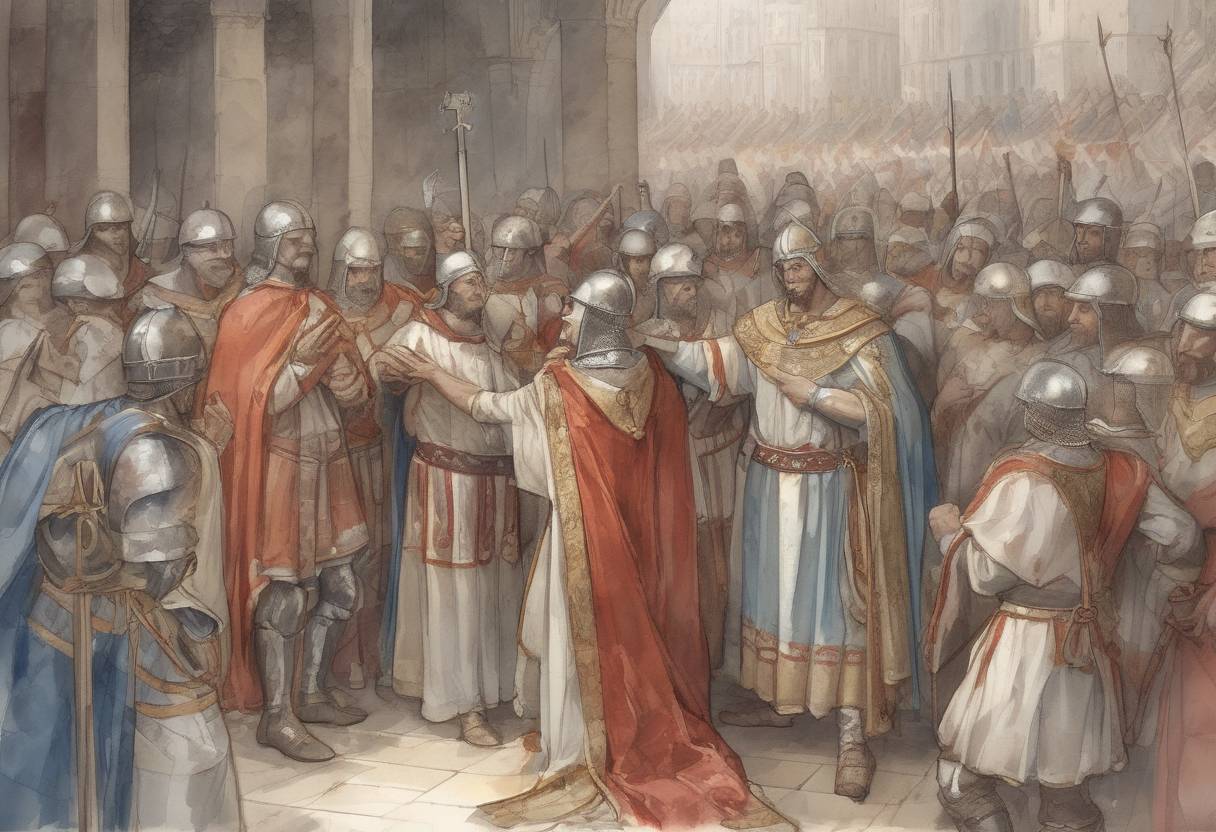
On September 24, 768, Pepin the Short, King of the Franks, passed away, marking a pivotal moment in European history. His death led to the division of his kingdom between his two sons, Charlemagne and Carloman I, setting the foundation for the future Carolingian Empire.
Pepin the Short, born in 714, was the first king of the Carolingian dynasty. He was the son of Charles Martel, the famed Frankish military leader who halted the Muslim advance into Western Europe at the Battle of Tours in 732. Pepin became Mayor of the Palace in 741 and, with the support of the Pope, deposed the last Merovingian king, Childeric III, in 751. He was crowned King of the Franks, marking the beginning of the Carolingian dynasty.
Pepin’s Reign: Pepin expanded Frankish territories and strengthened the alliance with the Papacy, which was crucial for the legitimacy of his rule. His reign was marked by military campaigns that consolidated Frankish power in Europe.
Succession Planning: Following Frankish tradition, Pepin planned for the division of his realm between his sons, Charlemagne and Carloman I. This was a common practice intended to ensure peace and stability by providing each heir with a portion of the kingdom.
Upon Pepin’s death, his kingdom was divided as follows:
Charlemagne (Charles the Great): Received the larger portion of the kingdom, including Neustria, Aquitaine, and the western parts of the Frankish realm.
Carloman I: Inherited the eastern regions, including Austrasia, Alemannia, and Thuringia.
Tensions and Rivalry: The division initially led to tensions between the brothers, as both sought to assert their dominance. However, Carloman’s sudden death in 771 allowed Charlemagne to reunite the Frankish kingdom under his sole rule.
Rise of the Carolingian Empire: Charlemagne’s subsequent reign saw the expansion of the Frankish state into an empire that covered much of Western and Central Europe. His coronation as Emperor in 800 by Pope Leo III marked the revival of the Western Roman Empire and laid the groundwork for the Holy Roman Empire.
Cultural and Political Legacy: The Carolingian Renaissance, a revival of art, culture, and learning, flourished under Charlemagne’s rule. The administrative and legal reforms he implemented had a lasting impact on European governance.
Pepin the Short’s death and the division of his kingdom were crucial in shaping the medieval European landscape, setting the stage for the Carolingian Empire’s rise and the eventual formation of modern European states.
Source: en.wikipedia.org