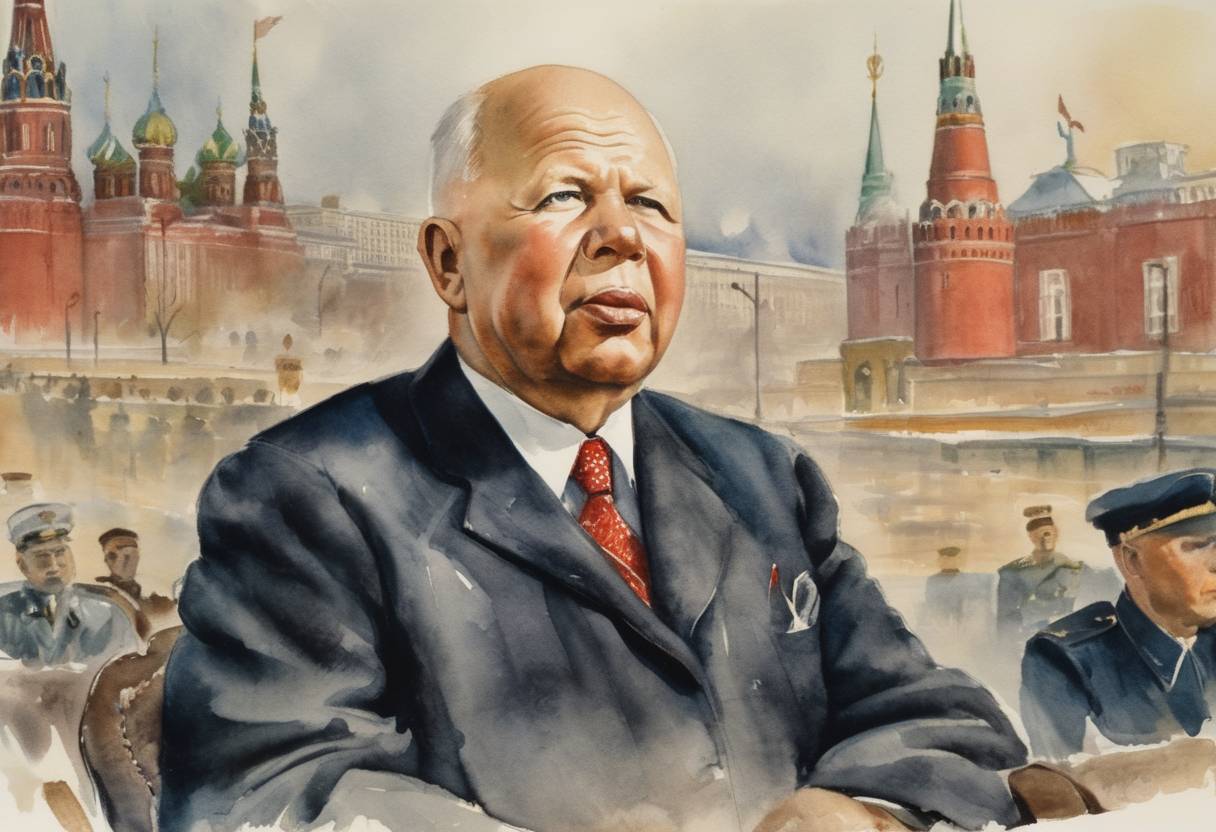
Nikita Khrushchev Appointed General Secretary of the Communist Party
Background
In the aftermath of Joseph Stalin’s death on March 5, 1953, the Soviet Union entered a period of transition and uncertainty. The power vacuum left by Stalin’s authoritarian rule led to a struggle among the top party leaders. Initially, a collective leadership emerged with key figures such as Georgy Malenkov, Lavrentiy Beria, Vyacheslav Molotov, and Nikita Khrushchev vying for influence.
Appointment of Nikita Khrushchev
On September 7, 1953, Nikita Khrushchev was appointed First Secretary of the Communist Party of the Soviet Union. This position, which had undergone various title changes, was the most powerful in the Soviet political hierarchy, effectively making him the leader of the Soviet Union — a significant turning point during the post-Stalin succession battle.
Key Events Leading to His Appointment
- Power Struggle Post-Stalin: After Stalin’s death, there was an immediate power struggle with no clear successor due to Stalin’s preference for a centralized control devoid of obvious heirs.
- Arrest of Beria: Lavrentiy Beria, the head of the Soviet security apparatus, was perceived as a threat due to his control over the secret police. Khrushchev, along with others, orchestrated Beria’s arrest and execution in June 1953, eliminating a significant rival.
- Alliance Building: Khrushchev skillfully built alliances among key party figures and maneuvered politically to consolidate his influence.
Broader Historical Significance
Khrushchev’s ascent marked the beginning of a de-Stalinization process, as he distanced Soviet governance from the repressive policies of Stalin. His tenure saw several pivotal events including:
- The Secret Speech: Delivered in 1956, Khrushchev criticized Stalin’s regime and began a period of liberalization known as “The Thaw.”
- Domestic Reforms: Khrushchev implemented numerous policies aimed at improving living conditions, promoting agricultural reform, and reducing censorship.
- Foreign Policy Challenges: His leadership era was marked by the Cuban Missile Crisis, which brought the world to the brink of nuclear conflict, and the construction of the Berlin Wall in 1961.
Khrushchev’s appointment initiated a period of significant transformation within the Soviet Union, altering its internal dynamics and its role on the global stage.