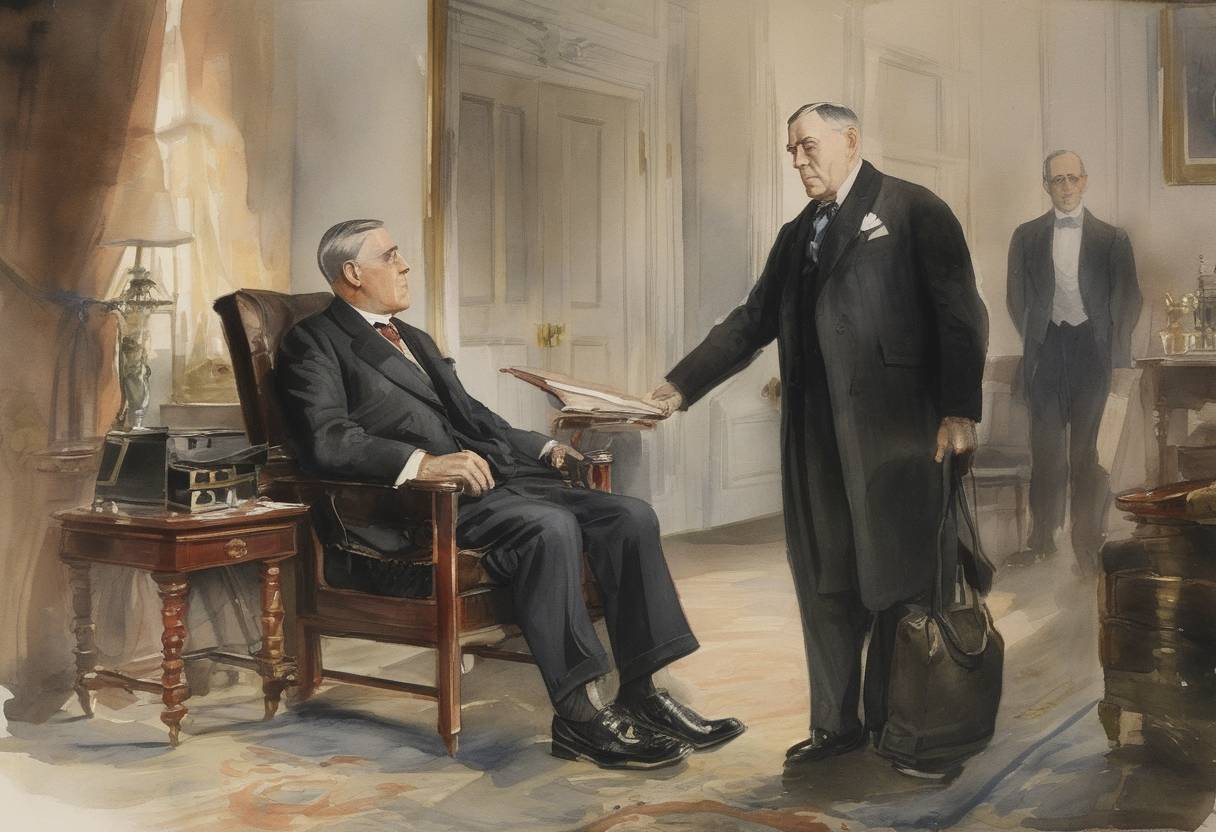
President Woodrow Wilson’s Stroke - October 2, 1919
On October 2, 1919, President Woodrow Wilson suffered a major stroke, an event that significantly impacted his presidency. This debilitating stroke left him partially paralyzed on his left side and impaired his ability to govern effectively for the rest of his term, raising critical questions about presidential succession and the capability to fulfill presidential duties.
Context Leading up to the Stroke
Prior to the stroke, Wilson had been intensely involved in promoting the Treaty of Versailles and the League of Nations. His commitment included a grueling nationwide speaking tour to gather public support, during which his health had visibly deteriorated. Wilson was known to have previously experienced several smaller strokes and suffered from hypertension.
Key Details of the Event
- Health Crisis: The stroke occurred at the White House, and Wilson’s condition was initially kept secret. His wife, Edith Wilson, collaborated with his physician, Dr. Carey Grayson, to manage access to the President and concealed the severity of his condition from his cabinet and the public.
- Impact on Governance: Wilson’s incapacitation led to a de facto regency by Edith Wilson, who screened matters requiring presidential attention and heavily influenced decision-making on his behalf. This unprecedented situation raised concerns about unofficial power exercised by a presidential spouse.
Historical Impact and Consequences
- Succession Issues: The event catalyzed discussions on presidential succession and the necessity for clarity on what should occur if a President is incapacitated. It highlighted flaws in the existing system, eventually contributing to the ratification of the 25th Amendment in 1967.
- League of Nations: Wilson’s incapacitation affected his leadership at a critical time when the U.S. Senate was deliberating the Treaty of Versailles. His inability to directly advocate for the League of Nations contributed to the Senate’s rejection in March 1920.
Legacy
Wilson’s stroke, and the consequent handling of presidential duties, underscored the need for mechanisms to address presidential disability. His health challenges during this period remain a notable case study in the balance of power within the U.S. government’s executive branch and the management of presidential incapacity.