Execution of Thomas Cromwell: July 28, 1540
1540 · London, England
Thomas Cromwell, chief minister to King Henry VIII of England, was executed on charges of treason and heresy.
December 31, 1105
The Concordat of London was agreed upon, where Henry I of England and Anselm, Archbishop of Canterbury, reached an agreement to settle the Investiture Controversy in England, marked by a compromise that allowed bishops to perform homage for their temporalities but keeping investiture as a spiritual act.
London, England | Kingdom of England
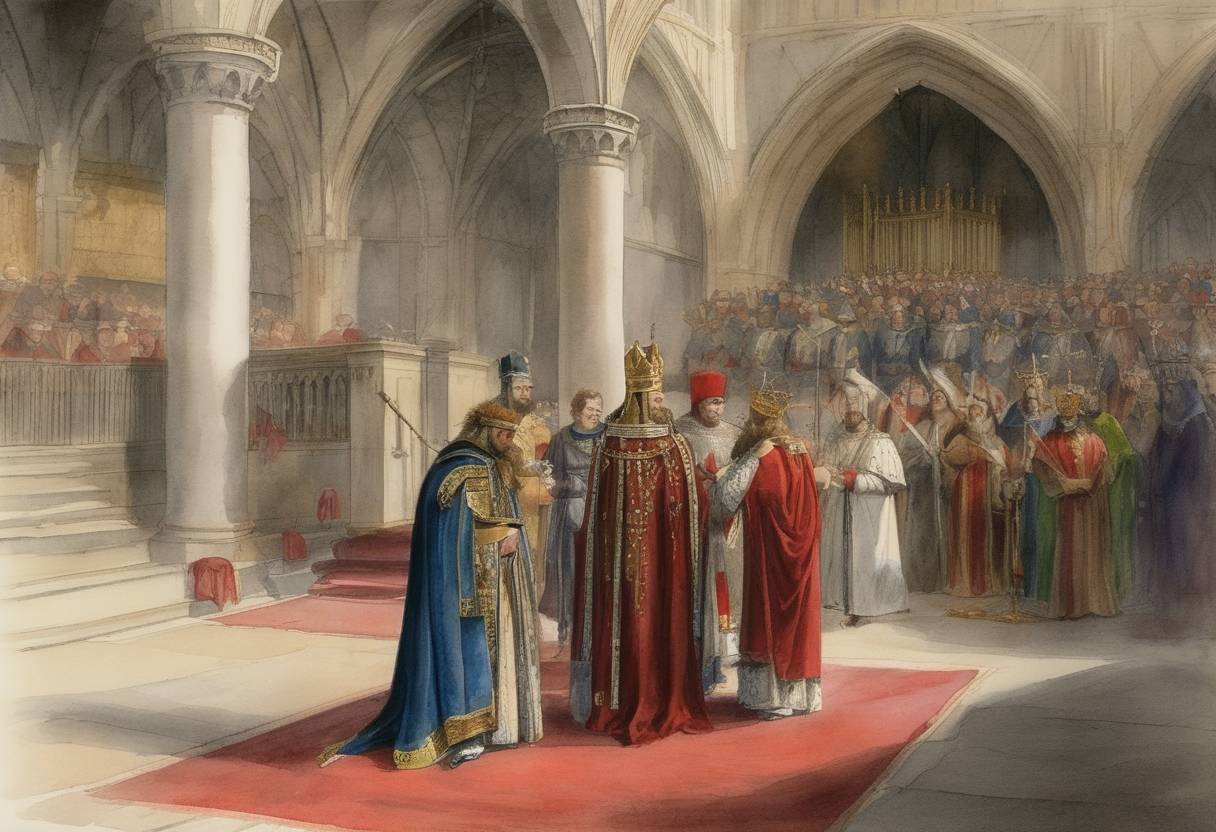
The Concordat of London, a critical moment in the resolution of the Investiture Controversy in England, was agreed upon between King Henry I of England and Anselm, Archbishop of Canterbury, on December 31, 1105. This event marked a significant compromise in the long-standing conflict between ecclesiastical and royal powers over the appointment of bishops and abbots, a dispute that had engulfed much of Europe.
The Investiture Controversy was a major conflict of the 11th and early 12th centuries involving monarchies across Europe and the Papacy. The crux of the controversy was the issue of lay investiture, whereby secular leaders held influence over the appointment of church officials by bestowing them with the symbols of office. The Church argued for the sole right to conduct spiritual investitures.
In England, the disagreement was particularly acute between King Henry I, who sought to maintain royal prerogative over church appointments, and Anselm, a staunch supporter of church reforms and papal authority as promoted by Pope Gregory VII.
The Concordat of London represented a deft compromise to reconcile the competing interests of the church and monarchy:
Homage for Temporalities: Bishops and abbots in England could perform homage to the king for the secular holdings associated with their positions. This act acknowledged the king’s temporal authority and his role in the conferment of land and titles.
Investiture as a Spiritual Act: The investiture of church officials — specifically, the presentation of the ring and staff, symbols of ecclesiastical authority — was confirmed to be a purely spiritual act, reserved for the church’s domain. This effectively separated the spiritual and temporal responsibilities, conceding the point of spiritual supremacy to the Pope and the Church.
The Concordat of London was a pivotal moment that diminished royal control over the church, aligning with broader church reforms that sought to establish ecclesiastical autonomy from secular rule. It set a precedent for future agreements in Europe, notably influencing the Concordat of Worms in 1122 that resolved similar disputes in the Holy Roman Empire.
In England, the agreement helped to stabilize the relationship between the crown and the church, allowing for a more harmonious coexistence and governance. The compromise underscored the gradual shift towards distinct delineation between temporal and spiritual powers in medieval Europe, a transition that would continue to evolve in subsequent centuries.
Source: www.britannica.com