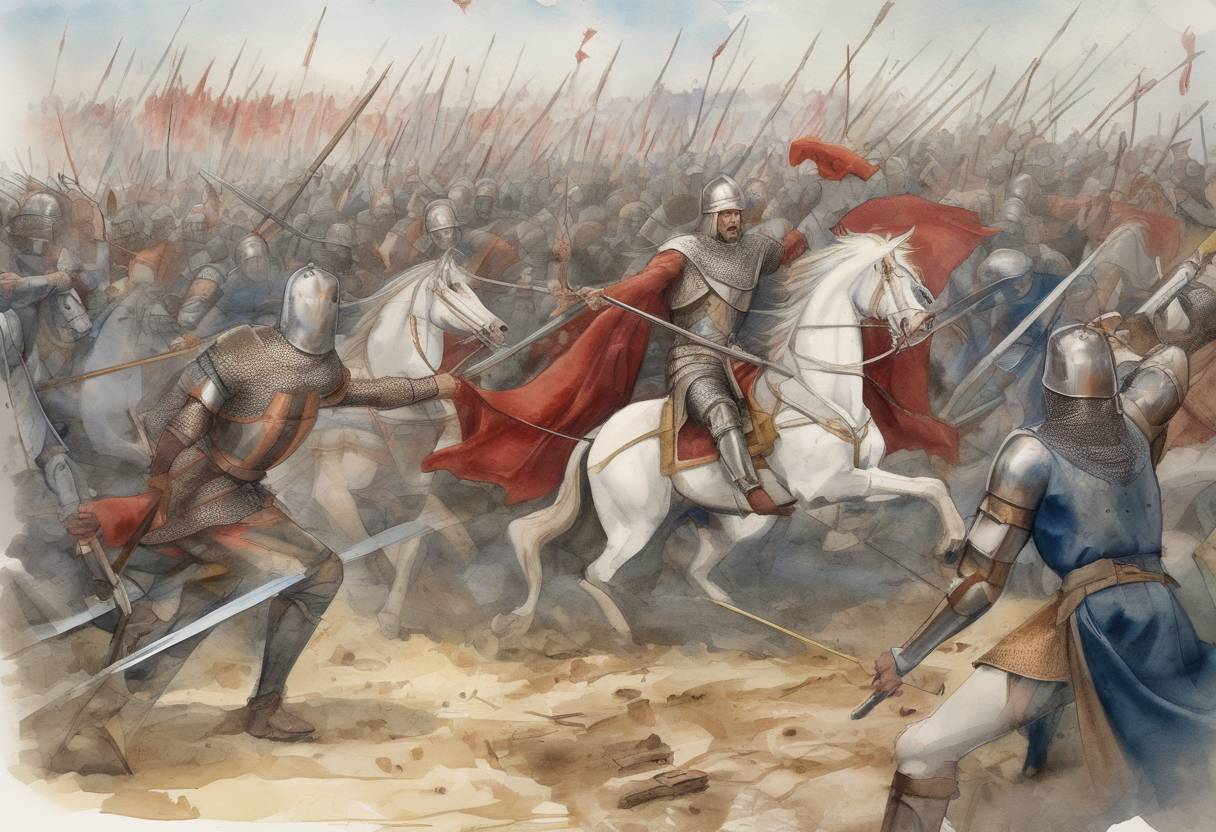
Battle of Compiègne - September 26, 715
On September 26, 715, a pivotal battle took place at Compiègne, which significantly shaped the power dynamics within the Frankish Kingdom. This confrontation saw Charles Martel, a key figure in Frankish history, defeat Ragenfrid, the Mayor of the Palace of Neustria. This victory was instrumental in consolidating Charles Martel’s power, setting the stage for his future dominance and the eventual rise of the Carolingian dynasty.
Background
Frankish Kingdom: During this period, the Frankish Kingdom was divided into several regions, with Neustria and Austrasia being the most prominent. The Mayors of the Palace were powerful officials who often held more influence than the Merovingian kings they served.
Ragenfrid: As the Mayor of the Palace of Neustria, Ragenfrid wielded considerable power. He sought to expand his influence and control over the Frankish territories, often clashing with rival factions.
Charles Martel: Known as “The Hammer,” Charles Martel was the illegitimate son of Pepin of Herstal, the Mayor of the Palace of Austrasia. Following his father’s death, Charles faced opposition from various factions, including Ragenfrid, who sought to diminish his influence.
The Battle
Location: The battle occurred near Compiègne, a strategic location in the Frankish territories.
Forces: Charles Martel led the Austrasian forces, while Ragenfrid commanded the Neustrian army. The battle was part of a broader conflict for control over the Frankish realm.
Outcome: Charles Martel’s forces decisively defeated Ragenfrid’s army. This victory was crucial in establishing Charles’s authority and diminishing Ragenfrid’s power.
Aftermath and Significance
Consolidation of Power: The victory at Compiègne allowed Charles Martel to consolidate his power in Austrasia and extend his influence over Neustria. It marked the beginning of his rise as the de facto ruler of the Frankish Kingdom.
Rise of the Carolingians: Charles Martel’s success laid the groundwork for the Carolingian dynasty, which would eventually replace the Merovingian kings. His grandson, Charlemagne, would go on to become one of the most famous rulers in European history.
Military Reforms: Charles Martel is credited with significant military reforms, including the development of a cavalry-based army, which would prove crucial in future battles, such as the Battle of Tours in 732.
The Battle of Compiègne was a turning point in Frankish history, marking the emergence of Charles Martel as a central figure in the kingdom’s politics and military affairs. His leadership and reforms would have lasting impacts on the structure and power dynamics of medieval Europe.