Discovery of Liquid Water on Mars - September 27, 2015
2015 · Washington, D.C., United States
NASA announced that liquid water was found on Mars, a significant discovery in the search for extraterrestrial life.
November 14, 2008
NASA announced that the Phoenix Mars Lander had confirmed the presence of water ice on Mars.
Pasadena, United States | NASA
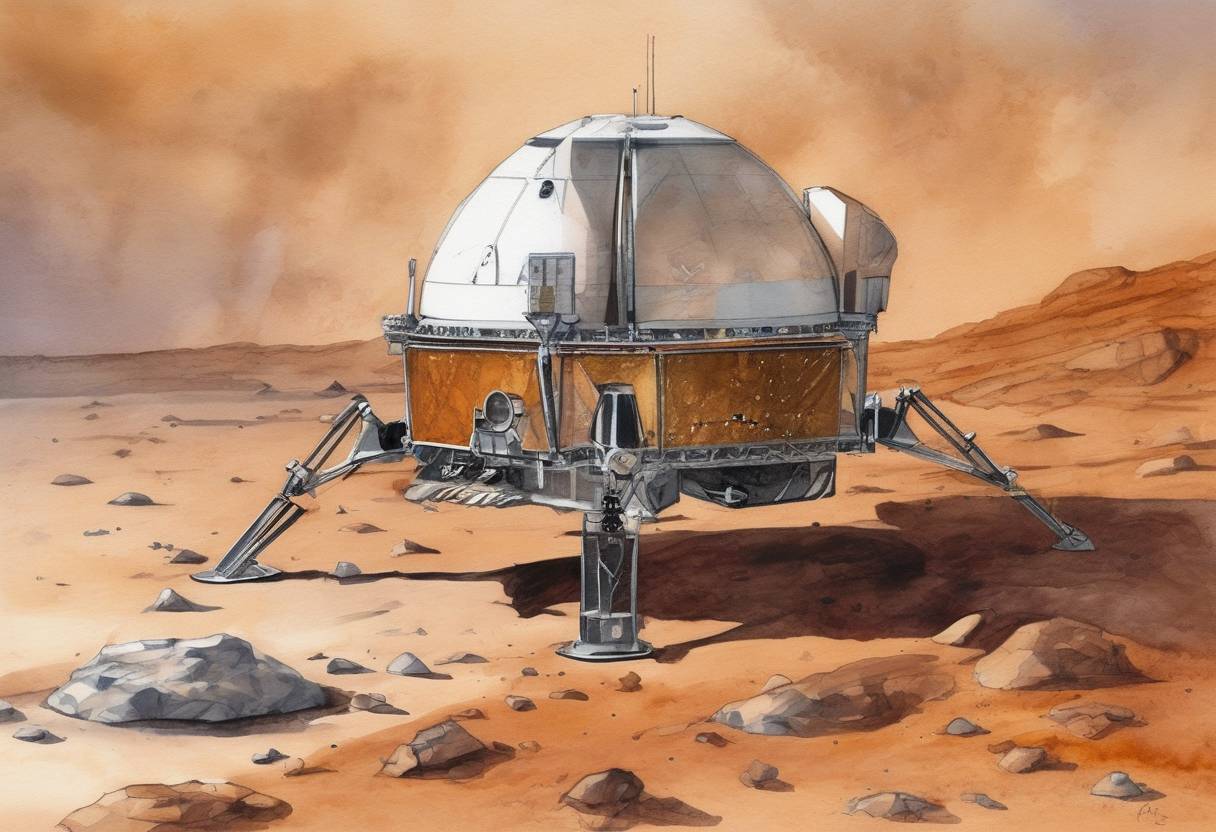
On November 14, 2008, NASA made a groundbreaking announcement that the Phoenix Mars Lander had confirmed the presence of water ice on Mars. This discovery was a significant milestone in planetary science and the ongoing exploration of Mars, providing crucial evidence that the Red Planet had conditions that could have supported life in the past.
The Phoenix Mars Lander was launched on August 4, 2007, and successfully landed on the Martian surface on May 25, 2008. The mission was part of NASA’s Mars Scout Program, designed to study the history of water and habitability potential in the Martian arctic’s ice-rich soil.
Landing and Initial Operations: Upon landing in the Vastitas Borealis, a flat, arctic region on Mars, the Phoenix Lander began its primary mission to dig into the Martian soil and analyze samples.
Soil Analysis: The lander’s robotic arm was used to dig trenches in the Martian soil, revealing bright, white material beneath the surface. Initial observations suggested this could be ice or salt.
Confirmation of Water Ice: The Thermal and Evolved-Gas Analyzer (TEGA) aboard Phoenix heated the samples, releasing water vapor, which confirmed the presence of water ice. This was a direct confirmation, as previous missions had only inferred the presence of ice from remote sensing data.
Implications for Past Life: The presence of water ice suggests that Mars may have had liquid water in the past, a critical ingredient for life as we know it. This discovery fueled further interest in the potential for past microbial life on Mars.
Future Exploration: The confirmation of water ice on Mars has significant implications for future human exploration. Water is a vital resource for sustaining human life and can be used to produce oxygen and fuel.
Scientific Understanding: This finding contributed to our understanding of the Martian climate and geological history, offering insights into the planet’s potential habitability.
Following the confirmation of water ice, the Phoenix mission continued to analyze Martian soil and atmospheric data until the end of its operational life in November 2008. The mission’s success paved the way for subsequent missions, such as the Mars Science Laboratory Curiosity rover and the Mars 2020 Perseverance rover, which continue to explore the planet’s surface and search for signs of past life.
The discovery of water ice on Mars remains a cornerstone in the field of astrobiology and planetary science, highlighting the importance of robotic exploration in expanding our understanding of the solar system.
Source: www.nasa.gov