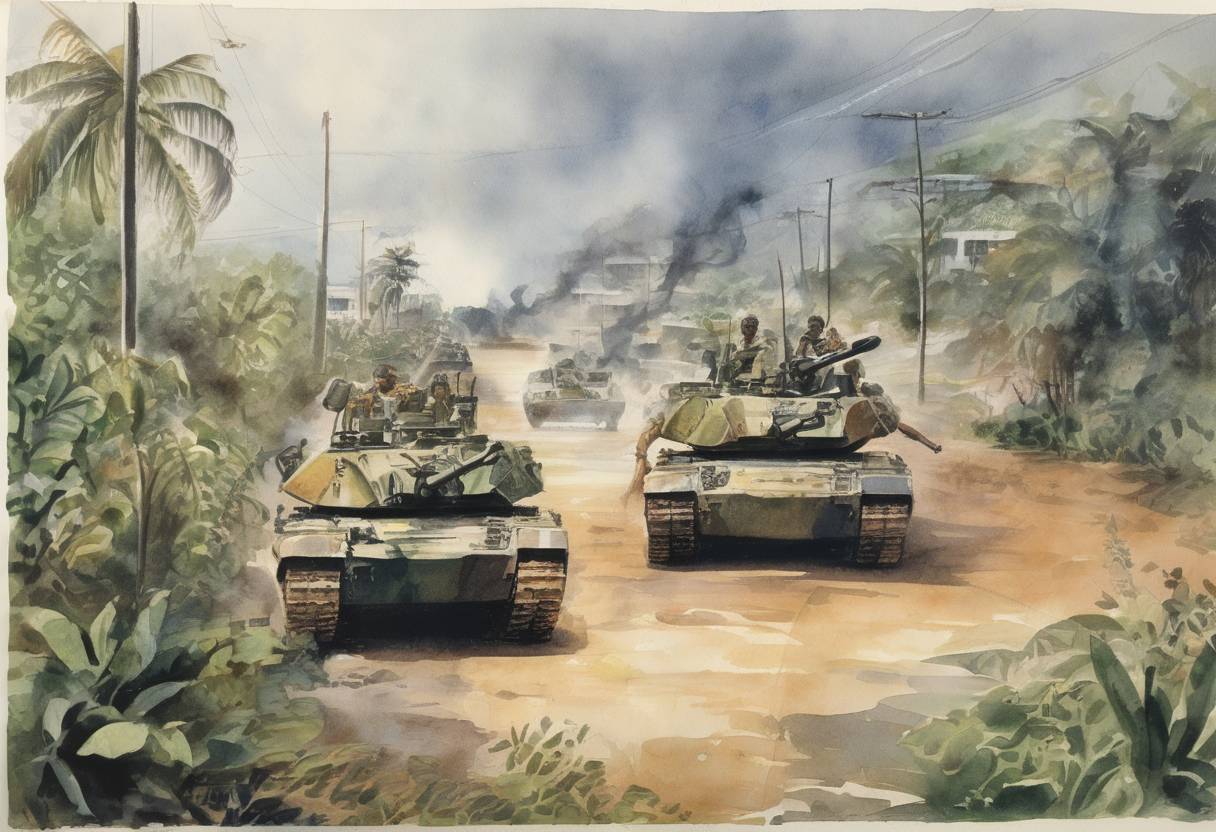
Operation Urgent Fury: The U.S. Invasion of Grenada on October 25, 1983
On October 25, 1983, the United States launched Operation Urgent Fury, a military invasion of the Caribbean island nation of Grenada. This operation was prompted by concerns over the safety of American citizens and the establishment of a Marxist government in Grenada.
Background
Grenada, a small island nation in the Caribbean, gained independence from the United Kingdom in 1974. In 1979, a Marxist-Leninist group led by Maurice Bishop overthrew the government, establishing the People’s Revolutionary Government. Bishop’s government aligned itself with Cuba and the Soviet Union, raising concerns in the United States during the Cold War era.
In October 1983, internal strife within the Grenadian government led to a coup. Bishop was placed under house arrest, and subsequently, he and several of his supporters were executed by a faction led by Deputy Prime Minister Bernard Coard. This turmoil heightened U.S. concerns about the stability of the region and the safety of approximately 600 American medical students studying at St. George’s University in Grenada.
The Invasion
President Ronald Reagan authorized the invasion, citing the need to protect American citizens and restore order. The operation involved approximately 7,600 troops from the United States and a coalition of Caribbean nations, including Jamaica and Barbados. The invasion force quickly overwhelmed Grenadian and Cuban military forces, encountering resistance but ultimately securing key locations, including the Point Salines International Airport.
Outcome and Aftermath
The invasion resulted in the swift defeat of the Grenadian and Cuban forces, and by November 2, 1983, a new government was installed in Grenada. The intervention was controversial; it drew criticism from the United Nations General Assembly, which deemed it a violation of international law. However, the operation was largely supported domestically within the United States, where it was seen as a successful demonstration of American resolve during the Cold War.
In Grenada, the invasion led to the establishment of a democratic government, and the country has since maintained a stable political environment. The event marked a significant moment in U.S. foreign policy, reflecting the Reagan administration’s willingness to use military force to counter perceived communist threats in the Western Hemisphere.
Broader Historical Significance
Operation Urgent Fury highlighted the geopolitical tensions of the Cold War and the U.S. policy of interventionism in the Americas. It underscored the Reagan administration’s commitment to combating the spread of communism and protecting American interests abroad. The invasion also set a precedent for future U.S. military interventions in the region and contributed to the broader discourse on the legality and ethics of such actions on the international stage.