Modern Neon Lighting Demonstration by Georges Claude
1910 · Paris, France
Modern neon lighting was first demonstrated by Georges Claude at the Paris Motor Show.
July 20, 1807
Nicéphore Niépce, a French inventor, received a patent for the Pyréolophore, the world's first internal combustion engine.
Paris, France | French Patent Office
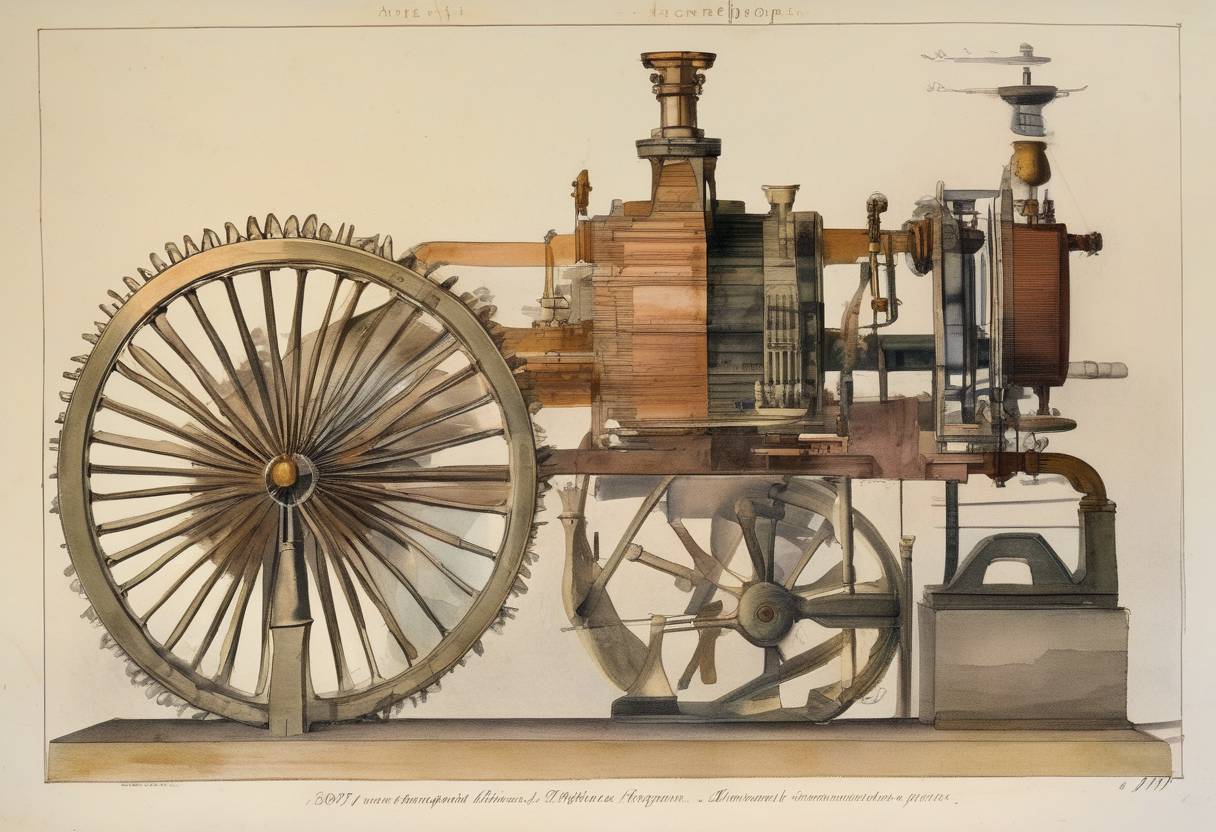
On July 20, 1807, Nicéphore Niépce, along with his brother Claude, received a patent for the Pyréolophore, recognized as the world’s first internal combustion engine. This invention marked a significant milestone in the history of engineering and technology, laying foundational work for the development of modern engines.
Nicéphore Niépce was a French inventor born on March 7, 1765, in Chalon-sur-Saône, France. He is perhaps best known for his pioneering work in photography, but his contributions to engineering are equally noteworthy. The early 19th century was a period of rapid technological advancement, with inventors across Europe experimenting with new forms of power and propulsion.
The Pyréolophore was an innovative engine that operated on the principle of internal combustion. Unlike steam engines, which were prevalent at the time and relied on external combustion, the Pyréolophore used controlled explosions of gas within a cylinder to produce motion. This concept was revolutionary and would eventually lead to the development of more efficient and powerful engines.
The patenting of the Pyréolophore was a crucial step in the evolution of engine technology. Although the engine itself did not achieve widespread use, it introduced the concept of internal combustion, which would be further developed and refined by later inventors such as Étienne Lenoir, Nikolaus Otto, and Karl Benz.
In conclusion, the patent granted to Nicéphore Niépce and his brother for the Pyréolophore on July 20, 1807, represents a landmark achievement in the history of engineering, highlighting the early exploration of internal combustion as a viable source of power.
Source: en.wikipedia.org