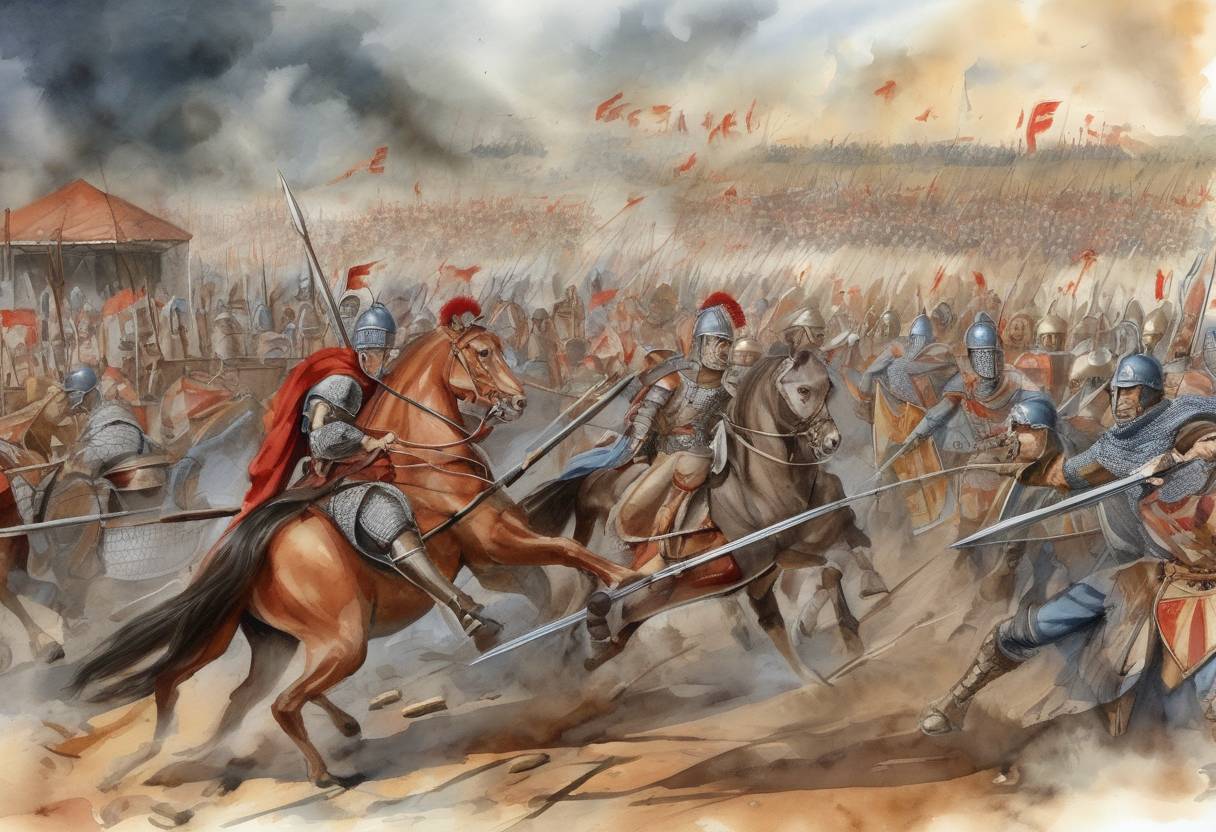
The Battle of Adrianople: August 9, 378
The Battle of Adrianople, fought on August 9, 378, stands as a significant turning point in the history of the Roman Empire. This battle saw the Roman army, led by Emperor Valens, suffer a devastating defeat at the hands of the Visigoths, a Germanic tribe. The consequences of this battle had far-reaching implications, contributing to the eventual decline of the Western Roman Empire.
Context Leading to the Battle
In the late 4th century, the Roman Empire was facing increasing pressure from various barbarian groups along its borders. The Visigoths, originally settled in the region north of the Danube River, sought refuge within the Roman Empire due to pressure from the Huns. In 376, they were allowed to cross the Danube and settle in Roman territory as foederati (allies) under the condition that they would provide military assistance to the Empire.
However, the relationship quickly soured due to mistreatment and exploitation by Roman officials, leading to a Visigothic uprising. The Visigoths, led by Fritigern, began pillaging the Balkan provinces, prompting the Roman Empire to respond militarily.
The Battle
Emperor Valens, eager to assert control and achieve a decisive victory, marched from Constantinople to confront the Visigoths near the city of Adrianople (modern-day Edirne, Turkey). Valens, possibly underestimating the strength of the Visigothic forces and eager to secure a victory without waiting for reinforcements from the Western Roman Emperor Gratian, engaged the Visigoths on August 9, 378.
The Roman forces, numbering between 15,000 to 20,000, faced a Visigothic army of similar size, bolstered by allied contingents of Ostrogoths and other barbarian groups. The battle commenced with the Romans attempting to break the Visigothic wagon circle, a defensive formation. However, the Visigothic cavalry, which had been foraging, returned at a crucial moment, attacking the Roman flanks and causing chaos within their ranks.
The Roman army was encircled and overwhelmed. Emperor Valens himself was killed in the battle, and the Roman forces suffered catastrophic losses, with estimates suggesting that two-thirds of the Roman army were either killed or captured.
Aftermath and Significance
The defeat at Adrianople was a severe blow to the Roman Empire. It exposed the vulnerabilities of the Roman military and marked a shift in the balance of power between the Roman Empire and the barbarian tribes. The loss of a Roman emperor in battle was a rare and demoralizing event, and it left the Eastern Roman Empire in a precarious position.
In the years following the battle, the Visigoths continued to roam and plunder the Balkans, eventually being settled in the Roman Empire as foederati once more. The battle is often cited as a critical moment that foreshadowed the eventual fall of the Western Roman Empire in the 5th century, as it demonstrated the Empire’s inability to effectively manage and integrate the various barbarian groups within its borders.
The Battle of Adrianople is remembered as a pivotal event that highlighted the changing dynamics of power in late antiquity and underscored the challenges faced by the Roman Empire in maintaining its territorial integrity and political stability.