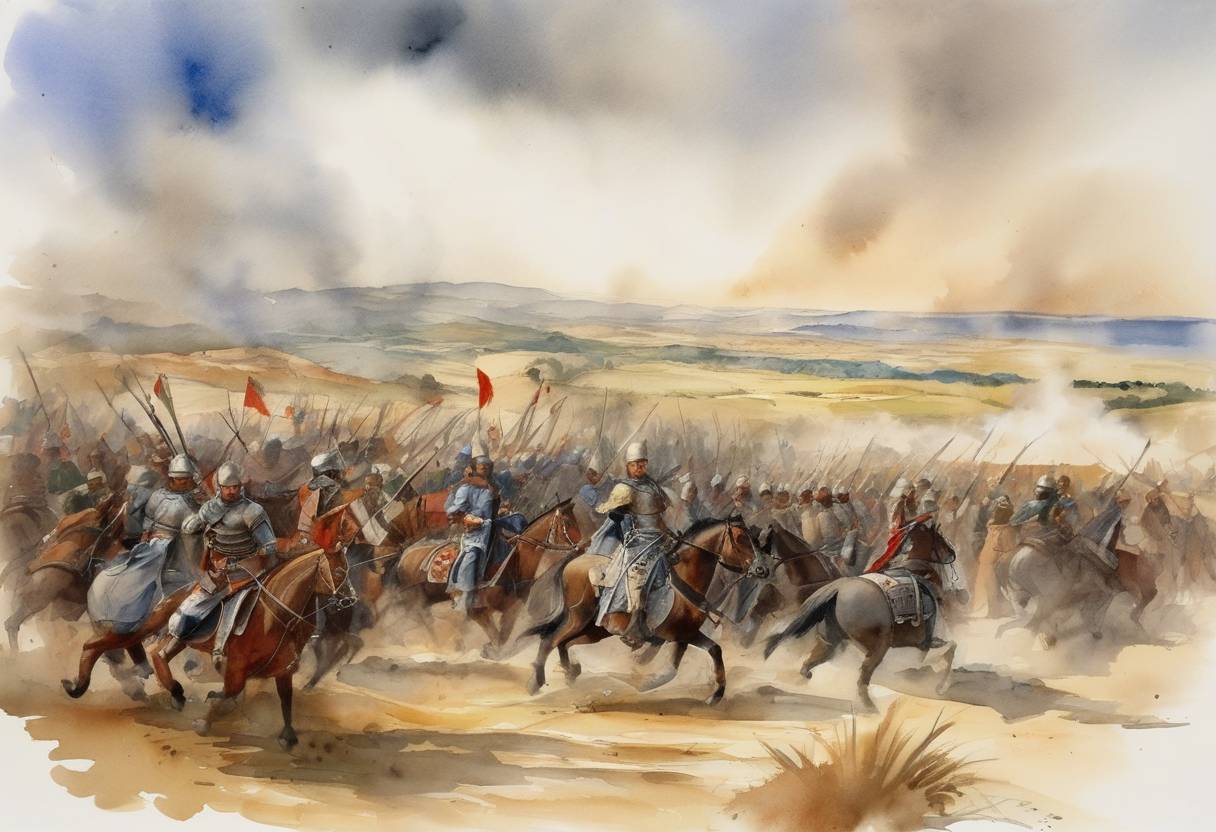
Battle of Río Salado: October 31, 1340
The Battle of Río Salado was a pivotal military engagement fought on October 31, 1340, near Tarifa in the region of Andalusia, southern Spain. This battle marked a decisive victory for the combined forces of Castile and Portugal against the Marinid dynasty of Morocco and their allied Nasrid Kingdom of Granada. This confrontation was significant as it demonstrated the decline of Muslim power on the Iberian Peninsula and was a turning point in the Reconquista efforts by Christian kingdoms.
Context Leading to the Battle
In the early 14th century, the Marinid dynasty, under Sultan Abu al-Hasan Ali, was at the peak of its power in North Africa. The Marinids sought to reassert Islamic influence over the Iberian Peninsula by supporting their Muslim allies, the Nasrids of the Kingdom of Granada. For the Christian kingdoms of Castile and Portugal, this posed a significant threat, as the Marinid incursions into southern Spain threatened to reverse gains made during the earlier phases of the Reconquista.
The Alliance of Castile and Portugal
In response to the Marinid threat, Alfonso XI of Castile sought the support of his neighboring Christian kingdom, Portugal. King Afonso IV of Portugal joined forces with Castile, forming a formidable alliance. This collaboration was crucial in gathering resources and military strength necessary to confront the Marinid and Granadian alliance.
The Battle
The Battle of Río Salado unfolded near the Salado River, close to Tarifa. The Christian coalition, effectively led by Alfonso XI and Afonso IV, consisted of knights, infantry, and archers, equipped with superior European armament and tactics. On the other hand, the Marinid and Nasrid forces, commanded by Sultan Abu al-Hasan, were experienced in desert warfare and had a significant cavalry component, which they hoped would give them an edge.
Despite the Marinid’s initial tactical advantage in cavalry, the battle tilted in favor of the Christians due to the effective use of terrain, superior coordination between Portuguese and Castilian forces, and their strategic use of infantry. The Christian forces managed to rout their Muslim opponents, inflicting heavy casualties and forcing the Marinid Sultan to retreat.
Aftermath and Significance
The victory at Río Salado marked the end of the last major Muslim invasion of the Iberian Peninsula. This battle not only secured Christian dominance in southern Spain but also bolstered the morale and ideological confidence of the Christian kingdoms during the Reconquista. For the Marinid dynasty, the defeat signified a decline in influence, and they were unable to stage another significant military campaign into Europe.
This triumph also paved the way for further territorial consolidation and unification efforts among Iberian Christian kingdoms, ultimately culminating in the eventual fall of Granada in 1492 and the completion of the Reconquista. The battle underscored the shifting balance of power in Iberia and the increasing effectiveness and cooperation among Christian states in repelling external threats.