Hosni Mubarak's Resignation: February 11, 2011
2011 · Cairo, Egypt
Egyptian President Hosni Mubarak resigned after 18 days of mass protests, ending his 30-year rule.
April 18, 1954
Gamal Abdel Nasser seizes power in Egypt, beginning a new era of military leadership in the country. His leadership marked the end of British military presence and the start of widespread reforms in Egypt.
Cairo, Egypt | Egyptian Government
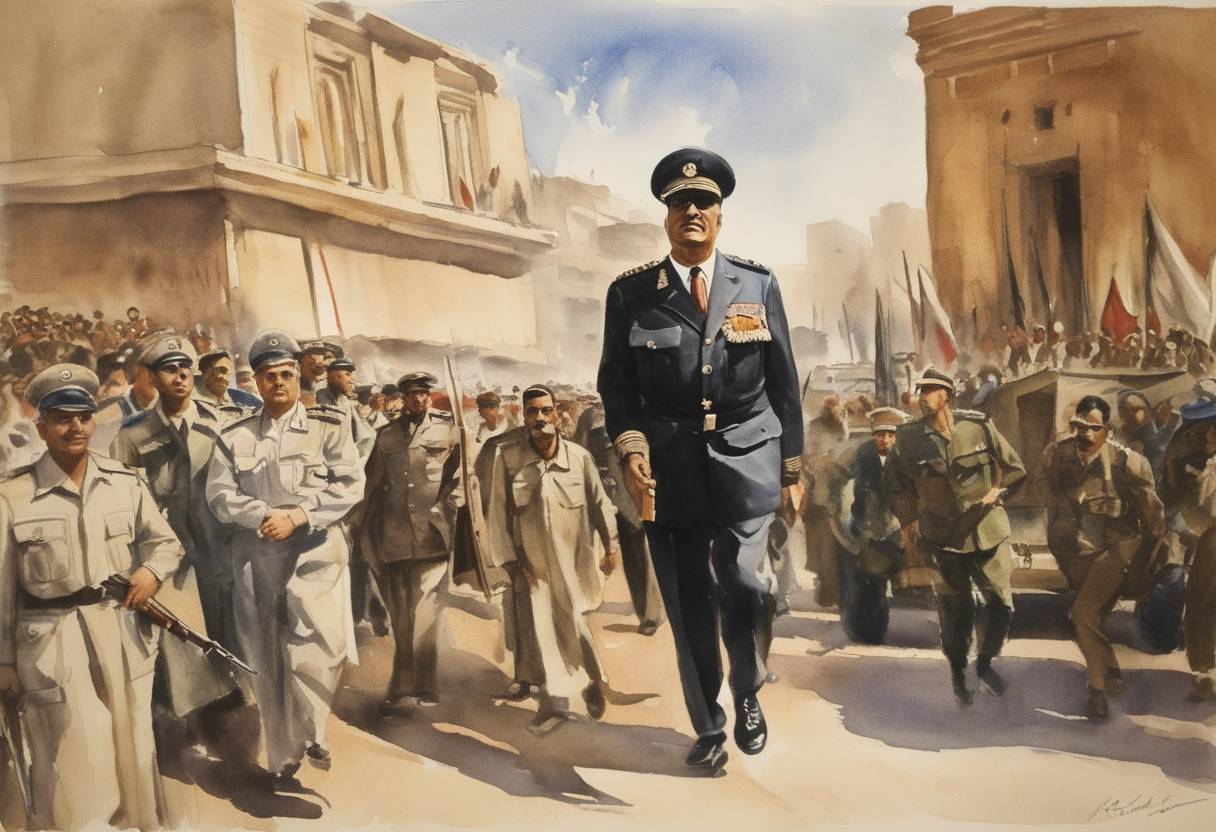
On April 18, 1954, Gamal Abdel Nasser decisively consolidated his power in Egypt, marking a significant shift towards military leadership in the country. This came after a series of political maneuvers where Nasser, then a leading figure of the Free Officers Movement, effectively sidelined President Muhammad Naguib. The day cemented Nasser’s status as the de facto leader of Egypt, setting the stage for his presidency and the transformation of Egypt’s political landscape.
In 1952, a group of young military officers known as the Free Officers Movement, led by then-Colonel Nasser, orchestrated a coup d’état that ended the monarchy of King Farouk I, which had been tainted by corruption and plagued by national indignities under colonial influence. Initially, General Muhammad Naguib served as the first President of the Republic of Egypt following the revolution. However, tensions between Naguib and Nasser began to surface over different visions for Egypt’s future.
By April 1954, Nasser had outmaneuvered Naguib and his supporters following a brief power struggle. Rapid political developments culminated on April 18th with Nasser taking control of the government machinery and effectively neutralizing potential opposition, thereby beginning his direct rule. Nasser’s ascent marked a shift toward military-led governance, emphasizing pan-Arabism, and social reform.
Nasser’s effective takeover led to the expulsion of British troops from the Suez Canal Zone in 1956, a move symbolic of Egypt’s reclaiming sovereignty after decades of British military and political presence. Under Nasser, Egypt embarked on ambitious social reforms, including agrarian reform to alleviate rural poverty, nationalization of key industries, and the promotion of Arab nationalism.
Moreover, Nasser’s leadership set a precedent for military influence in Egyptian politics that would resonate for decades. His policies and charisma not only influenced domestic politics but also positioned Egypt as a prominent leader in the Middle East and on the world stage.
Gamal Abdel Nasser’s assumption of power represented a turning point that had far-reaching implications for Egypt and the Arab world. While his era was marked by significant achievements in terms of modernizing Egypt and asserting its independence, it also witnessed authoritarian control and stifled political dissent. Nasser’s leadership style and vision profoundly shaped modern Egyptian identity and influenced the wider Arab nationalist movements during the 20th century.
Source: www.britannica.com