Northwest Airlines Flight 255 Crash - August 16, 1987
1987 · Detroit, United States
Northwest Airlines Flight 255 crashed shortly after takeoff from Detroit Metropolitan Airport, killing 154 of the 155 people on board.
August 2, 1985
Delta Air Lines Flight 191 crashed while approaching Dallas/Fort Worth International Airport due to a microburst-induced wind shear, killing 137 people.
Dallas, United States | Delta Air Lines
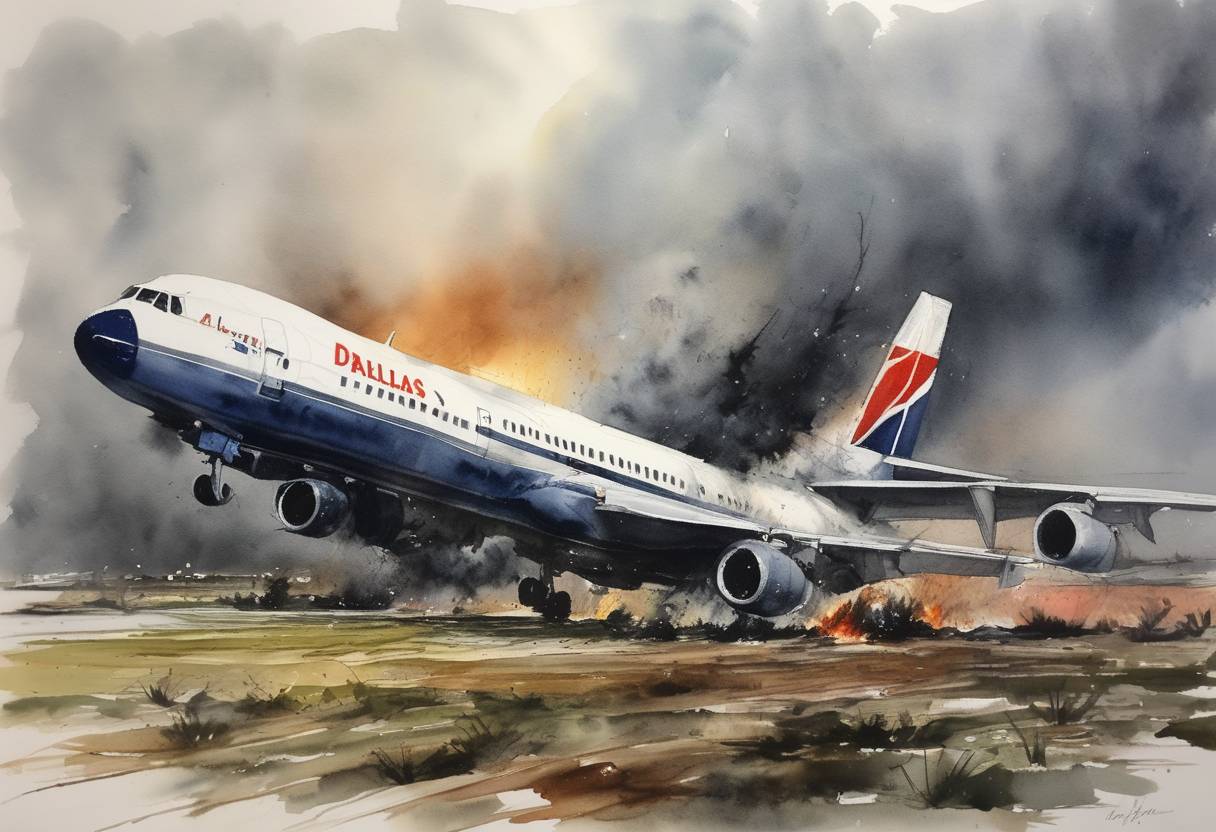
On August 2, 1985, Delta Air Lines Flight 191, a Lockheed L-1011-385-1 TriStar, experienced a catastrophic crash while approaching Dallas/Fort Worth International Airport (DFW). The crash resulted due to a microburst-induced wind shear, claiming the lives of 137 people, including passengers and crew.
Flight 191 departed from Fort Lauderdale-Hollywood International Airport in Florida with a planned stopover at DFW before continuing to Los Angeles International Airport. The aircraft had 152 people on board, including 152 occupants and 11 crew members.
As Flight 191 was on its final approach to DFW, it encountered severe weather conditions. Unbeknownst to the flight crew, a microburst—a sudden and powerful downdraft associated with thunderstorms—was present along the flight path. Despite the aircraft’s advanced technology, at the time, effective predictive measures or detection for such weather phenomena were limited.
At approximately 6:05 PM CDT, the aircraft encountered the microburst-induced wind shear just 6 miles from the runway. The intense downdrafts and sudden wind shifts caused the aircraft to lose lift dramatically. The pilots attempted to regain control; however, the varying airspeed and direction overwhelmed their efforts.
The aircraft hit an open field north of the airport perimeter, striking a car on State Highway 114 and two above-ground water tanks before breaking apart and catching fire.
The crash investigation was carried out by the National Transportation Safety Board (NTSB). Their report identified the microburst-induced wind shear as the primary cause of the crash. It also noted that challenges in alerting flight crews to such weather patterns played a significant role.
This disaster was pivotal in improving aviation safety protocols. It led to extensive research into weather phenomena, advancements in onboard weather radar systems, and the implementation of ground-based Doppler weather radar systems, which are now standard for detecting wind shear conditions.
The crash of Flight 191 highlighted the critical need for better understanding and communication of meteorological hazards in aviation, prompting ongoing enhancements in weather prediction and pilot training to better manage similar scenarios.
The tragedy of Delta Air Lines Flight 191 remains a somber reminder of the impact of severe weather on aviation. It significantly influenced safety measures and technological advancements, ultimately contributing to safer air travel by ensuring pilots have the tools and knowledge to detect and respond to sudden atmospheric changes effectively.
Source: www.ntsb.gov