Henry IV Crowned King of France
1594 · Chartres, France
Henry IV is crowned King of France at the Cathedral of Chartres.
November 13, 1474
Henry IV of Castile dies, leading to a succession crisis in Castile and the start of the War of the Castilian Succession.
Madrid, Spain | Crown of Castile
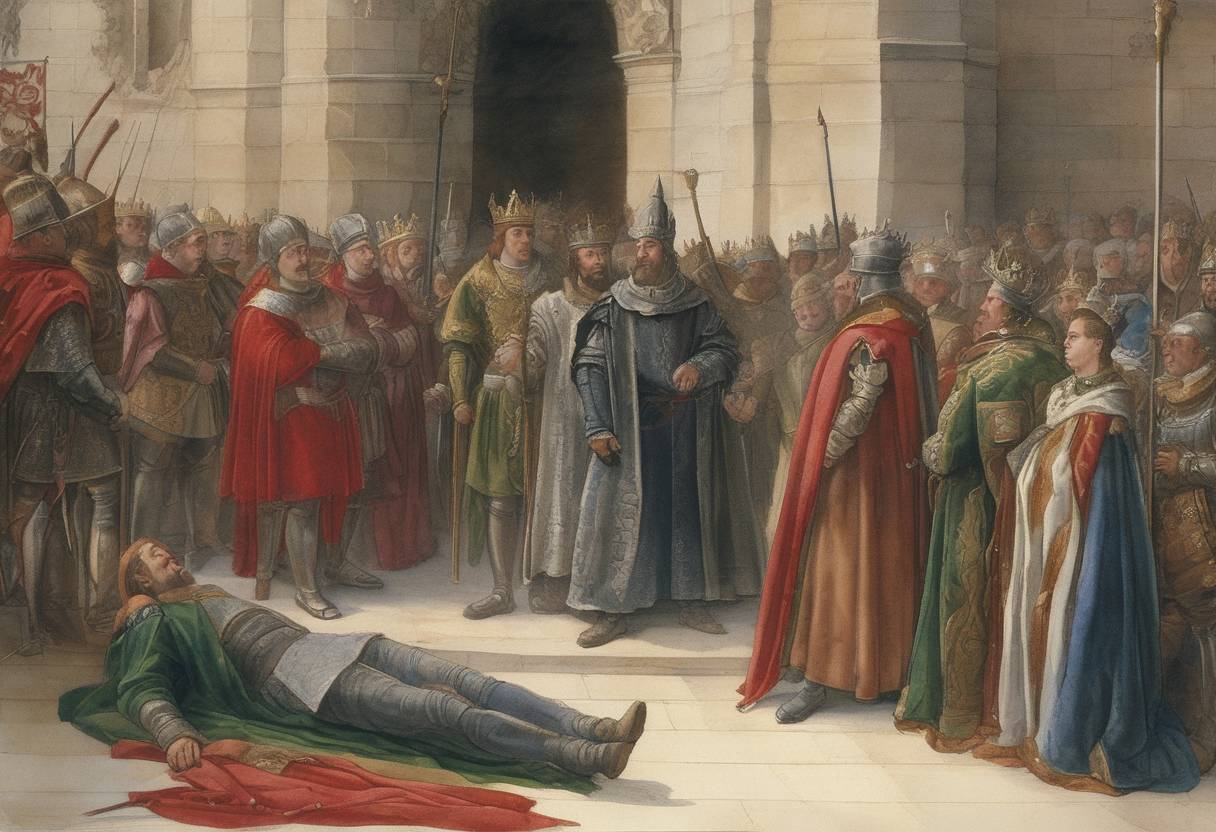
On November 13, 1474, King Henry IV of Castile, a contentious and often contested ruler, passed away. His death precipitated a significant political crisis and eventually led to the War of the Castilian Succession, a conflict that would shape the future of the Iberian Peninsula.
Henry IV, often referred to as “Henry the Impotent,” ascended to the Castilian throne in 1454. His reign was marred by instability, stemming from internal strife, weak leadership, and his controversial marriage. His failure to produce a male heir added to the tensions within the kingdom. Henry had a daughter, Joan, known as “La Beltraneja,” whose legitimacy was widely disputed due to suspicions surrounding her birth. As a result, the question of succession loomed large over his reign.
Upon Henry’s death on November 13, 1474, a fierce dispute erupted over the rightful heir to the throne. Two main factions emerged:
Supporters of Joan: This faction, primarily comprising Castilian nobles loyal to Henry IV, supported the claim of his daughter, Joan. They argued that despite the controversies, Joan was the legitimate successor.
Supporters of Isabella: Opposing Joan’s claim were the proponents of Isabella, Henry’s half-sister. Isabella was supported by powerful nobles, and her recent marriage to Ferdinand of Aragon in 1469 strengthened her position, promising the potential for unification between Castile and Aragon.
The succession crisis quickly escalated into a full-blown conflict, known as the War of the Castilian Succession (1475-1479). The war not only involved domestic factions but also saw the intervention of external powers, with Portugal backing Joan and France also supporting her cause against the combined dynastic aspirations of Ferdinand and Isabella.
The conflict concluded with the Treaty of Alcáçovas in 1479. This treaty recognized Isabella and Ferdinand as the de facto rulers of Castile, while Joan, pressured by the outcome, retired to a convent. The resolution of the succession crisis had far-reaching implications:
Unification of Spain: The marriage and joint rule of Isabella and Ferdinand laid the groundwork for the eventual unification of Spain, as they consolidated their power and embarked on a series of reforms and expansions.
Colonial Expansion: The marriage and subsequent resolution fortified Spain, allowing the monarchs to focus resources on expeditions, most notably sponsoring Christopher Columbus’s voyage in 1492, which opened the New World to European exploration and colonization.
The events following Henry IV’s death were pivotal, influencing the political landscape of Spain and Europe in the late 15th century and beyond.
Source: en.wikipedia.org