Capture of Breda - May 14, 1590
1590 · Breda, Netherlands
Maurice of Nassau captures the city of Breda from the Spanish in the Eighty Years' War.
April 6, 1580
One of the Ten Days Misunderstanding during the Eighty Years' War: the Spanish army, led by Alexander Farnese, captured Kortrijk.
Kortrijk, Spanish Netherlands | Spanish Empire
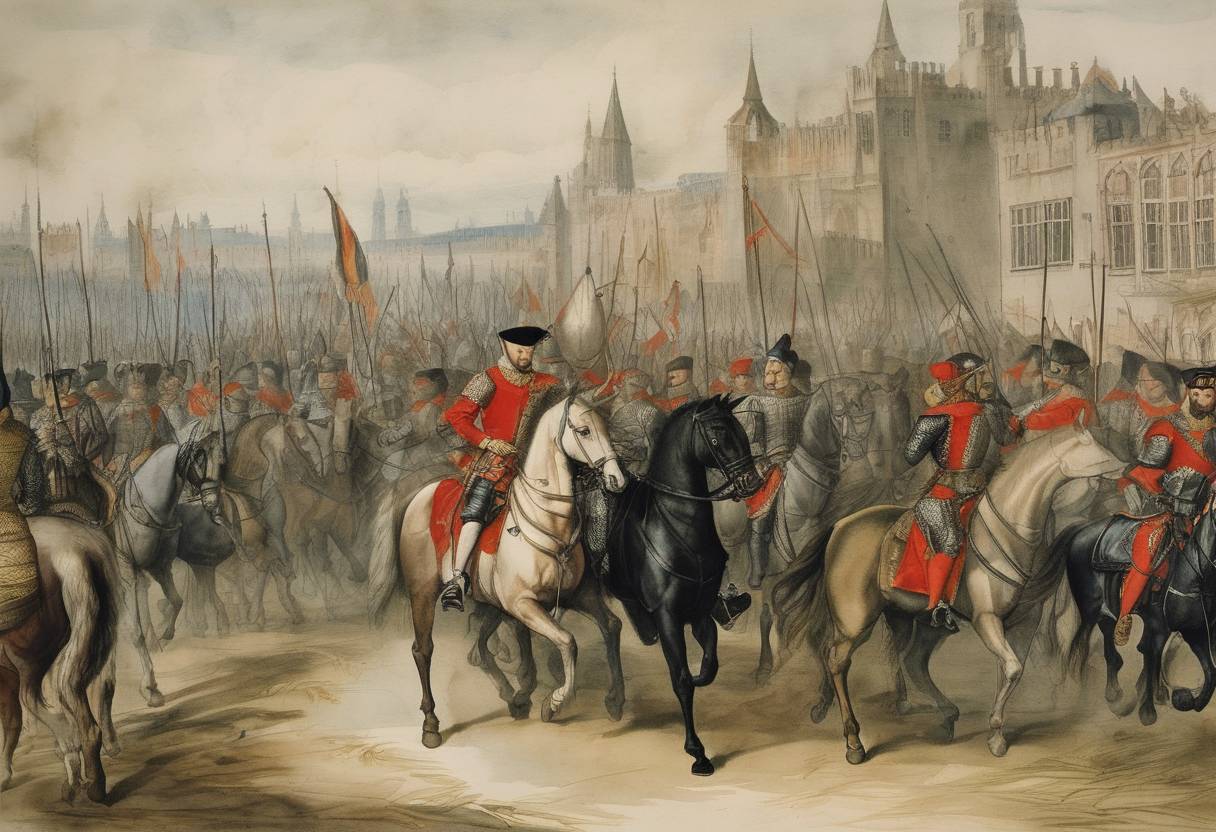
On June 4, 1580, during the Eighty Years’ War, the Spanish forces led by Alexander Farnese, Duke of Parma, successfully captured the city of Kortrijk in present-day Belgium. This event occurred during the broader conflict between the Spanish crown and the Dutch provinces seeking independence.
The Eighty Years’ War, which started in 1568, was a protracted struggle between the Spanish Empire and the provinces of the Habsburg Netherlands. The conflict arose from tensions due to religious and political grievances against Spanish rule. The Dutch sought independence and freedom from Catholic Spanish control, while the Spanish aimed to retain their territories and spread Catholicism.
Before the capture of Kortrijk, Alexander Farnese was appointed Governor of the Spanish Netherlands in 1578. Tasked with regaining control over rebellious provinces, Farnese implemented military campaigns and strategic sieges with remarkable effectiveness.
Kortrijk, located in the County of Flanders, was strategically significant due to its position near the French border. The capture was part of Farnese’s campaign to reclaim territories under the Union of Utrecht, which aligned with the Dutch cause for independence.
On June 4, 1580, Farnese’s forces swept into Kortrijk. Despite the formidable defense mounted by the city’s garrison, the Spanish troops managed to overcome the defenses, leading to a decisive victory. This capture was a tactical maneuver, allowing the Spanish to control a crucial part of Flanders.
The capture of Kortrijk exemplified Farnese’s effective military leadership. His campaigns significantly impacted the momentum of the Eighty Years’ War, temporarily halting the Dutch drive for independence in some regions. The victory at Kortrijk, in particular, reinforced Spanish control over Flanders, thereby strengthening their strategic position.
In the broader context, while Spanish forces gained territorial control, such victories often came with increased resistance and resentment among the local populace. These tensions continued to fuel the protracted struggle that would last until the de facto independence of the northern provinces, ultimately recognized in the Treaty of Westphalia in 1648.
The capture of Kortrijk therefore stands as a testament to the ebb and flow of territorial gains during the Eighty Years’ War, illustrating the complexities and local resistances within the larger narrative of Dutch rebellion and European warfare.
Source: en.wikipedia.org