Assassination of Yitzhak Rabin - November 4, 1995
1995 · Tel Aviv, Israel
Israeli Prime Minister Yitzhak Rabin is assassinated by a right-wing Israeli radical after a peace rally in Tel Aviv.
September 28, 1995
Israeli Prime Minister Yitzhak Rabin and PLO Chairman Yasser Arafat signed a pact to expand Palestinian self-rule in the West Bank.
Washington, D.C., United States | Israel, Palestinian Liberation Organization
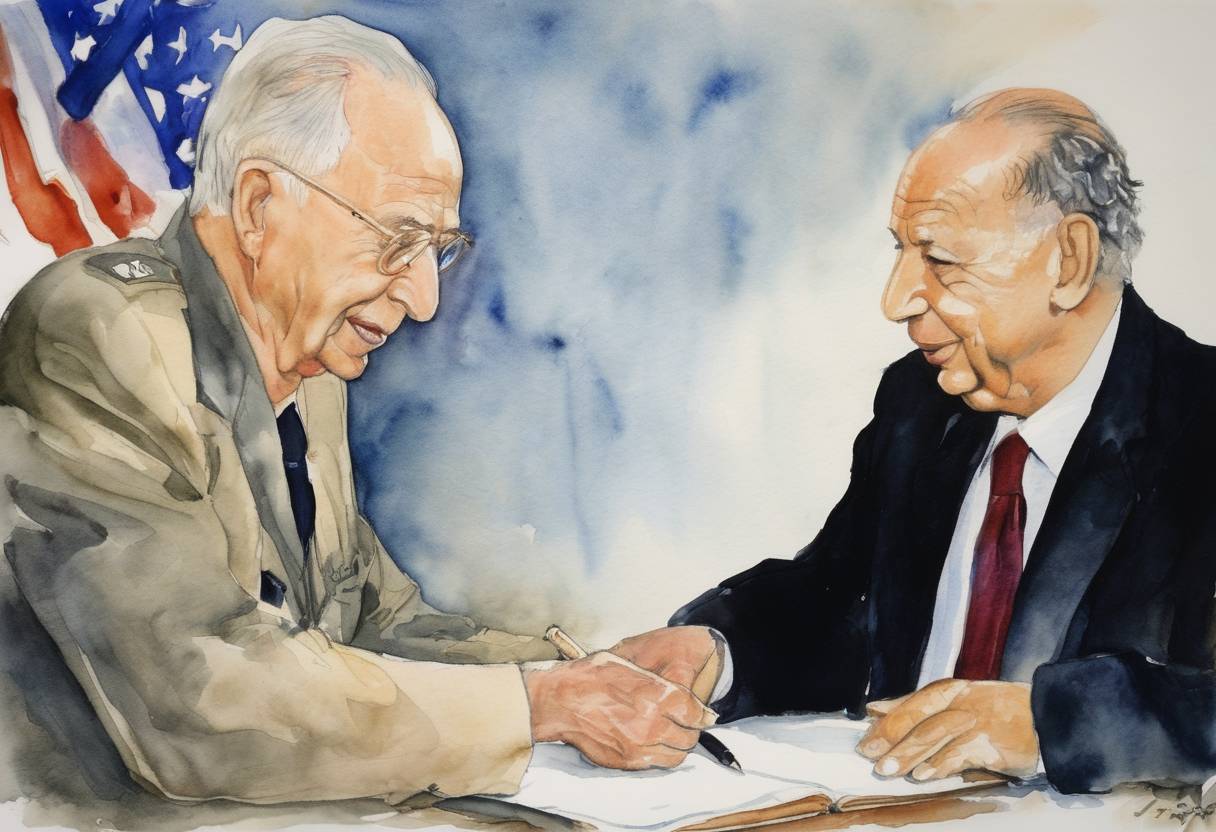
On September 28, 1995, a significant step towards peace in the Middle East occurred when Israeli Prime Minister Yitzhak Rabin and Palestine Liberation Organization (PLO) Chairman Yasser Arafat signed the Israeli-Palestinian Interim Agreement on the West Bank and the Gaza Strip, often referred to as Oslo II, in Washington, D.C.
This accord was a continuation of the peace process initiated by the Oslo Accords, signed in 1993. The initial Oslo Accords established principles for peace but required further agreements to detail the implementation processes. Oslo II aimed to expand Palestinian self-rule in the West Bank, building on the framework laid by the initial accords to further the goal of a two-state solution.
Transfer of Powers: The agreement outlined the transfer of various civil powers and responsibilities from the Israeli military government to the newly established Palestinian Authority (PA), covering areas such as education, health, social welfare, and taxation.
Territory Segmentation: The West Bank was divided into three zones:
Elections and Governance: Provisions for Palestinian elections were included to enable the democratic selection of representatives, enhancing political autonomy within the defined areas.
Palestinian Council Establishment: The agreement facilitated the establishment of a Palestinian Council to assume governance on domestic issues.
The Oslo II Accord was critical in enhancing Palestinian self-governance and was a landmark in Israeli-Palestinian relations. However, the agreement faced significant challenges:
Despite its challenges, the agreement was a pivotal event in the peace process, symbolizing hope for a peaceful coexistence and establishing a precedent for future negotiations.
Source: www.britannica.com