1555 · Augsburg, Holy Roman Empire
The Peace of Augsburg was signed, ending the conflict between Catholic and Lutheran rulers in the Holy Roman Empire.
November 29, 1530
The first time the Protestant confession was presented to Holy Roman Emperor Charles V in the Diet of Augsburg. It was a crucial event in the Protestant Reformation, marking a formal presentation of the beliefs that would form Lutheran doctrine.
Augsburg, Holy Roman Empire | Protestants, Holy Roman Emperor's Diet
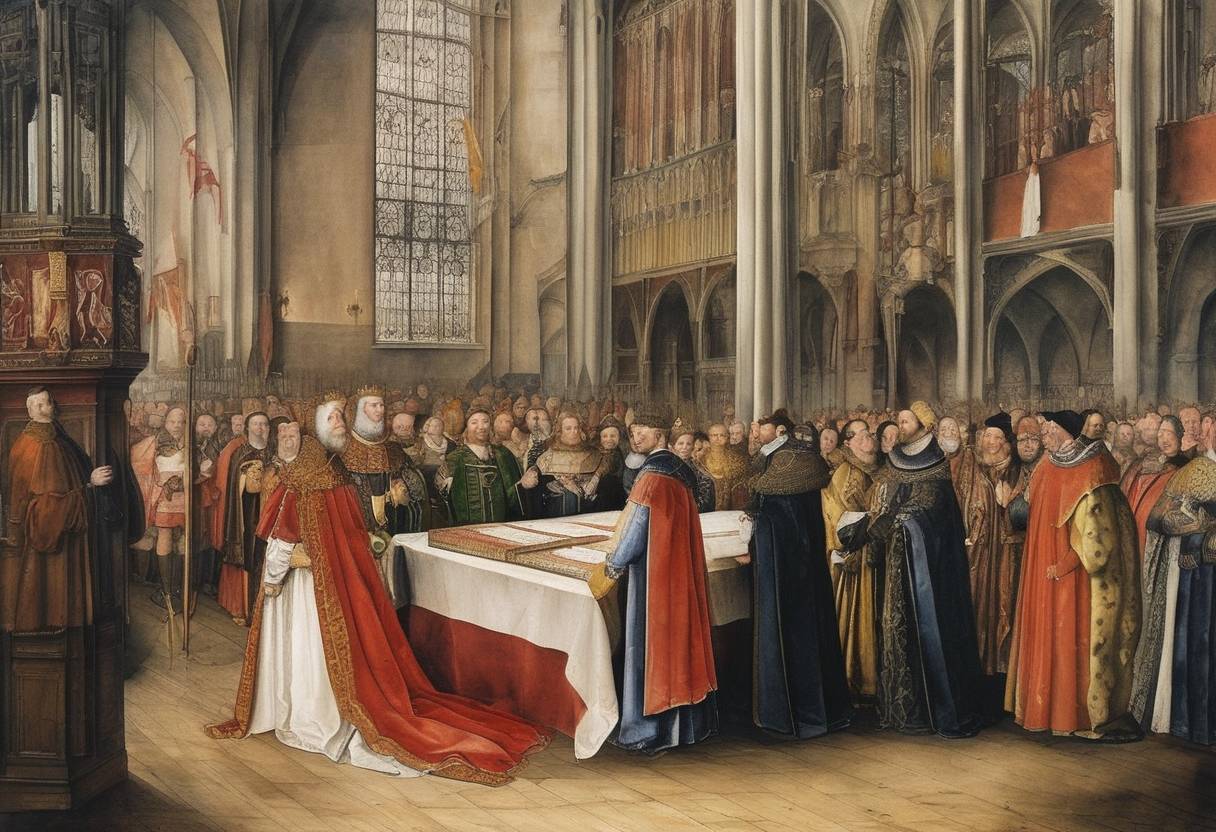
The Protestant Confession at the Diet of Augsburg occurred on June 25, 1530, rather than November 29, 1530. Here is an account of the event based on the accurate date:
The Augsburg Confession marked a pivotal moment in the Protestant Reformation. On June 25, 1530, a formal statement of Lutheran beliefs was presented to Emperor Charles V of the Holy Roman Empire at the Diet of Augsburg. This event was crucial in delineating the doctrines of the nascent Protestant movement and presented an organized response to Catholic criticisms.
The early 16th century was a period of intense religious turmoil and transformation across Europe. Martin Luther’s 1517 Ninety-Five Theses had set off a movement that challenged the doctrines and practices of the Catholic Church. By 1530, tensions had escalated as various principalities and regions within the Holy Roman Empire embraced reformist ideas. The Emperor, seeking to unify his realm in the face of external threats, particularly from the Ottoman Empire, called the Diet of Augsburg to address the religious schism and present a united front.
The Augsburg Confession was primarily drafted by Philipp Melanchthon, a close associate of Martin Luther. Comprising 28 articles, it was carefully constructed to articulate Lutheran doctrines while addressing Catholic criticisms. The Confession covered fundamental theological points such as justification by faith, the nature of the sacraments, and the role of Church authority. Its tone was conciliatory, seeking to highlight Christian commonalities and foster dialogue.
On June 25, the confession was publicly read before the Emperor and the Diet. The reading took place in the spacious assembly hall of the Episcopal Palace of Augsburg, attended by numerous princes, theologians, and officials. The Lutherans hoped to present a moderate stance that could be accepted by the Emperor, emphasizing their loyalty to the Empire while clarifying their religious convictions.
The presentation of the Augsburg Confession was a watershed in the Reformation. Although Charles V was not swayed and the Confession did not result in immediate reconciliation with the Catholic Church, it effectively solidified Lutheranism’s distinct identity within Christendom. It became a foundational document for the Lutheran Church, encapsulating the theological essence of the Reformation.
Subsequent efforts at reconciliation were largely unsuccessful, ultimately leading to the Schmalkaldic War and the establishment of the Peace of Augsburg in 1555, which acknowledged the Protestant faith’s legitimacy within the Holy Roman Empire.
The Augsburg Confession remains a central document, symbolizing the Protestant movement’s intellectual and theological rigor and its enduring impact on Christianity.
Source: en.wikipedia.org