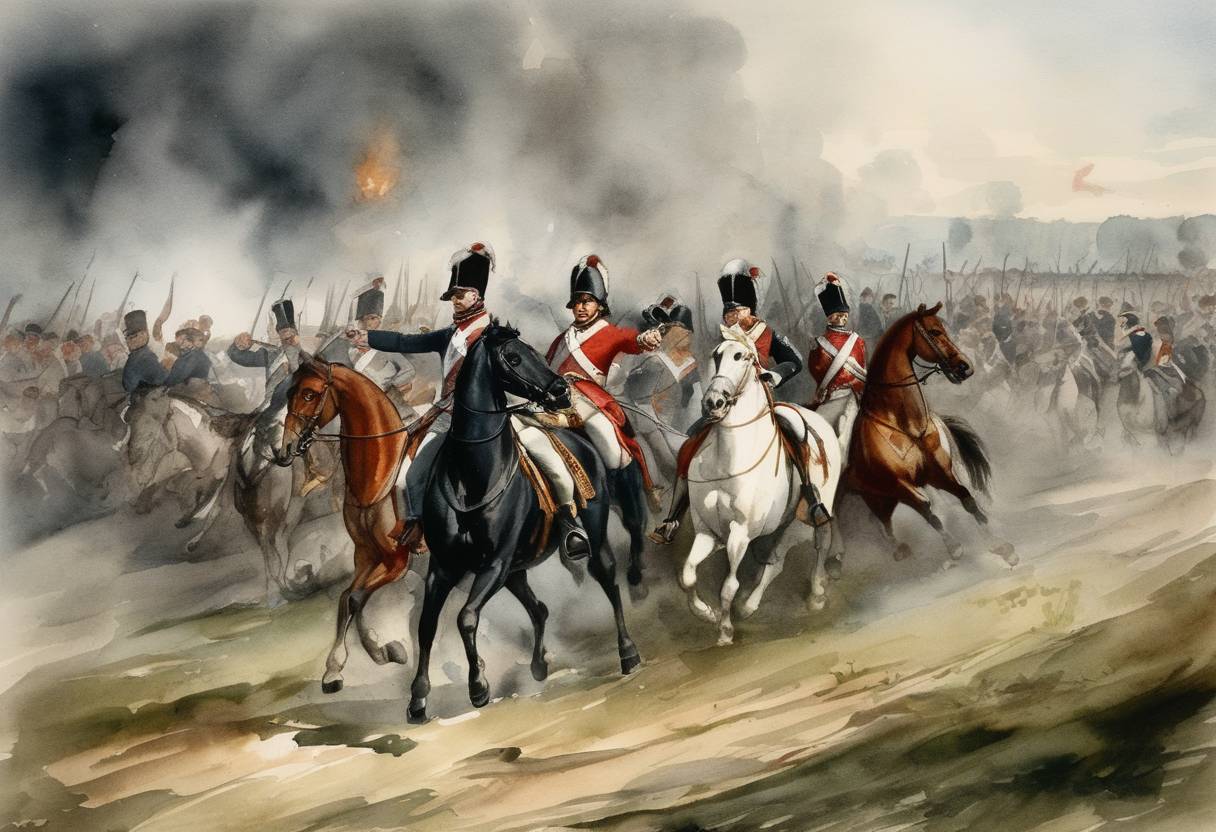
Battle of Maciejowice - October 10, 1794
The Battle of Maciejowice, fought on October 10, 1794, was a pivotal conflict during the Kościuszko Uprising, a nationalistic and revolutionary endeavor aimed at defending Polish sovereignty against foreign dominance, chiefly Russian and Prussian forces.
Context and Prelude
The Kościuszko Uprising began in March 1794 under the leadership of Tadeusz Kościuszko, a veteran of the American Revolutionary War and a skilled strategist. His aim was to liberate Poland from the grasp of the partitioning powers — Russia, Prussia, and Austria — which had already divided significant portions of Polish territory among themselves. By October 1794, the uprising had reached a critical juncture, with Polish insurgents grappling with superior Russian forces.
The Battle
The Russian forces, under the command of General Alexander Suvorov, were tasked with quelling the Polish insurrection. Suvorov, renowned for his military acuity and tactical prowess, engaged Kościuszko’s forces at Maciejowice, a small village in eastern Poland.
The battle unfolded with approximately 7,000 Polish soldiers under Kościuszko facing a Russian contingent that significantly outnumbered them. Despite the ferocity and determination displayed by the Polish fighters, the Russian army, leveraging superior numbers and supply lines, managed to envelope the Polish forces effectively.
Kościuszko himself was wounded and captured during this intense confrontation, marking a devastating blow to the insurgent cause. His capture demoralized the Polish fighters and signaled a shift in favor of the Russian campaign to regain control over the rebellious regions.
Aftermath and Historical Significance
The defeat at Maciejowice proved to be a turning point. The capture of Kościuszko not only dampened the morale of the Polish forces but also led to the unraveling of the organized resistance. By November 1794, Warsaw succumbed to Russian forces, leading to the ultimate suppression of the uprising.
The implications of the Battle of Maciejowice were profound. It marked one of the final nails in the coffin for Polish independence until the country’s eventual reconstitution in the 20th century. The battle underscored the insurmountable challenges Poland faced against militarily superior adversaries and the geopolitical intricacies of late 18th-century Europe.
Alexander Suvorov’s victory at Maciejowice further bolstered his reputation as one of Russia’s preeminent military leaders, showcasing his strategic ingenuity and contributing to his enduring legacy in military history.