Ingenuity's Second Flight on Mars - April 21, 2021
2021 · Jezero Crater, Mars (planetary),
NASA's Ingenuity helicopter successfully performed its second flight on Mars, setting records for a higher and longer flight than its initial attempt.
February 21, 2021
NASA's Mars helicopter Ingenuity survived its first night on Mars autonomously, a key milestone before its historic flight.
Jezero Crater, Mars | NASA
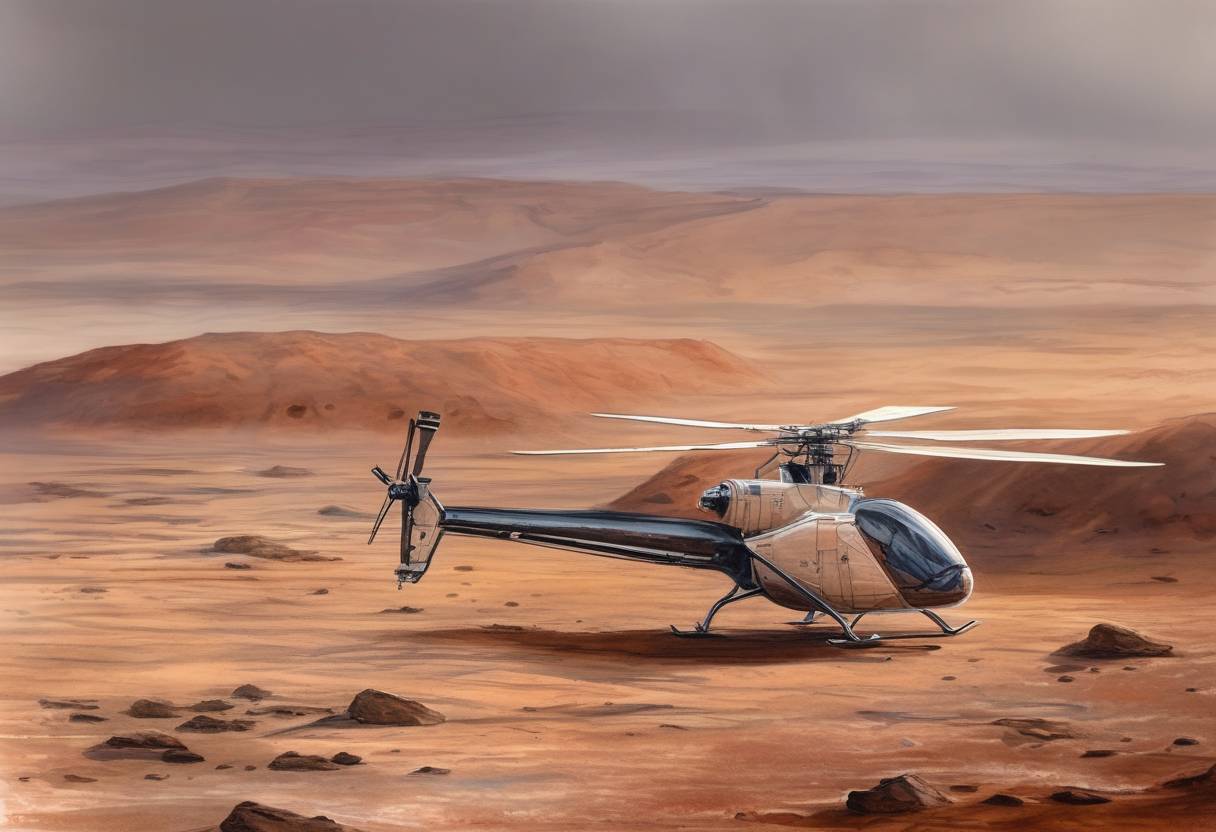
On February 21, 2021, NASA’s Mars helicopter Ingenuity successfully survived its first night on the Martian surface independently, marking a crucial milestone in its mission. This small rotorcraft, part of the Mars 2020 mission, represents a significant leap in extraterrestrial exploration, as it was designed to achieve powered, controlled flight on another planet for the first time.
Ingenuity was deployed from the Perseverance rover, which had safely landed in Jezero Crater on February 18, 2021. As a technology demonstration, Ingenuity was tasked with proving the feasibility of powered flights on Mars, a place with an atmosphere only 1% as dense as Earth’s. Surviving the frigid Martian night, with temperatures dropping as low as minus 130 degrees Fahrenheit (minus 90 degrees Celsius), was essential for its onboard systems.
The autonomous survival of Ingenuity through its first night on Mars involved its ability to use its own power source—a small solar panel—to keep its vital components warm and functional. This operation was critical for the subsequent testing of its systems, preceding its series of flight tests. The helicopter’s ability to independently manage its power and temperature demonstrated its readiness to face the harsh environmental conditions.
Ingenuity’s successful night-time survival was pivotal, pointing to a promising outlook for upcoming test flights. These tests were envisaged as “Wright Brothers moment” milestones, aiming to achieve the first powered flight under highly challenging conditions distinct from Earth’s.
This achievement was more than just a technical success; it represented a breakthrough that could pave the way for more advanced aerial explorations on Mars and other planetary bodies, enhancing our capability to study previously inaccessible areas.
Ingenuity’s survival was an early yet crucial step in a series of operations outlined to determine the feasibility of aerial vehicles in planetary exploration. This advancement was anticipated to open new frontiers for scientific missions, potentially revolutionizing the way we explore the cosmos in the future.
Source: www.nasa.gov