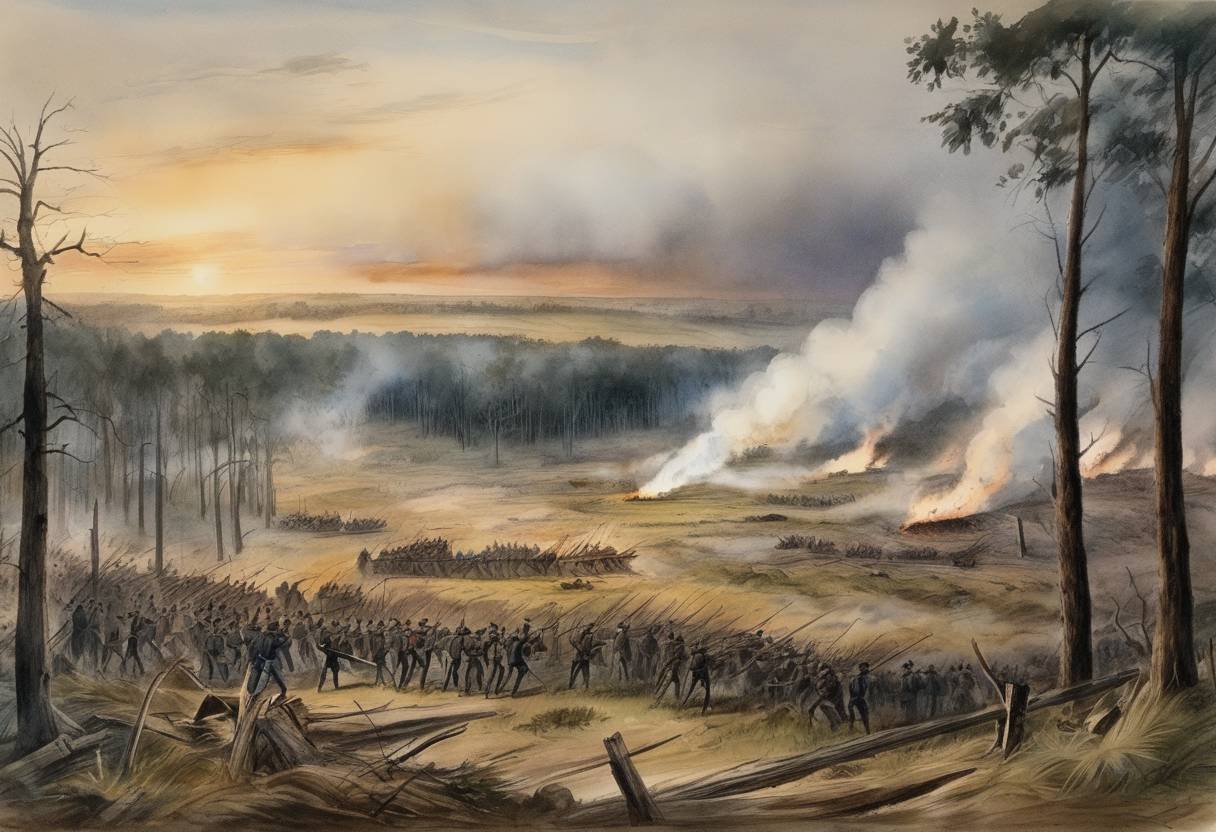
Battle of the Crater
The Battle of the Crater occurred on July 30, 1864, during the American Civil War, as part of the Siege of Petersburg campaign. This battle represents a significant, albeit tragic, Union attempt to break through Confederate defenses.
Background
The Siege of Petersburg, beginning in June 1864, involved a series of battles for control of the crucial supply lines to the Confederate capital at Richmond, Virginia. Union forces, under the command of General Ulysses S. Grant, sought to cut off these lines and compel the fall of Richmond by besieging Petersburg.
The Plan
In a bid to break the stalemate, Union forces devised an innovative yet risky plan. Led by Colonel Henry Pleasants, a former mining engineer, Union soldiers from the 48th Pennsylvania Infantry dug a 511-foot tunnel under the Confederate lines. Their goal was to place explosives under the Confederate fortifications, creating a breach through which Union troops could pour into the enemy’s position.
The Explosion
Early on the morning of July 30, 1864, the explosives were detonated with devastating effect. The explosion created a massive crater—170 feet long, 60 feet wide, and 30 feet deep—killing between 250 to 350 Confederate soldiers instantaneously. It momentarily disoriented the Confederate defense but failed to result in the breakthrough the Union had hoped for.
The Aftermath
The follow-up Union assault was marred by confusion and poor leadership. Troops were initially hesitant, leading to delays, and the assaulting forces forded directly into the crater instead of bypassing it, resulting in a disastrous bottleneck. Confederate forces, led by General William Mahone, quickly regrouped and counterattacked with artillery and infantry, inflicting severe casualties on the disorganized Union troops.
Consequences
The failed assault resulted in approximately 3,800 Union casualties, significantly higher than the Confederate losses. The Union’s inability to capitalize on the explosion’s initial success was due to poor planning, execution, and delayed support. The debacle led to the removal of several Union officers from command and further extended the Siege of Petersburg.
Historical Significance
The Battle of the Crater is a notable example of innovative military engineering coupled with poor tactical exploitation. It serves as a study in the necessity of cohesive planning and execution in military operations, illustrating the challenges of leadership and coordination under the pressures of war. The prolonged Siege of Petersburg continued, playing a pivotal role in the eventual conclusion of the Civil War in 1865.