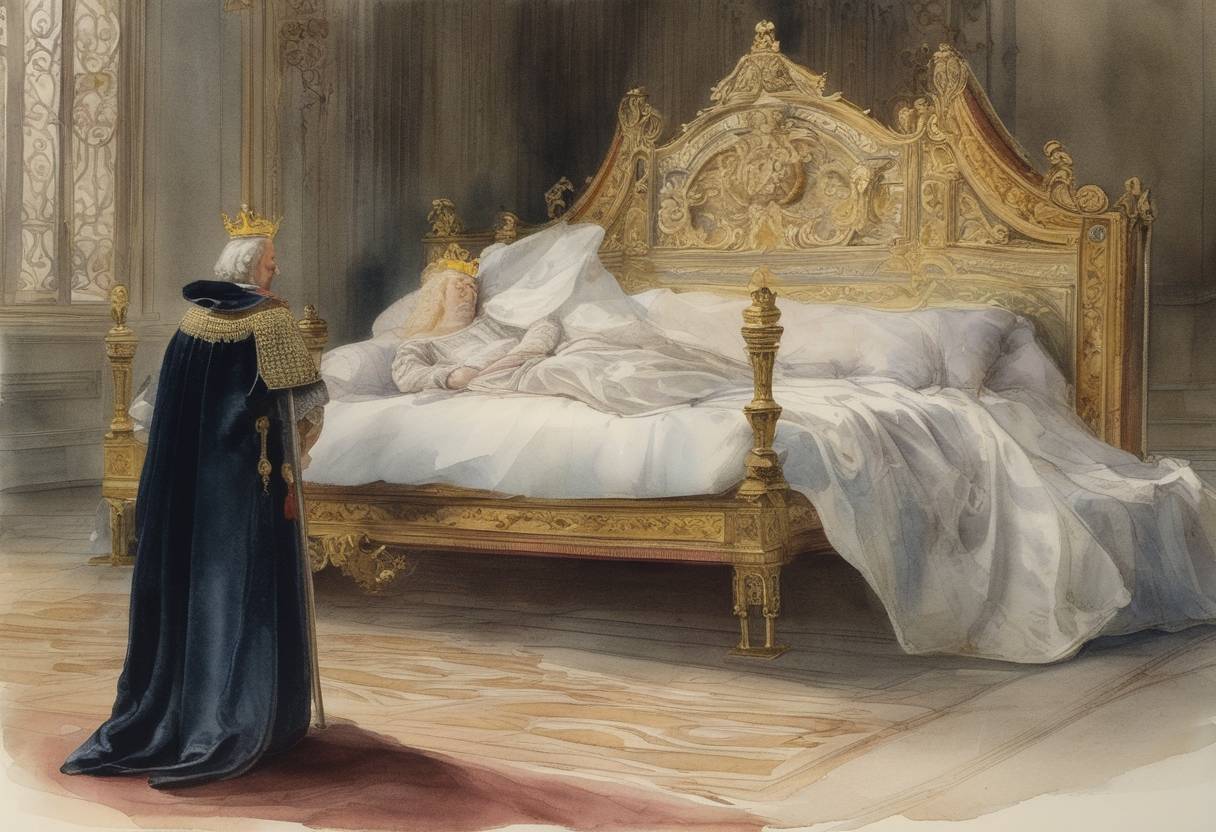
The Death of King Charles IV of France and the Succession Crisis
On January 24, 1328, King Charles IV of France, also known as Charles the Fair, passed away without a male heir, precipitating a significant succession crisis. Charles IV was the last king of the Capetian dynasty, which had ruled France for over 300 years since the accession of Hugh Capet in 987. His death marked the end of direct male Capetian lineage and sparked a contentious debate over the rightful successor to the French throne.
Context and Background
Charles IV was the youngest son of Philip IV of France and Joan I of Navarre. He ascended the throne in 1322 after the death of his brother, Philip V. During his brief reign, Charles IV faced challenges such as economic hardship and ongoing conflicts, including issues with England concerning territories like Aquitaine and Scotland.
Prior to his death, Charles IV had three marriages. His third wife, Jeanne d’Évreux, was pregnant at the time of his demise but would later give birth to a daughter, further complicating the succession issue.
The Succession Crisis
The lack of a direct male heir led to the invocation of Salic Law, which excluded females from the succession to the French throne. This medieval legal tradition was interpreted to prevent women from inheriting the French crown, as well as excluding the line via the female descent from passing claims to their sons.
The principal claimants to the throne were:
Philip of Valois: A nephew of Philip IV and cousin of Charles IV. Philip was a prominent French nobleman and had experience within the administration and military, making him a suitable candidate.
Edward III of England: Edward was the son of Isabella of France, Charles IV’s sister, and King Edward II. His claim was through the female line, which was weakened by the application of Salic Law.
Outcome and Significance
The French nobility, who favored a Frenchman over an English king, supported Philip of Valois. The need for a stable monarchy to avoid internal conflict and maintain national integrity led to the acknowledgment of Philip of Valois as King Philip VI in 1328.
This decision, however, sowed the seeds for future conflict. Edward III of England, feeling spurned, would later press his claim to the French crown, a contention that played into the broader geopolitical struggles between England and France. This eventually contributed to the outbreak of the Hundred Years’ War in 1337, a protracted series of conflicts that profoundly shaped both nations and medieval European history.
The death of Charles IV without a male heir thus not only concluded the original Capetian line but also set the stage for decades of rivalry and warfare between France and England, fundamentally altering the course of European history.