Italy Declares War on France and the United Kingdom: June 10, 1940
1940 · Rome, Italy
Italy declared war on France and the United Kingdom during World War II.
January 7, 1935
Benito Mussolini and French Foreign Minister Pierre Laval sign the Franco-Italian Agreement.
Rome, Italy | French government, Italian government
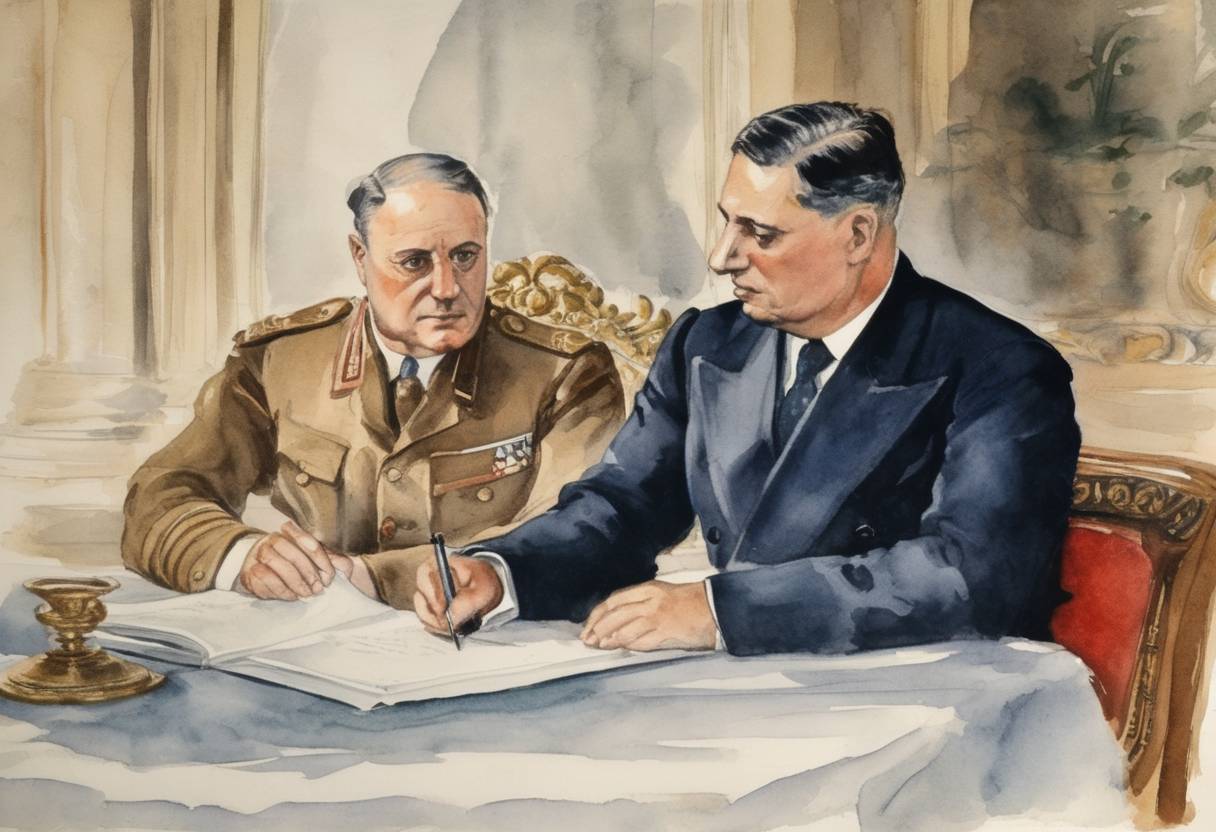
On January 7, 1935, Benito Mussolini, the Italian dictator, and Pierre Laval, the French Foreign Minister, signed the Franco-Italian Agreement in Rome. This diplomatic accord was a strategic effort to mend relations between France and Italy, amidst rising tensions in Europe due to the actions of Nazi Germany and the broader geopolitical shifts of the interwar period.
During the early 1930s, Europe was embroiled in political instability. Italy, under Mussolini’s fascist regime, sought to expand its influence in the Mediterranean and consolidate its power on the continent. France, on the other hand, was wary of Hitler’s Germany and keen on securing alliances to bolster its security.
The agreement was motivated by France’s desire to prevent Italy from aligning too closely with Germany, which would further isolate France diplomatically. Mussolini was interested in obtaining French support for his ambitions in the Balkans and Africa.
The Franco-Italian Agreement had several key components:
Colonial Concerns: France agreed to recognize certain Italian interests in the trove of the French colonial empire, particularly concerning Tunisia. In return, Mussolini promised not to exploit ethnic Italian groups in French territories for political gain.
Military Cooperation: Both countries agreed to cooperate on military matters, though the specifics were limited. This aspect was more about mutual assurance than substantive commitments.
Neutrality Stance: Italy pledged neutrality if Germany attacked France directly, reinforcing a counterbalance to the burgeoning German aggression.
The agreement momentarily improved Franco-Italian relations. However, its long-term effectiveness was limited due to the volatile political landscape of the 1930s:
Ethiopian Influence: Shortly after the agreement, Mussolini’s invasion of Ethiopia in October 1935 severely strained relations, as it contradicted the spirit of mutual diplomatic support promoted in the agreement. The League of Nations imposed sanctions on Italy, which led Mussolini to become more inclined towards an alliance with Hitler’s Germany.
Shift in Alliances: This agreement is often seen as a temporary diplomatic maneuver that ultimately failed to solidify a lasting Franco-Italian alliance. By 1936, Italy had pivoted towards closer ties with Nazi Germany, leading to the formation of the Rome-Berlin Axis.
In essence, while the Franco-Italian Agreement of 1935 highlighted the complexities of European diplomacy during the interwar years, its influence was short-lived as the continent edged closer to the outbreak of World War II.
Source: en.wikipedia.org