May 17, 1861

The Kingdom of Italy was officially declared, following the annexation of various states in the Italian peninsula.


Turin, Italy | Kingdom of Italy
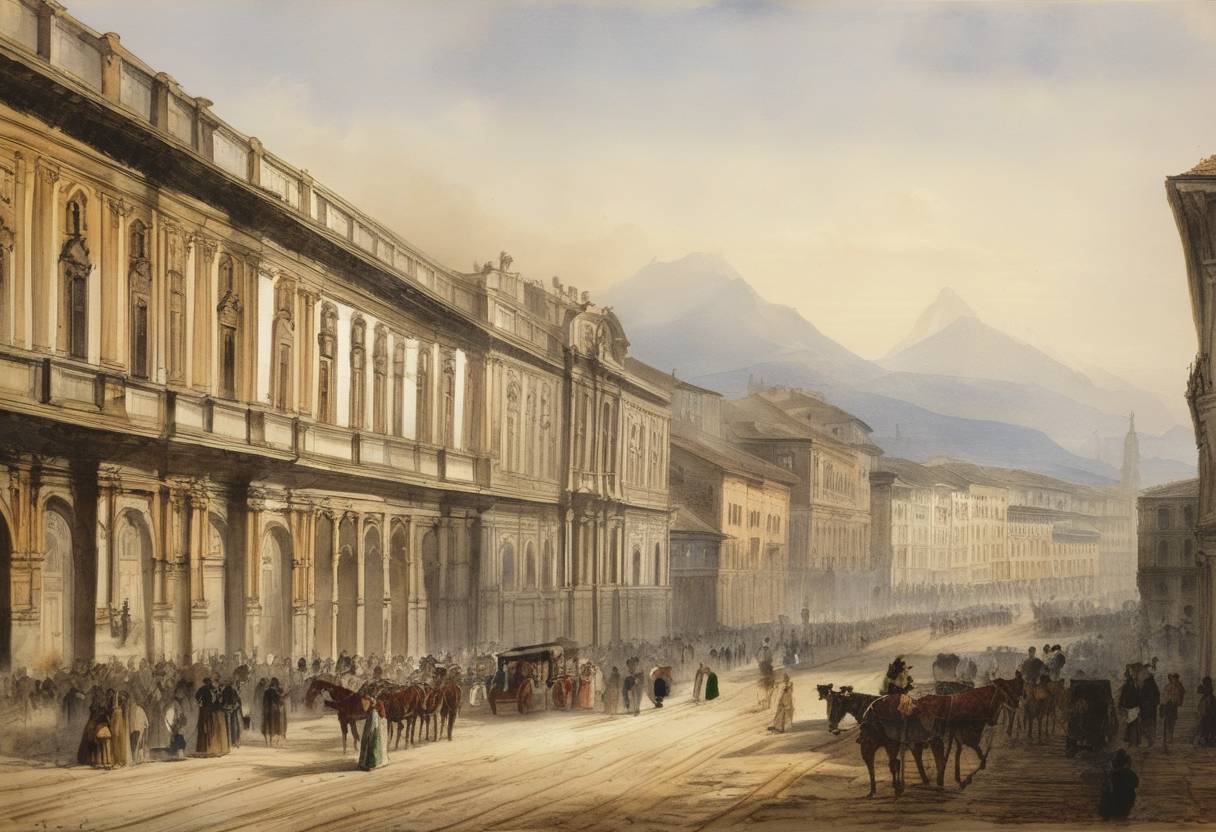
Watercolor painting based depiction of The Kingdom of Italy was officially declared, following the annexation of various states in the Italian peninsula. (1861)

The Proclamation of the Kingdom of Italy on May 17, 1861

On May 17, 1861, the foundation of the Kingdom of Italy was affirmed. This event marked a pivotal moment in the process of the Italian unification, known as the Risorgimento, which spanned much of the 19th century.

Context

The progress towards unification began in the early 19th century, as the Italian peninsula was fragmented into multiple states and territories controlled by foreign powers such as Austria, Spain, and France. The widespread desire for a unified Italy gained momentum following the Napoleonic Wars, driven by the ideas of liberalism and nationalism.

Key Events Leading to the Declaration

The path to unification was catalyzed by several critical maneuvers:

  • The Role of Key Figures: Leaders such as Count Camillo di Cavour, the Prime Minister of Piedmont-Sardinia, Giuseppe Garibaldi, and King Victor Emmanuel II were instrumental in the unification process. Cavour’s diplomatic strategies, coupled with Garibaldi’s military campaigns, significantly furthered the cause.
  • Piedmont-Sardinia’s Expansion: Under Cavour, Piedmont-Sardinia led the charge, expanding its influence through alliances and wars, such as the Second Italian War of Independence against Austria in 1859, which resulted in the acquisition of Lombardy.
  • The Expedition of the Thousand: In 1860, Garibaldi’s expedition to the southern part of the Italian peninsula led to the overthrow of the Kingdom of the Two Sicilies, further consolidating the disparate Italian states.

The Proclamation

By May 17, 1861, most of the Italian peninsula, with the exception of Rome and Venetia, had been unified under a single national crown. This newly unified entity was officially named the Kingdom of Italy, with Victor Emmanuel II of the House of Savoy becoming the first king.

  • The Political Structure: A parliamentary monarchy was established, characterized by the merging of various territories into a centralized state. Though initially incomplete, this formation laid the groundwork for the modern nation of Italy.

Aftermath and Consequences

  • Continuous Unification Efforts: While the Kingdom of Italy was officially formed in 1861, full unification was not realized until 1870 when Rome was captured and declared the capital of Italy, following the withdrawal of French troops.
  • Cultural and Political Integration: The unification set the stage for significant social and economic transformation within the new Italian state, including efforts to integrate various regional identities and economic systems into a cohesive national framework.

Significance

The creation of the Kingdom of Italy was a significant European historical event that substantially altered the political landscape of the continent. It demonstrated the potent force of nationalism and the impact of strategic diplomacy and military action in achieving state formation. The successful unification influenced other nationalistic and democratic movements across Europe and the world.