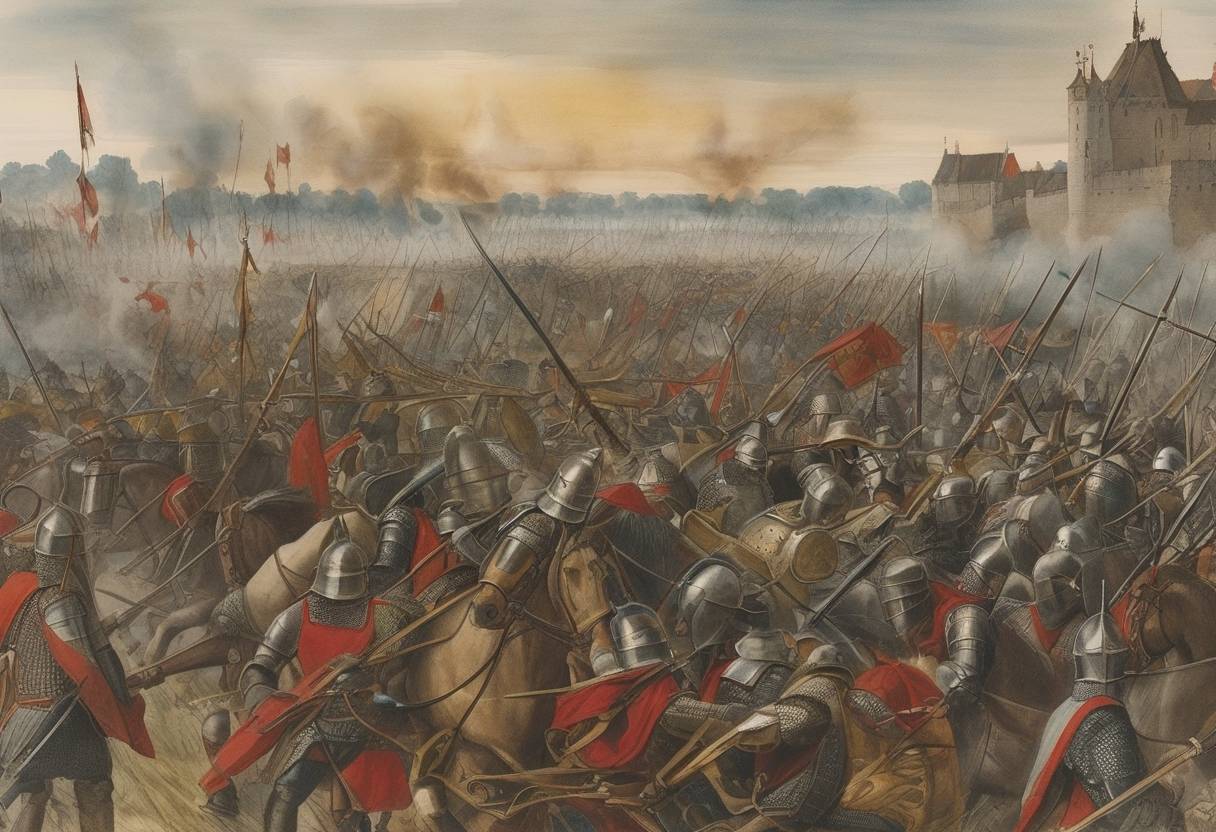
Battle of the Golden Spurs (Battle of Courtrai)
Date: July 11, 1302
Location: Near Kortrijk, Flanders (modern-day Belgium)
Background
The Battle of the Golden Spurs was a key conflict in the Franco-Flemish War. During this period, control of Flanders, a wealthy and strategically important region, was contested by the French crown and local Flemish powers. Tensions had been escalating due to French King Philip IV’s attempts to assert control over the territory, which was economically significant due to its thriving textile industry.
Combatants
Flemish Forces: Comprised mainly of local militias and guild members from various Flemish cities, notably Bruges, Ypres, and Kortrijk. These were primarily infantry troops equipped with goedendags (a type of weapon combining a spear and club) and longbows.
French Forces: Led by Count Robert II of Artois, the French army consisted of heavily armored knights and professional soldiers, representing the might of the French feudal aristocracy.
The Battle
On July 11, 1302, the Flemish forces, numbering around 9,000 mostly infantry, faced the French army, which was about 8,000 strong with a significant cavalry component. The battleground was marshy, located near the banks of the Groeninge River, conditions that favored the foot soldiers rather than the French cavalry.
The Flemish forces employed a defensive strategy, utilizing ditches and pikes to counter the cavalry charges. The terrain and their tactics effectively neutralized the advantage of the French knights. The Flemish militia’s disciplined and coordinated effort eventually overwhelmed the attacking French, leading to a significant and surprising victory.
Aftermath and Significance
Casualties and Captures: The French suffered heavy losses, with an estimated 1,000 knights and 2,000 infantry killed. The battle was named the “Battle of the Golden Spurs” because about 500 pairs of golden spurs, worn by the fallen French knights, were collected from the battlefield.
Impact on Flanders: The victory boosted Flemish morale and solidified their control over Flanders, allowing the region to enjoy a period of greater autonomy and economic prosperity.
Impact on Warfare: This battle demonstrated the effectiveness of well-trained infantry against traditional cavalry-led armies, marking a shift in medieval military tactics that would influence later conflicts across Europe.
The Battle of the Golden Spurs remains a symbol of Flemish resistance and identity. Annually commemorated in Flanders, it underscores the determination of local forces to defend their homeland against foreign domination.